





 Portuguese
  English
  Spanish
  5 min of reading
  0 comments


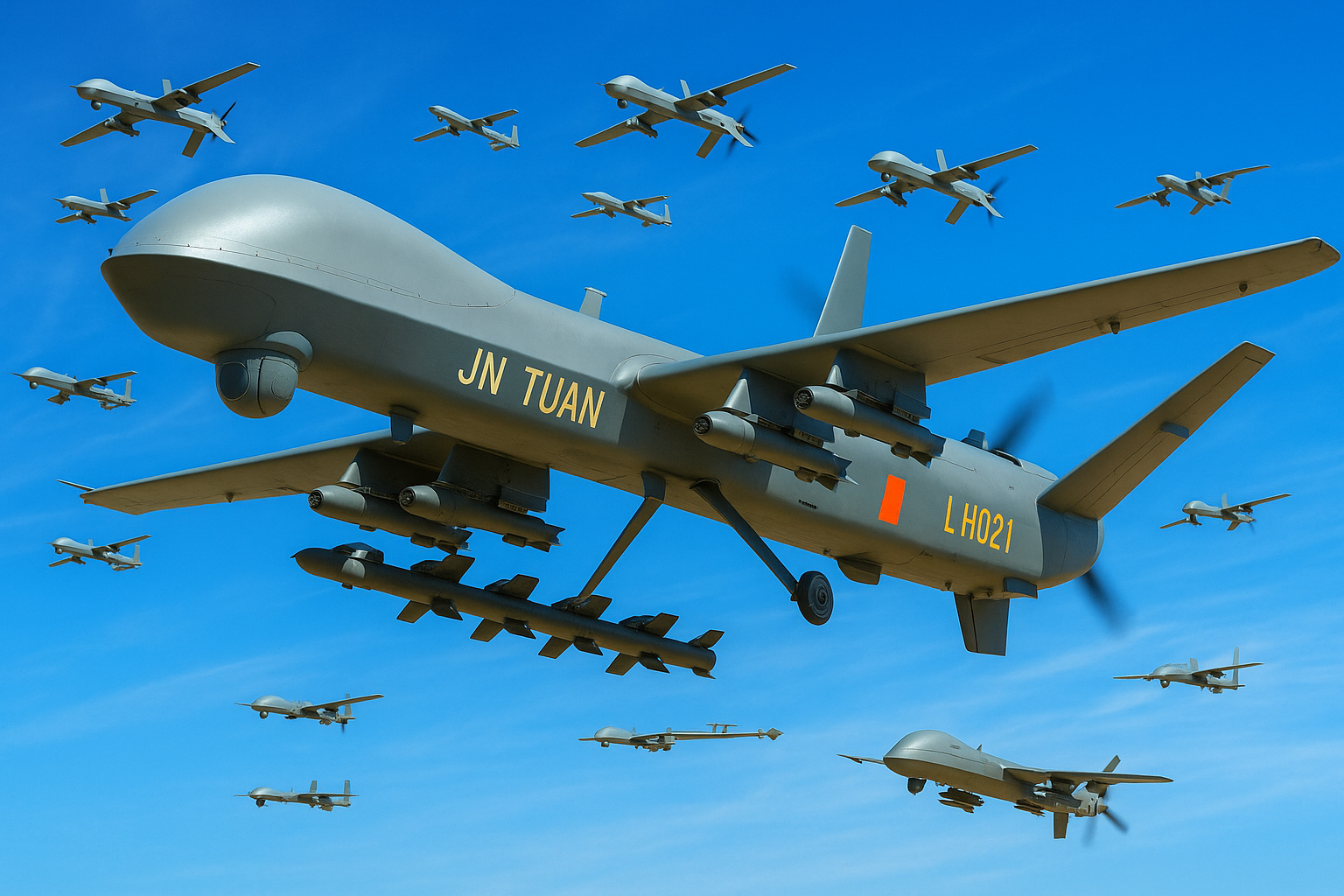
New Military Aircraft from China, Called Jiu Tian, Could Redefine Combat Strategies by Operating as a Flying Base with a Range of 7 Thousand km
China is about to inaugurate a new chapter in modern technological warfare with the rollout of its latest military aircraft, the Jiu Tian, nicknamed “mother ship” by local media and international experts. This is an unmanned aerial vehicle (UAV), capable of launching swarms of up to 100 kamikaze drones in mid-flight, carrying 16 tons of ammunition, and flying with autonomy of up to 7,000 kilometers.
Unveiled at the Zhuhai Airshow in 2024, China’s new military aircraft impressed analysts with its robustness, innovation, and strategic versatility. The expectation is that the Jiu Tian will conduct its first test mission before the end of June 2025, according to information from the South China Morning Post and state broadcaster CCTV, which confirmed the aircraft’s preparation for final operational tests before being officially integrated into the People’s Liberation Army of China.
A “Mother Ship” Capable of Coordinating Attacks with Kamikaze Drones
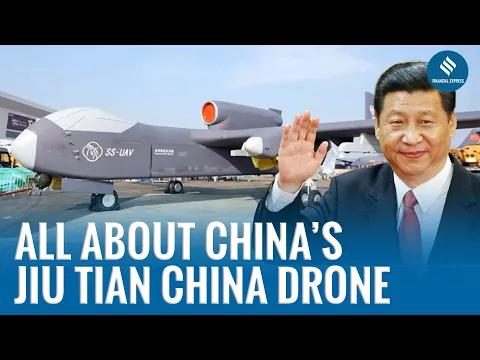

The main differentiator of the Jiu Tian is its ability to operate as a true mobile airbase, releasing up to 100 kamikaze drones from dual compartments located on both sides of the fuselage. The model is designed to conduct coordinated collective attacks, a tactic that promises to overcome traditional air defense systems and increase the tactical reach of the Chinese armed forces in asymmetrical warfare scenarios.
-
NASA issues a warning for the feared Godzilla El Niño that could change the planet’s climate in 2026 with extreme warming of the Pacific capable of causing devastating droughts in some regions and historic floods in others simultaneously.

-
Archaeologists discover a 100-meter ship graveyard in a submerged Greek city, and what has appeared on the seabed of Libya could change what was known about this ancient port.

-
You buy the refrigerator and still have to see ads: Samsung starts displaying advertising on appliances and generates negative reactions among consumers.

-
What can really trigger large volcanic eruptions? Research suggests that gas returning to the magma may be more dangerous than gas escaping from it.


With a wingspan of 25 meters and a payload capacity of 16 tons, with 6 tons exclusively for the transport of drones, the Jiu Tian integrates artificial intelligence systems and autonomous flight algorithms. In addition to its armament, the aircraft could be used for remote command of drone squadrons, even in high-risk environments, such as areas with radar jamming or intense electronic interference.
Comparisons of the New Military Aircraft from China with the Global Hawk and Reaper
With this project, the new military aircraft from China positions itself directly as a competitor to the American models RQ-4 Global Hawk and MQ-9 Reaper, two of the most widely used UAVs by the United States Department of Defense. However, the Jiu Tian differentiates itself by its function of multiple release of flying munitions, expanding not only the operational area but also the density of attacks in a single overflight.
According to sources from the specialized press, combat simulations presented at the Zhuhai Airshow showed the Jiu Tian operating in conjunction with autonomous attack drones in formation, enhancing the capability to saturate strategic targets with precision and without the need for human pilot exposure.
Civil and National Security Applications
In addition to military use, the Chinese government also plans to apply the Jiu Tian in unarmed roles, such as:
- Maritime Surveillance
- Border Monitoring
- Rescue and Emergency Operations
- Large-Scale Environmental Inspection
These functions aim to demonstrate the dual-use nature of the technology, that is, the possibility of utilization in both civil and military contexts. The system’s flexibility may facilitate public acceptance and drive the development of other large aircraft with embedded intelligence.
Who Developed the New Military Aircraft from China?
The Jiu Tian project is the result of a joint effort by AVIC (Aviation Industry Corporation of China), a state conglomerate leading the country’s aircraft production, and Xian Chida Aircraft Parts Manufacturing, specialized in structural parts and components for UAVs.
Both are part of China’s military modernization program, which has already produced notable models such as the CH-7 — a stealth combat drone — and the Wing Loong-X, aimed at anti-submarine warfare. The Jiu Tian will be another strategic addition to the growing fleet of Chinese drones, which is already considered one of the most advanced in the world in terms of swarms capability and operational autonomy.
Disruptive Potential in the Geopolitical Landscape
The launch of a “mother ship” with swarm drone control capability represents a significant advancement in the competition for air and technological superiority among military powers. Its ability to operate autonomously, attack multiple targets, and evade interception systems positions the Jiu Tian as a concrete threat to any conventional military force.
Furthermore, the model reinforces China’s position as an emerging power in the field of cyber warfare and unmanned systems, challenging the technological hegemony of the United States and its allies.
The use of kamikaze drones on a large scale could shift the balance in conflict zones such as the South China Sea or areas of border tension with India and Taiwan.
Inaugural Mission Scheduled for June
The first test mission of the Jiu Tian is scheduled to take place before the end of June 2025, according to CCTV. The expectation is that the flight will include actual drone launch, telemetry data collection, and assessment of aerodynamic behavior at different altitudes and loads.
After the initial flight, the model will enter a phase of more intensive operational tests, with different payloads and combat simulations in a real environment. If successful, the Jiu Tian is expected to be officially integrated into the Chinese air force in the second half of this year.
A Watershed in the Drone Warfare
The new military aircraft from China represents not only a technological innovation but a milestone in the evolution of armed conflicts in the 21st century.
The concept of a “flying mother ship,” capable of releasing dozens of lethal drones in coordinated missions, anticipates a warfare scenario where autonomy, swarm power, and artificial intelligence dominate the battlefield.
As the world watches closely the first flights of the Jiu Tian, one thing is certain: the global race for air supremacy is far from over — and the sky has become, more than ever, the new battleground among military powers.









-

-

2 pessoas reagiram a isso.