





 Portuguese
  English
  Spanish
  5 min of reading
  0 comments


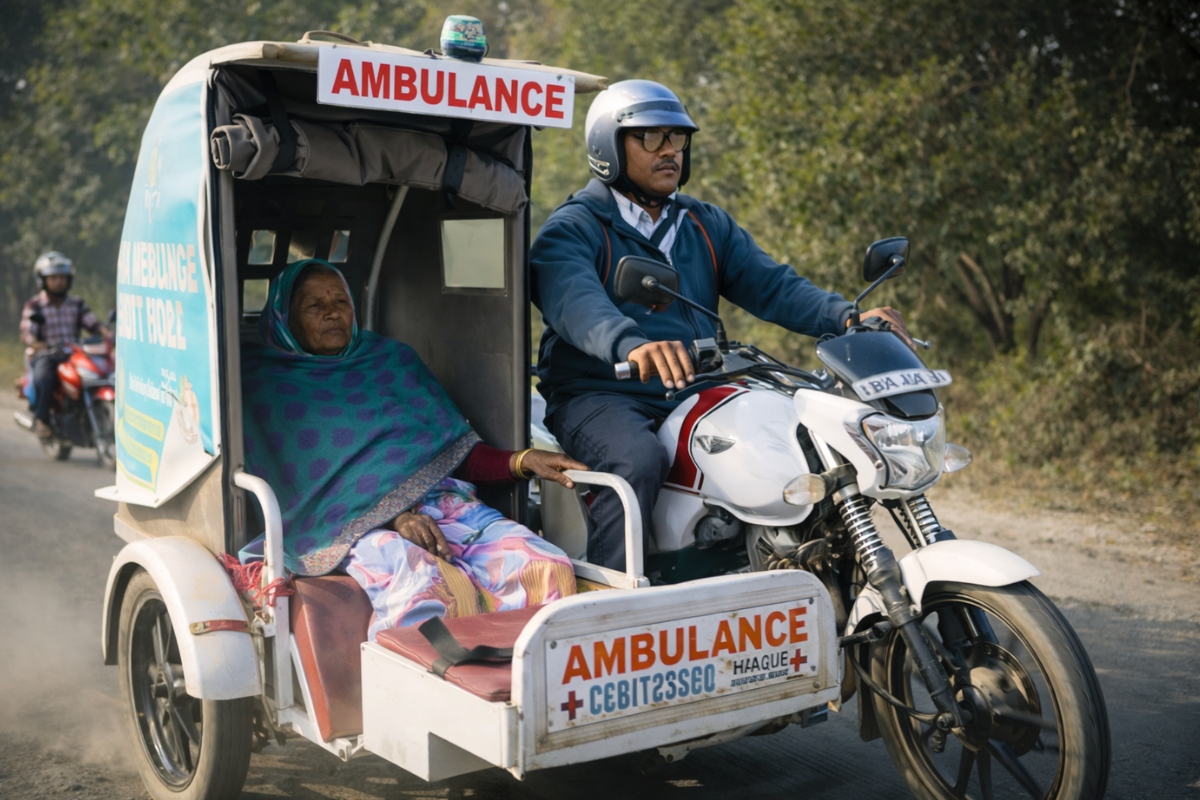
After An Ambulance Didn’t Arrive In Time, Karimul Ties A Colleague To His Motorcycle And Saves Him; Then, He Enhances The Vehicle With First Aid Items, Expands Service Routes, And Initiates A Volunteer Service That Has Already Taken Thousands Of People To The Hospital
In communities in North West Bengal, India, where emergency care faces logistical barriers and ambulance coverage is limited, a tea plantation worker has become a lifesaver for thousands of people.
A Tragedy That Changed Everything
In 1995, in the village of Dhalabari, Jalpaiguri district, Karimul Haque experienced the worst night of his life. His mother fell seriously ill and needed urgent medical attention. Desperate, Karimul went door to door asking neighbors for help, seeking any vehicle that could take her to the nearest hospital, located about 45 kilometers away. But in that area, marked by transportation difficulties and a lack of emergency services at the time, he found neither an ambulance nor a quick means of transport.
His mother passed away at home due to a heart attack. The pain was devastating, and even more devastating was the feeling of not having been able to obtain the necessary help in time: “I couldn’t find an ambulance; that’s why I couldn’t save my mother’s life,” he would recall years later, according to a report by Al Jazeera. That night, Karimul made a vow that would change the reality of his community: no one else would die for not being able to reach a hospital.
-
Friends have been building a small “town” for 30 years to grow old together, with compact houses, a common area, nature surrounding it, and a collective life project designed for friendship, coexistence, and simplicity.

-
This small town in Germany created its own currency 24 years ago, today it circulates millions per year, is accepted in over 300 stores, and the German government allowed all of this to happen under one condition.

-
Curitiba is shrinking and is expected to lose 97,000 residents by 2050, while inland cities in Paraná such as Sarandi, Araucária, and Toledo are experiencing accelerated growth that is changing the entire state’s map.

-
Tourists were poisoned on Everest in a million-dollar fraud scheme involving helicopters that diverted over $19 million and shocked international authorities.


The Birth Of The Motorcycle Ambulance
In 1998, an incident at the tea plantation where he worked solidified his idea. A colleague fainted in the field, and the conventional ambulance could not arrive in time. Without a second thought, Karimul took the man as a passenger on his Bajaj motorcycle and drove him to Sadar Hospital in Jalpaiguri. The colleague made a complete recovery, and Karimul realized that his modest motorcycle could make the difference between life and death.
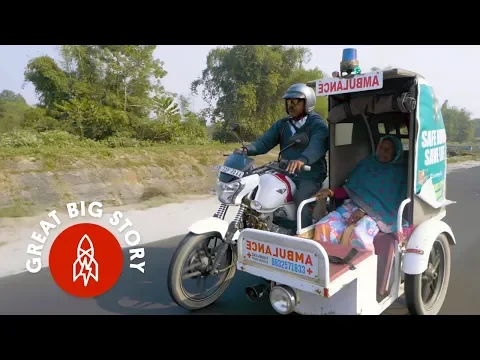
From then on, he converted his vehicle into an improvised ambulance. He designed a handmade stretcher, made local adaptations, and began transporting the sick and injured from his village and neighboring communities to hospitals located 40 to 50 kilometers away. Over time, he incorporated an oxygen cylinder, a waterproof stretcher, and basic first aid equipment. According to The Better India, Karimul has become a reference for assistance in that region.

A Free Service 24 Hours A Day
What makes Karimul’s work extraordinary is not just the physical act of transporting patients: it is the empathy, urgency, and trust he places in every trip. He operates all hours, throughout the year, completely free of charge. He helps patients get admitted to hospitals, provides medications when necessary, and on several occasions has performed resuscitation maneuvers in critical situations.
Karimul provides emergency coverage to over 20 villages in the Dhalabari area. By 2019, he had transported approximately 5,000 to 5,500 people completely free of charge, a number that earned him a spot in the International Bharat World Record.
More Than Transport: A Community Health System
Over the years, Karimul expanded his mission well beyond patient transport. Trained by local doctors, he began offering basic first aid and organizing periodic health campaigns in different communities in the region.
In a corner of his home, he set up a small emergency clinic where he provides primary care, administers intravenous fluids, and connects patients with city doctors through phone calls for remote prescriptions. He has also incorporated digital technology to conduct tests for glucose levels, blood pressure, and hemoglobin. According to SocioStory, Karimul has also begun delivering preventive health talks in the communities.

A Family United By The Mission
Karimul lives a modest life in the village of Rajadanga, in Malbazar. He shares his home with his wife Anjuya Begum, their two sons Rajesh and Raju, and their wives. The family survives on a small betel leaf shop and a cell phone repair workshop run by his sons.
During the day, Karimul works as a laborer on the tea plantation, and most of his earnings go towards buying fuel and medication for his ambulance service. Sometimes, villagers contribute small donations, but the effort is fundamentally familial: his children and relatives have joined the mission voluntarily and without pay.
National And International Recognition
In 2017, the Government of India awarded Karimul Haque the Padma Shri, the fourth highest civilian honor in the country, in recognition of his extraordinary humanitarian contribution. That same year, he received the India Star Award.
His story transcended borders and was covered by international media outlets such as Al Jazeera, which dubbed him “India’s Ambulance Dada.” In January 2021, his life was depicted in the book “Bike Ambulance Dada,” published by Penguin Random House India and written by journalist Biswajit Jha. He also appeared on the television show Kaun Banega Crorepati alongside actor Sonu Sood on January 1, 2021. Additionally, it was announced that a biographical film about his life was in preparation.
Building A Better Future
Despite the recognition, Karimul remains grounded. With the resources received from the awards, he started building a hospital to provide free medical services to his community. He also created a free self-defense and taekwondo school for children in the area.
During the COVID-19 pandemic, Karimul led sanitation campaigns in the Dhalabari area, helped families conduct funeral rituals when there was widespread fear of contact with the deceased, and distributed food among the elderly in his village and neighboring communities.
A Legacy Of Compassion
Karimul Haque is not just a social worker: he is a symbol of what selfless service can achieve, even without wealth, formal education, or institutional support. In a system where emergency response still faces challenges in various locations, his life is a living lesson.
“I lost my mother because I couldn’t save her in time. I don’t want that to happen to anyone else,” says Karimul Haque. And thanks to him, in the communities of Jalpaiguri, thousands of people have had a second chance at life.
Karimul Haque is currently about 60 years old and continues to provide his motorcycle ambulance service from the village of Dhalabari, West Bengal, India.










-

-

-

-

-

10 pessoas reagiram a isso.