





 Portuguese
  English
  Spanish
  4 min of reading
  0 comments


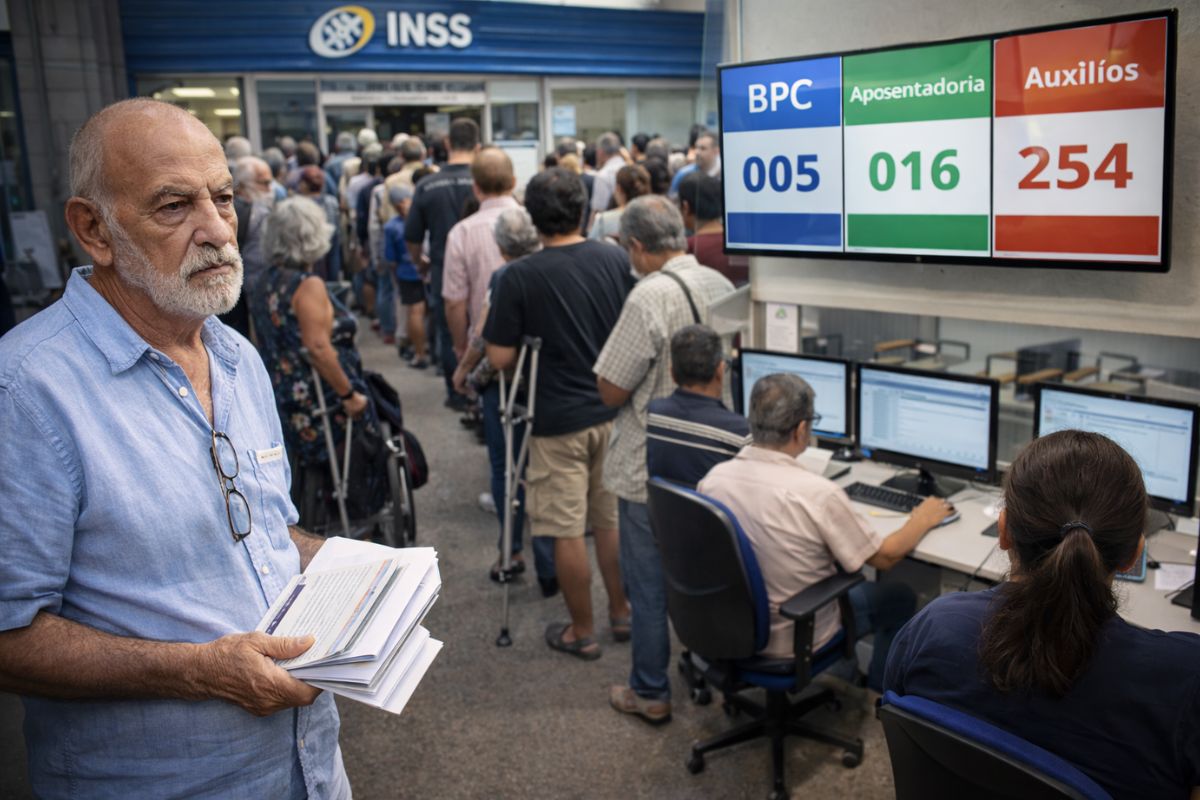
Since January 2026, retirement and allowances have left analysis and entered the National Queue of INSS, officialized by Portaria PRES/INSS nº 1.919 in the Official Diary. The PGB redistributes processes among 2.3 thousand employees, prioritizes those who have been waiting the longest, and targets BPC and benefits for disability, 80% of the demand.
The change that placed retirement and allowances in a National Queue of INSS, since January 2026, shifts the criterion from “where the request was made” to a single flow: any qualified employee can analyze a request, even if it is in another state, with automatic distribution by the PGB.
At the center of this triage is the promise of reducing the waiting time, with priority for those who have been waiting the longest and with a concentrated focus on BPC and benefits for disability, which the agency itself points out as about 80% of the demand. In two weeks, according to INSS, over 105 thousand tasks have been pulled for analysis and 48,574 have already been completed.
What The National Queue Changes In Practice
Previously, the analysis of retirement and allowances was tied to regional managements: each unit handled what entered its area of operation.
-
Oil surged to $115 a barrel due to the war in the Middle East, and diesel in Brazil has already risen to R$ 7.45 per liter, while the United States…

-
Brazilian city bets on the business environment to generate jobs and attract investments in the energy sector — secretary reveals strategy at Macaé Energy 2026.

-
50 viaducts, 4 tunnels, 28 bridges, and 40 kilometers of bike paths: BR-262 in Espírito Santo will receive 8.6 billion reais for the largest engineering project in the state’s history, inspired by the Immigrant Highway in São Paulo.

-
Brazil produces too much clean energy and doesn’t know what to do with it: over 20% of solar and wind capacity was wasted in 2025 while investors flee and 509 renewable generation projects were abandoned in the last year.


With the National Queue, INSS unifies the stock and no longer depends on the local “map” of employees, making it possible for regions with lower volumes to help clear the backlog of others.
The idea is simple, but the effect is significant: the request no longer “moves” according to the ZIP code, but according to the available capacity.
This also changes the point of attention for the insured: the monitoring is no longer linked solely to the originating agency and depends on the progress in the national mesh.
Priority By Waiting Time And The Weight Of Assistance Benefits
INSS states that the new strategy prioritizes those who have been waiting the longest for a response, with emphasis on more sensitive profiles, such as elderly people awaiting approval.
In this framework, retirement and allowances enter a queue that attempts to order delays based on the age of the request, rather than the strength of a specific region.
At the same time, the task force concentrates efforts where the queue is largest: BPC and benefits for disability.
As these two groups represent about 80% of the demand, addressing them tends to affect the average time of the entire queue.
It’s a surgical cut: reducing the dominant stock can generate quick impact, but it also requires consistency so as not to push bottlenecks to other stages of the process.
PGB And The Automatic Redistribution: Why This Matters
The operational mechanism of this nationalization is the Benefit Management Program (PGB).
It uses technical criteria to automatically distribute processes among available analysts, allowing a case filed in one state to be completed by an employee in another federative unit.
In practice, PGB functions like a work router: it tries to balance the load, reduce accumulation islands, and speed up what has been stalled.
For INSS, the gain lies in elasticity: more people can work where the queue is heaviest, without waiting for physical team relocation or regional restructuring.
The Initial Numbers And What They Reveal About The Rhythm Of The Queue
INSS released a snapshot from the first two weeks of the new model: over 105 thousand tasks pulled for analysis and 48,574 completed.
This type of data helps to see cadence but does not answer the central question of the insured: how long will it take until a decision is made in their retirement and allowance case.
The technical reading of these numbers requires caution: completed tasks may include different types of activity, with distinct complexities.
Still, the snapshot suggests that national redistribution has the capacity to speed up steps, especially when the bottleneck is a lack of labor in specific regions and not absence of documents or need for expertise.
Portaria, Transparency And What The Insured Needs To Observe
The measure was formalized by Portaria PRES/INSS nº 1.919, published in the Official Diary of the Union, and the agency’s public discourse is about “really tackling the queue.”
The president of INSS, Gilberto Waller, linked nationalization to the possibility of directing more employees to cases with greater delays, without regional constraints.
For those who depend on BPC and benefits for disability, or await retirement and allowances, the change brings an advantage and a risk.
The advantage is that the queue is no longer held hostage by local capacity; the risk is the feeling of opacity if the insured cannot understand why a process “skipped” stages or changed responsible parties.
The more automated the triage, the greater the need for clarity in criteria and deadlines.
The National Queue reposition retirement and allowances within INSS as a single flow, with priority for those who have been waiting the longest and with a focus on BPC and benefits for disability.
If the promise is to reduce delays, the real test will be to maintain the pace without creating new shadows in the path of the insured.
Have you ever had a request stuck at INSS or know someone in that situation? What do you consider more fair in a queue: prioritizing the elderly, prioritizing those who have been waiting the longest, or separating by type of benefit like BPC and benefits for disability?










-

-

2 pessoas reagiram a isso.