





 Portuguese
  English
  Spanish
  4 min of reading
  0 comments


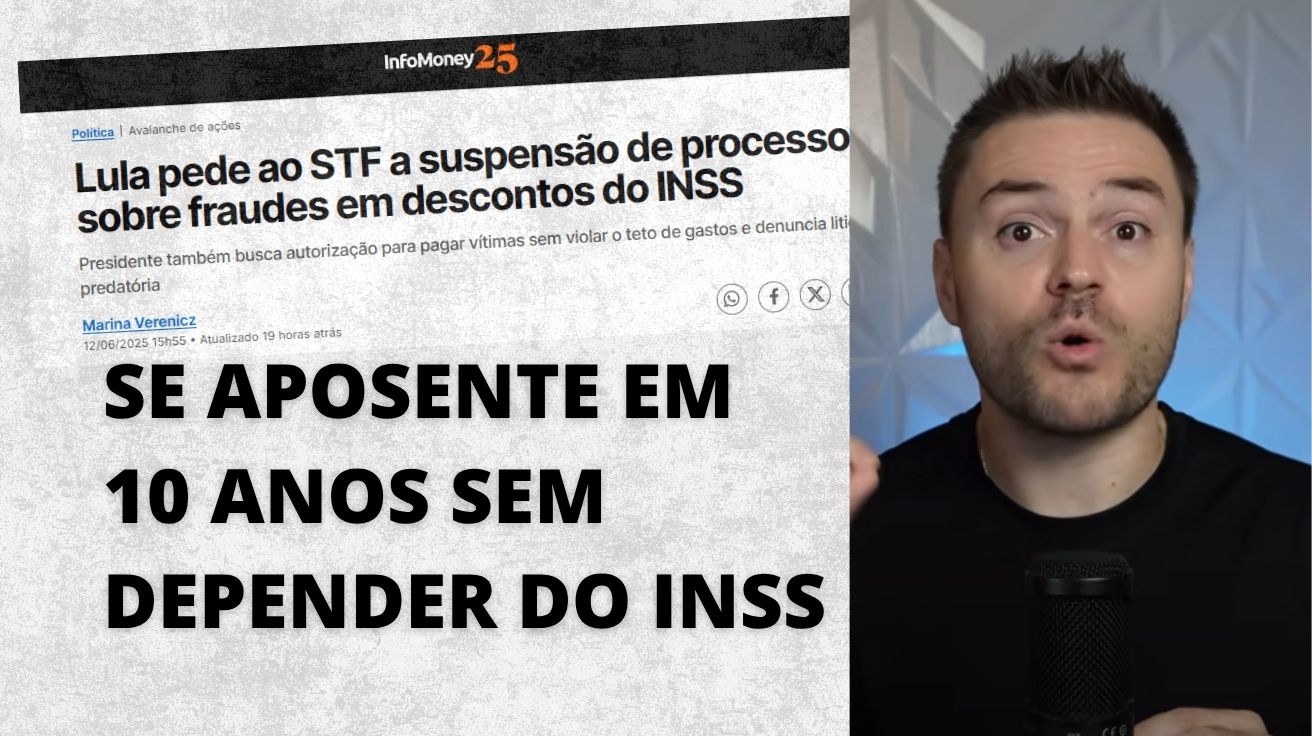
While the Lula government tries to block in court the payment of reimbursements to retirees harmed by fraud in INSS deductions, experts show how any Brazilian can retire on their own in a decade with planned monthly contributions and discipline.
Between March 2020 and March 2025, thousands of INSS retirees and pensioners were victims of improper deductions from their benefits. Now, the federal government is asking the Supreme Federal Court to rule that the Union should not be held liable for the fraud, putting the reimbursement of these losses at risk. The proposal includes, among other things, preventing court decisions from forcing double payments of the amounts deducted.
In the face of this legal uncertainty and doubts about the reliability of the public pension system, interest in alternatives is growing. The good news is that it is indeed possible to build a private retirement, with total autonomy, by making affordable monthly contributions and leveraging compound interest in your favor. Below, we outline the step-by-step process created by investment specialist Alberto Tolvetti to retire in 10 years, even without relying on the INSS.
-
Mercado Livre “opens the vault” and announces a record investment of R$ 57 billion in Brazil in 2026, a value 50% higher than the previous year, with an expansion plan that includes 14 new logistics centers, totaling 42 units in the country and hiring an additional 10,000 employees.

-
How investment in technology can revolutionize the national economy and enhance industrial gains, according to a study that highlights the direct impact on productivity, innovation, and wealth retention within Brazil.

-
The largest food company on the planet, JBS, has just opened a 4,000 square meter laboratory in Florianópolis to develop customized proteins that modulate muscle mass gain, immune response, and metabolic performance.

-
After nearly 30 bids and competition among industry giants, a Spanish company purchases one of the largest airports in Brazil for almost R$ 3 billion and takes over the management of Galeão in a concession that will last until 2039.


How the Government Wants to Avoid Payments to Harmed Retirees
President Luiz Inácio Lula da Silva has filed a lawsuit in the Supreme Court requesting the suspension of all legal actions brought by INSS beneficiaries who were victims of improper deductions by fraudulent associations. The request, presented jointly with the Attorney General of the Union, Jorge Messias, is registered as Request for Noncompliance with Fundamental Precept (ADPF).
The government asks that the Supreme Court declare unconstitutional the court decisions that require the public authority to reimburse retirees. Additionally, it seeks to prevent the courts from granting double refunds, as provided for in the Consumer Defense Code.
To avoid a fiscal impact on the federal budget, the Planalto asks for authorization to open extraordinary credit, provided it does not violate the spending cap. However, this amount would not be enough to cover the damages caused by widespread fraud.
According to the Planalto, the explosion of lawsuits is being encouraged by opportunistic law firms seeking profits from mass actions. Judicialization, according to the government, could harm public coffers and delay the real resolution of problems for those who were harmed.
Lost Money with Improper Deductions? Here’s How to Achieve Retirement on Your Own
As the reimbursement by the INSS becomes increasingly uncertain, building a passive income through monthly investments proves to be a viable and safe alternative. Financial educator Alberto Tolvetti demonstrates that with BRL 2,912 invested monthly for 10 years, it is possible to reach a net worth of BRL 600,000, enough to generate BRL 5,000 per month in passive income.
This projection considers a conservative yield of 10% per year and is based on assets that have historically grown well above inflation, such as stocks, real estate funds, and fixed income. For example, Banco do Brasil had an appreciation of 276% over 10 years, while the accumulated inflation in the same period was 69.42%.
The simulation indicates that at the end of the period, the investor would have contributed BRL 349,000, and the rest of the wealth would come from multiplication through the effect of compound interest. Even if it is not possible to contribute this amount each month, starting with less already puts you on the path to financial freedom.
For example, someone who can contribute BRL 5,000 per month would, after 10 years, have a net worth of BRL 1,030,000, enough for a monthly income of BRL 8,583, adjusted for inflation.
Conservative Returns, Real Assets, and Independence
The proposal is simple: replace the state dependency model with a personal retirement plan based on discipline and consistency. Even using conservative estimates, the average return of the assets listed in Tolvetti’s example was 26.38% per year over the last 10 years — and still, the simulation only considered 10% return to avoid illusions.
Among the analyzed assets were stocks from solid companies, high-liquidity real estate funds, and fixed income bonds that offer constant dividends. Furthermore, all the listed assets significantly outperformed inflation, preserving purchasing power in the long term.
The magic of compound interest only works with time and consistent contributions. That’s why starting as early as possible, even with little, makes a huge difference. There are funds that allow investments starting from BRL 10, making it accessible for any investor profile.
Another crucial point is that monthly contributions do not need to be eternal. After 10 years, with the wealth formed, the investor can stop contributing and start living off the income generated by their own money.
From Victim to Independent: Turn Frustration into a Long-Term Strategy
Many retirees today are frustrated with the system, whether from fraud like the improper INSS deductions or the low value of their benefits. But the practical example demonstrated by Tolvetti shows that financial independence is possible with planning and consistency.
It is not an easy path. The discipline to invest every month, even in tough times, is the biggest challenge. Many times, it will be necessary to reduce consumption to ensure the contribution. But the results are lasting and liberating: a monthly income for life, with values adjusted for the real appreciation of the chosen assets.
In addition, investing is not dependent on luck or magic formulas. All that is necessary is financial education, time, and informed decisions. And with so many digital tools and accessible content today, learning about the subject has never been easier.
The greatest advantage? You free yourself from reliance on court decisions, politicians, and promises. And you take control of your retirement.










Seja o primeiro a reagir!