





 Portuguese
  English
  Spanish
  3 min of reading
  0 comments


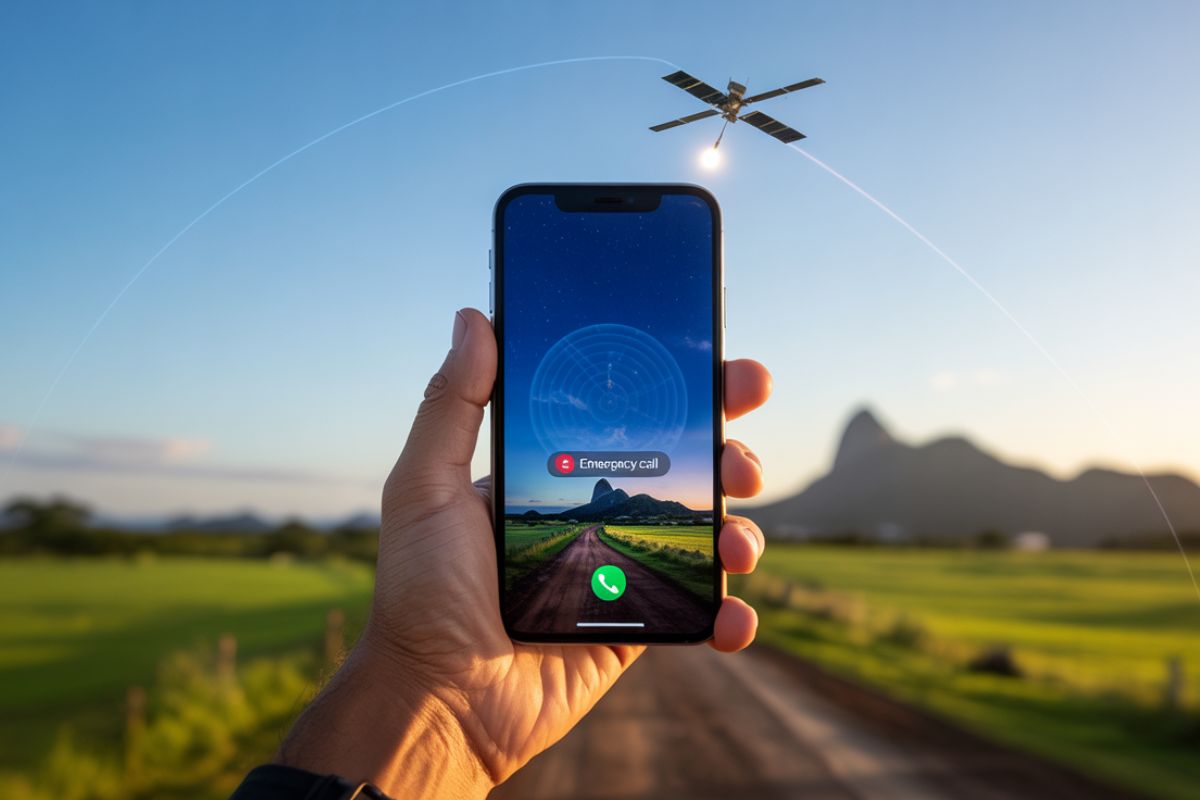
Available In The Latest Models, The Satellite Call Feature Turns The iPhone Into A Vital Safety Tool In Areas Without Cellular Signal Or Wi-Fi.
Your iPhone can now be your only salvation in a remote location. Apple has quietly implemented and expanded the satellite call feature in its latest models, a capability that has gone unnoticed by many users but represents one of the biggest innovations in personal safety in recent years. This is an expansion of the “Emergency SOS” system, designed to work where traditional networks do not reach.
This technology is not a luxury, but a critical communication tool that can make the difference between life and death. For those who hike, travel on remote roads, or live in areas with unstable signal coverage, understanding how satellite calls work is essential. The functionality redefines the smartphone as a crucial safety device.
How Do Satellite Calls Work On The iPhone?
The technology behind the feature is complex, but its use is surprisingly simple. When you are in an area without cellular signal or Wi-Fi and need help, the iPhone uses specialized internal antennas to connect directly to low-earth orbit satellites.
-
In Mexico, a 3,000-year-old Maya site with the dimensions of an entire city may have been built as a colossal map of the cosmos, created to represent the order of the universe and reveal how this people organized space, time, and rituals.

-
Japan wants to build a solar ring of 10,900 kilometers on the Moon to continuously send energy to Earth.

-
Weighing almost 1 ton, with temperatures of up to 3,000°C, the ability to launch 10,000 fragments within a radius of 1 km, capable of penetrating concrete and melting steel, Turkey’s terrifying bomb emerges as one of the most destructive non-nuclear weapons ever presented.

-
After a submarine disappeared beneath the “Doomsday Glacier,” scientists announce a new monstrous machine capable of operating at 3,000 meters depth to return to the heart of the ice and investigate a threat that could raise sea levels worldwide.


- Guided Interface: The device itself helps you find the satellite in the sky. An interface on the screen shows you where to point the iPhone to establish and maintain the connection.
- Optimized Communication: Since bandwidth is limited, the system does not function like a traditional voice call. Instead, it guides you through a quick questionnaire to understand the emergency (e.g., car accident, health issue, missing person). Your responses, location, altitude, and battery level are compressed and sent via message to emergency services.
- Relay Center: If the local emergency service does not accept text messages, Apple uses relay centers with trained specialists who make the call for you, relaying all the information.
Who Can Use It, Where It Works, And How Much Does It Cost?
The satellite call functionality is not available on all models. You need specific hardware for the communication.
- Compatible Models: The entire lineup of iPhone 14, iPhone 15, iPhone 16, and later models.
- Cost: The service is included free for two years upon activation of a compatible iPhone. Apple has not yet disclosed what the cost will be after this period.
- Coverage: Coverage has been expanded and now includes dozens of countries, including the United States, Canada, much of Europe, Australia, and New Zealand. Availability in Brazil has not yet been officially announced, but the expectation is that it will come soon with the expansion of the satellite network.
What Changes In Practice For Your Safety?
The practical impact of this feature is immense. Situations that could once be fatal now gain a new layer of security.
- Adventures And Sports: People lost on trails or experiencing accidents in remote locations now have a way to call for help.
- Car Travel: A flat tire or mechanical failure on a signal-free road is no longer a total isolation scenario.
- Natural Disasters: In cases of earthquakes or floods that disrupt communication infrastructure, satellite calls may be the only means of contact.
The Future Of Mobile Communication
Apple’s initiative establishes a new safety standard for the smartphone industry. The trend is that other manufacturers will follow suit, making satellite communication a standard feature in future devices. This represents a significant advancement for safety and mobility, reducing our reliance on terrestrial infrastructure and ensuring that help is always within reach, no matter where you are.
And you, did you already know your iPhone had this feature? Do you think that satellite calls are a feature that can make a difference? Leave your opinion in the comments!








-

Uma pessoa reagiu a isso.