





 Portuguese
  English
  Spanish
  3 min of reading
  0 comments


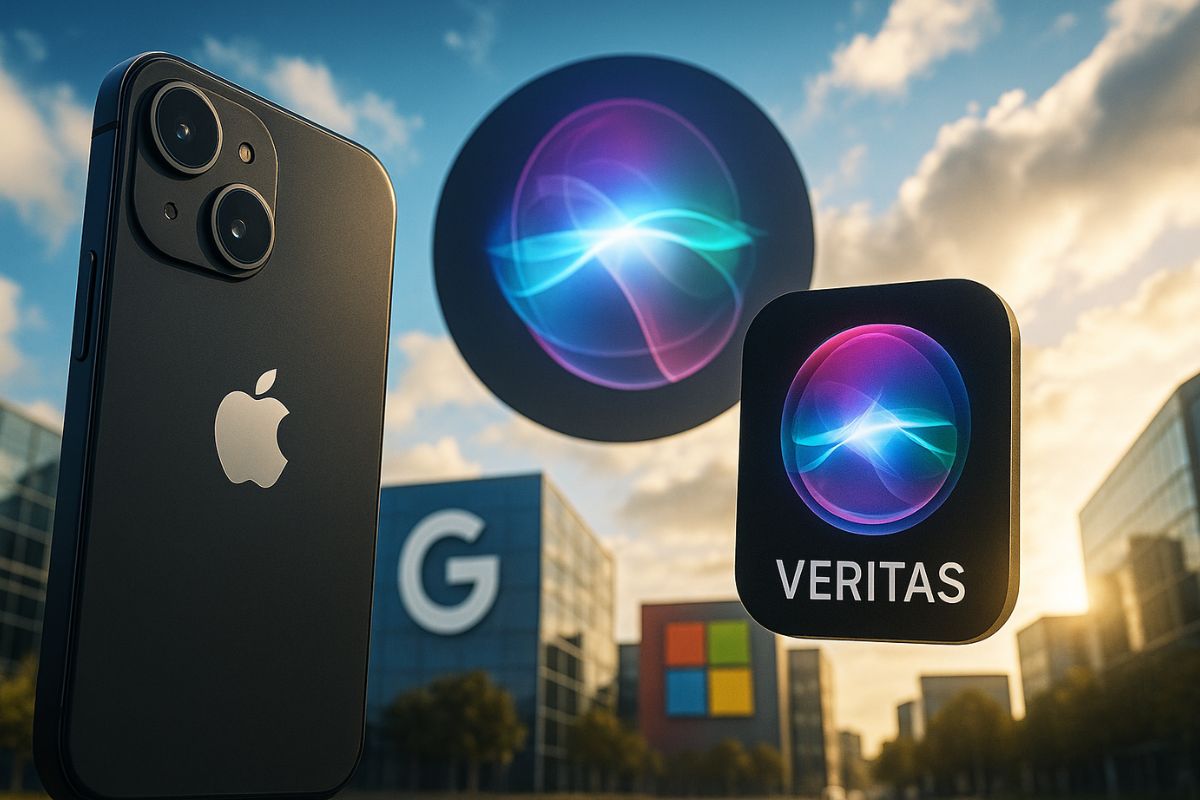
Project Bets on Advanced AI to Challenge Google and Microsoft in 2025.
Apple would be conducting internal tests with the Veritas app to Reinvent Siri, in an attempt to reposition its virtual assistant in the face of growing competition in the field of artificial intelligence. According to O Globo, the tool has been used to assess tasks ranging from data searches to message management and executing commands in applications.
The app, still in the experimental phase, is part of a broader effort by the company to transform Siri into a platform capable of directly competing with the solutions offered by Google and Microsoft.
The official launch is expected to occur as early as March next year, marking a new stage in the company’s strategy in the AI sector.
-
100 times less energy consumption: the innovation that could solve the huge energy crisis of AI.

-
Scientists reveal a new method using solar light that transforms plastic into vinegar and could change the game against pollution, converting waste into a sustainable solution with future global impact.
-
3,500-year-old tear discovered reveals a textile technique much more advanced than previously thought in the Bronze Age.

-
One of the largest manufacturers of military ammunition in the world is Brazilian and has just signed an agreement with the Navy to develop national ammunition for the frigates built in Santa Catarina that will protect the Blue Amazon.


What is Veritas and What is Its Role in Testing
Named Veritas, the application serves as an evaluation environment to measure Siri’s performance in everyday scenarios. The idea is to verify whether the new generation of the assistant can respond with greater accuracy, reduce errors, and adapt to user needs.
Apple sees this project as an opportunity to consolidate a robust technological foundation before bringing the changes to the general public. Unlike previous versions, the company is now betting on large language models, in line with the solutions that have been transforming the market since 2022.
Delays and Failures in the First Prototypes
Although the expectation was to launch the new Siri last spring, engineering problems delayed the schedule. According to internal reports, about one-third of the interactions had errors, which made the announcement unfeasible.
The delay, however, allowed the team to expand testing and refine functionalities such as integration with visual features, more natural voice navigation, and direct interaction on mobile device screens. The promise is to deliver a significantly superior experience to the current one.
Tim Cook and Apple’s Vision for AI
In internal meetings, CEO Tim Cook classified artificial intelligence as “the biggest technological transformation in decades,” emphasizing that Apple needs to be among the frontrunners. In this context, Veritas is seen as a strategic piece to ensure that Siri not only keeps up but exceeds expectations.
Additionally, the company is preparing deep changes in the operating system, focusing on camera features of up to 320 MP, 8K videos, and optimizations to run AI solutions more efficiently.
Reinvented Siri, But Without a Public Chatbot
While rivals like Google and Microsoft are advancing with open-use chatbots, Apple is taking a different stance. Craig Federighi, head of software, has stated that creating a popular chatbot is not an immediate priority.
The goal is to enhance Siri as an ecosystem of smart commands, without directly competing in the generalist conversational assistant segment.
This positioning shows caution but also indicates a differentiation strategy: Siri should be less of a chatbot and more of a core integration between Apple’s hardware, software, and services.
Outlook for 2025 and Beyond
The new software, codenamed Linwood, integrates proprietary and third-party models to boost the assistant’s performance.
It is expected that by the end of 2025, Siri will also undergo a complete visual overhaul and that new smart home devices will be launched, expanding the technology’s reach.
Even with the fierce competition from Google, Samsung, and Microsoft, Apple seems to bet on a path of consistency: maintaining internal development under control, ensuring that Siri’s evolution reflects its standard of privacy, security, and integration.
The Veritas app to reinvent Siri may represent the turnaround Apple needs to reclaim its leadership in artificial intelligence. The question remains whether the company will be able to turn years of delay into a competitive advantage against rivals who are already competing in the market with mature solutions.
And you, do you believe that Apple’s strategy of prioritizing integration over chatbots is correct? Or do you think the company risks falling behind? Share your opinion in the comments — we want to hear your view on this technological dispute.







Seja o primeiro a reagir!