





 Portuguese
  English
  Spanish
  6 min of reading
  0 comments


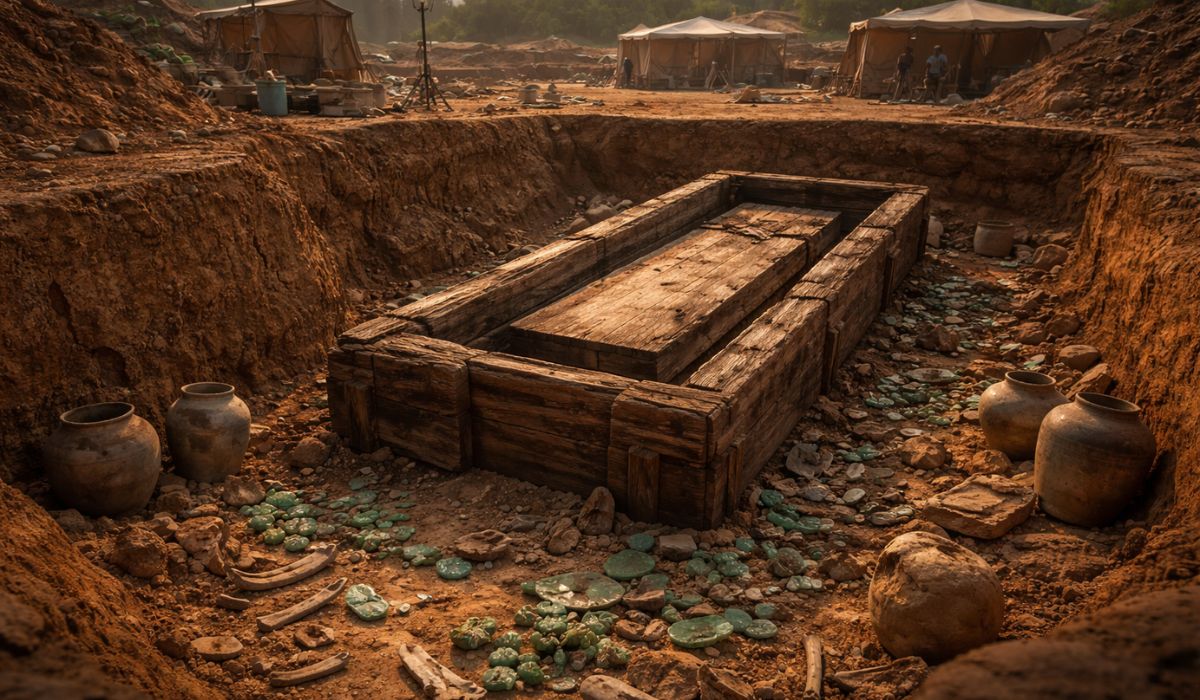
Discovery in China reveals rare traces of power, social hierarchy, and ritual destruction at an archaeological site that is changing researchers’ interpretations of the complexity of Neolithic societies linked to the Dawenkou culture.
A tomb approximately 5,000 years old, located in the ruins of Wangzhuang in the Chinese province of Henan, has led archaeologists to reassess the significance of the site for the study of Neolithic China.
The burial, identified as M27, features unusual dimensions for the time, a funerary assemblage of over 350 objects, and signs of destruction shortly after the burial.
For the researchers responsible for the excavation, the find reinforces the hypothesis that Wangzhuang was not a common settlement, but possibly a center of power linked to the Dawenkou culture.
-
A vacuum robot with a five-axis mechanical arm capable of picking up objects from the floor, avoiding obstacles in real time, and continuing to clean on its own inaugurates a new generation of appliances that see, think, and act within the home.
-
Geographers redefine the Brazilian relief and confirm the presence of mountains in 14 states with a new system that changes historical criteria and alters the way the territory is classified.

-
At a depth of 3,800 meters in the Atlantic, scientists have discovered a “lost city” with white towers up to 60 meters tall that has been active for over 120,000 years without relying on volcanoes.
-
Rare phenomenon intrigues science: video captures extremely rare square waves on Lake Michigan and geometric pattern near Indiana impresses.

What was found in tomb M27
The structure excavated in Yongcheng has over 17 square meters, a measurement considered out of the ordinary for the period.
According to the state agency Xinhua, the tomb measures between 4.52 and 4.8 meters in length and between 3.47 and 3.68 meters in width, in addition to having internal and external wooden coffins.
Inside, archaeologists cataloged more than 100 pieces of pottery, nearly 200 small jade ornaments, bone tools, and animal remains.
Among these remains are pig jaws, associated with wealth and social prestige in that cultural context, according to Chinese researchers.
The presence of this material, combined with the quantity of jade and pottery, is regarded by the team as an indication of the social position of the buried individual.
This assessment is part of a set of archaeological interpretations still under analysis.
The concentration and quality of the objects have also drawn attention for what they may reveal about the social organization of the time.

Liu Haiwang, leader of the joint archaeological team cited by Xinhua, stated that the wealth of funerary goods corresponds to the size of the tombs, which, according to researchers, indicates a social hierarchy already defined at that time.
This reading is used to support the existence of status differentiation and unequal distribution of resources.
In this context, the classification of the tomb itself has gained greater weight in the analyses.
Chinese archaeologists told Xinhua that the occupant of M27 may have been a “king” of a prehistoric state, a formulation presented cautiously and based on the size of the grave and the funerary assemblage.
More than the title attributed to the deceased, the central data for researchers is the possibility that there were already forms of political authority and social distinction on a scale more complex than previously assumed for this phase.
Wangzhuang and the archaeological relevance of the Dawenkou culture
The ruins of Wangzhuang belong to the middle and late periods of the Dawenkou culture, dated between 4000 BC and 2600 BC.
Since 2023, teams from the Provincial Institute of Cultural Heritage and Archaeology of Henan, Capital Normal University, and other institutions have been working on the excavations at the site.
In October 2024, Xinhua reported that 45 tombs of the Dawenkou culture had been identified in the area that year, with 27 already excavated.
Additionally, more than a thousand funerary artifacts have been recovered at the site, according to the same agency.
This volume of material has increased academic interest in the area and reinforced the assessment that the site may have played a broader regional role.
The site has begun to be analyzed not only as a funerary area but also as a possible nucleus of political and social organization.
It was in this context that the interpretation of Wangzhuang changed in scale.
Zhu Guanghua, an associate professor at Capital Normal University, told Xinhua that the most recent discovery indicates that the site was not an ordinary settlement but possibly the capital of a prehistoric kingdom.
The hypothesis considers not only M27 but also the set of tombs, the status differences between them, and the variety of objects already found.
Still, the available data itself recommends caution.
The material released so far points to an archaeological interpretation in development, rather than a definitive conclusion.
The significance of the site has increased because it provides concrete evidence of social stratification and the circulation of symbolic goods, but the exact definition of Wangzhuang’s political role remains dependent on the progress of excavations and laboratory analyses.

Cultural exchanges and circulation of objects in Neolithic China
Another point that has increased interest in the site is the cultural diversity suggested by the artifacts.
According to Li Xinwei, deputy director of the Ancient History Institute of the Chinese Academy of Social Sciences, also cited by Xinhua, the material found shows influences from eastern China, the central region, and the Yangtze River basin.
Among the mentioned examples are objects associated with the Yangshao culture, found in the same context as typical Dawenkou elements.
For archaeologists, this set indicates that Wangzhuang functioned as an area of contact between distinct traditions, rather than as an isolated community.
The simultaneous presence of materials linked to different Neolithic cultures is treated as evidence of interaction between groups from diverse regions.
According to specialists, this may have occurred through circulation networks, ritual exchanges, or other forms of contact still under investigation.
This interpretation aligns with a more recent line of Chinese archaeology that seeks to understand the formation of civilization in the territory as a plural process, with regional nuclei in interaction.
Wangzhuang has gained prominence precisely for offering material traces of this crossing of influences.
Pottery, funerary practices, and characteristics observed in human remains are part of this picture analyzed by researchers.
Signs of destruction in the 5,000-year-old tomb
Tomb M27 also shows signs of intervention after the burial.
According to Zhu Guanghua, the tomb was severely damaged after the burial.
Most of the remains of the buried individual have disappeared, with only a few toe bones preserved.
Small jade ornaments were found scattered inside and outside the coffin.
Additionally, several ceremonial stone blades appeared intentionally broken, according to the team.
The archaeologists reported that they are still investigating the reason for this destruction.
So far, the confirmed information is the existence of deliberate damage shortly after the funeral, with no definitive public conclusion about the cause.
This aspect has altered the focus of the discovery.
In addition to being a monumental burial, M27 records a subsequent violation that has not yet been conclusively explained.
Among the possibilities considered by specialists are power disputes, looting, or some type of ritual practice, but none of these hypotheses have been publicly confirmed so far.
The scientific value of the site is therefore linked to two main fronts.
On one hand, the material helps document the presence of social inequality, productive specialization, and the circulation of prestige objects around 5,000 years ago.
On the other hand, it indicates that these groups already maintained complex forms of regional interaction and possibly conflict, according to the reading of the archaeologists involved in the study.
With part of the tombs still to be excavated, Wangzhuang remains one of the sites monitored by researchers interested in the formation of political structures in Neolithic China.
The next stages of excavations and analyses may help clarify the role of the site within the Dawenkou culture and the reason why tomb M27 was targeted for destruction shortly after the burial.







Seja o primeiro a reagir!