





 Portuguese
  English
  Spanish
  4 min of reading
  0 comments


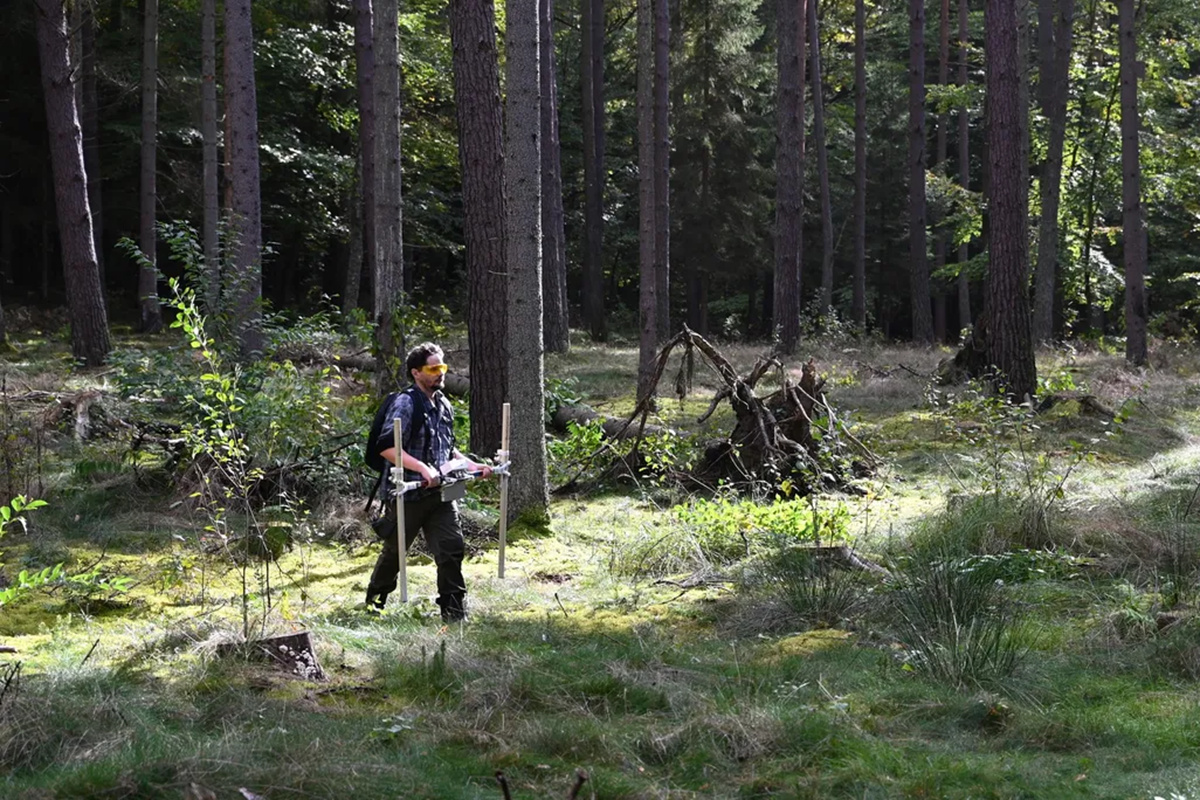
Remains of a mysterious medieval city buried in forests of northwest Poland revealed a square, main street, walls, a 5.5-meter moat, and hundreds of artifacts, while archaeologists are still trying to clarify why the ancient urban core was abandoned centuries ago.
The discovery of the remains of a mysterious medieval city buried in the forests of northwest Poland has reignited the investigation into an ancient urban core that existed hundreds of years ago and was abandoned under circumstances that researchers have yet to clarify. Identified as Stolzenberg, the locality began to be studied more systematically after a series of excavations and surveys conducted by archaeologists from the Relicta Foundation.
The team found structures at the site that may correspond to a central square, a main street, and a moat 5.5 meters deep. The discoveries reinforce the hypothesis that it was a medieval village organized according to a precise urban plan, surrounded by defensive elements and marked by occupations that spanned different historical periods.
Search for Stolzenberg began from ancient records
Researchers from the Relicta Foundation, a Polish archaeological organization specializing in lost medieval cities, have been searching for Stolzenberg since 2019. The starting point was a reference found in records from 1909, which mentioned a “dead” city near the village of Sławoborze, in an area that today is part of the West Pomerania region of Poland.
-
A forgotten cord on the floor of a basement in Vienna leads a plumber to a box containing 30 kilograms of gold with Mozart’s face, hidden before World War II. The treasure, worth 2.3 million euros, was just centimeters away from a worker who ignored the sign a day earlier.
-
A couple buys an old chalet, breaks the kitchen floor for renovation, and finds over a thousand coins of gold and silver hidden since the English Civil War over 4 centuries ago.

-
Rigid bags with their days numbered: new trend prioritizes comfort in 2026.

-
YouTuber creates an excavator equipped with a giant 4.5-meter sword to challenge his brother to a rematch, and the invention quickly goes viral on social media.

In the forests south of Sławoborze, the team located a horseshoe-shaped moat and remains of defensive walls described as ramps. In 2020, metal detectors used in the area revealed hundreds of artifacts, which increased interest in the site and led to the continuation of work in the following years.
With support from the Polish Ministry of Culture and National Heritage, researchers conducted deep drilling, geophysical surveys, and LiDAR scans. In an area of approximately 15 acres surrounded by walls and a moat, more than 1,500 anomalies were identified, that is, unusual terrain features associated with the possible presence of hidden structures underground.
Remains of the mysterious city reveal urban layout and medieval occupation
According to archaeologists, these anomalies were distributed in a precise urban plan, described as being in the German style. In the center of the area, signs of a market square emerged, surrounded by residential lots and connected to a main street leading to the city gates.
Radiocarbon dating indicated that the village was already active in the 14th century. Researchers believe that Stolzenberg was built in the late 13th century or early 14th century, before being abandoned at some point prior to the 16th or 17th centuries.
Recent excavations also revealed around 400 artifacts with a wide chronology, covering thousands of years. The oldest objects date back to the Bronze Age, while the most recent are from World War II, showing that the area was used in different eras, although medieval items are considered the most important for confirming urban occupation during that period.
Among these medieval finds, archaeologists highlighted silver coins, metal elements of belts, and coat fasteners typical of medieval burgher attire. Tools, brooches, belt buckles, and a coin depicting a 13th-century duke were also found, pieces that, according to Marcin Krzepkowski, confirm that the site was in use during the Middle Ages.
Artifacts from different eras expand the mystery of the site
In addition to the medieval remains, the excavation uncovered containers with meat and butter dated from World War II. Krzepkowski also reported being particularly intrigued by the presence of lead rifle bullets and fragments of cannon grenades found in the area.
According to him, these materials may be linked to a battle that occurred in 1761 during the Seven Years’ War between Russian and Prussian forces. The presence of artifacts from such distinct periods has transformed the site into an area of even greater interest, as it gathers evidence of successive uses over the centuries.
Despite the advances, researchers still do not know who founded Stolzenberg or why its inhabitants left the city. According to the team, there are several hypotheses for the disappearance of the settlement, including plagues, wars, famine, and border disputes, although none have been confirmed so far.
Another possibility considered is that the city was relocated to another site. Krzepkowski stated that, as strange as it may seem, cities were sometimes relocated to newer and more convenient areas, even distances of up to a dozen kilometers, for reasons such as proximity to rivers, flood risk, the search for faster expansion, changes in trade routes, or competition with neighboring centers.
Research continues to understand the life of the ancient inhabitants
The archaeological site is still in the analysis phase, and the team intends to deepen the investigation in future studies. One of the goals is to learn more about the diet of the inhabitants of Stolzenberg through bioarchaeological analyses, which could help reconstruct aspects of daily life in the ancient village.
Krzepkowski stated that the group from the Relicta Foundation is still at the beginning of the research journey. For him, the site functions as a true time capsule full of mysteries, the clarification of which could enhance understanding of the processes of settlement and city formation in this part of Europe.








Seja o primeiro a reagir!