





 Portuguese
  English
  Spanish
  5 min of reading
  0 comments


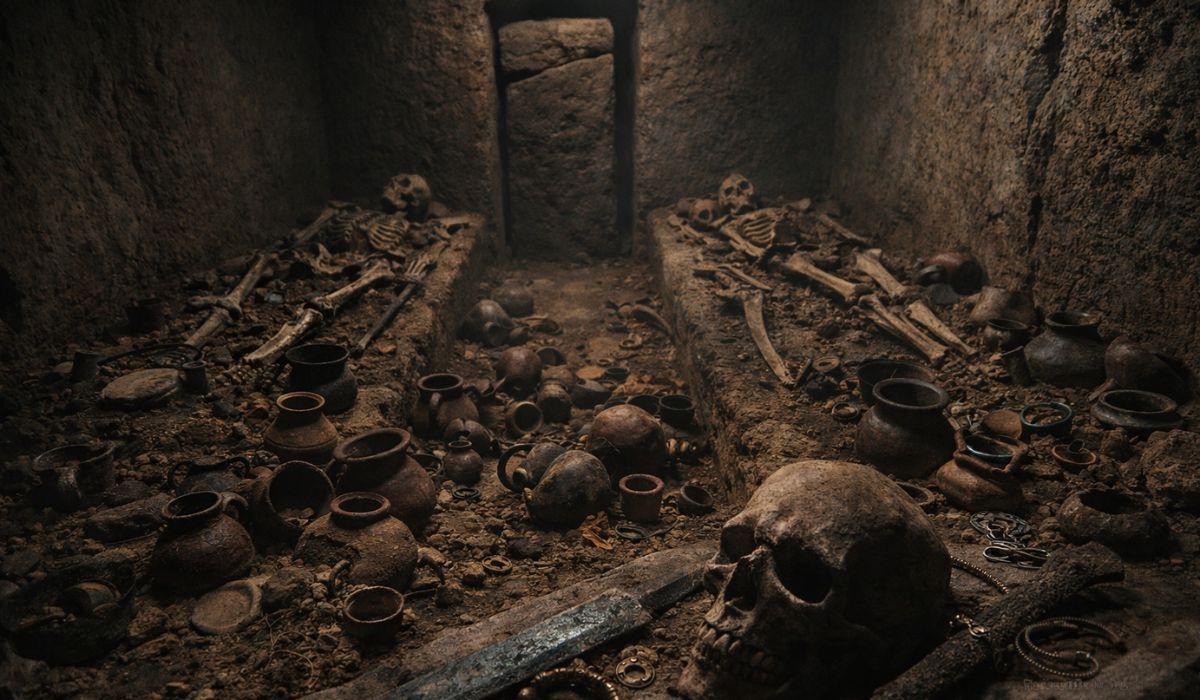
Discovery made in the center of Italy gained attention for gathering a rare combination of sealed tomb, preserved objects, and human remains of a civilization that preceded Roman rule.
An Etruscan tomb found intact in the center of Italy continues to attract attention for a rare characteristic in archaeology: the interior remained sealed for about 2,500 years, with human remains and over 100 preserved objects in their original position.
Excavated in San Giuliano, about 70 kilometers from Rome, the funerary chamber offers researchers the opportunity to study burial practices without signs of ancient or modern looting.
The find was announced in 2025 by the San Giuliano Archaeological Research Project, SGARP, an international initiative linked to Baylor University and developed in collaboration with Italian archaeological authorities.
-
Volcanic lava transforms into threads as fine as human hair that travel over 30 kilometers by wind and fall like cutting rain on roofs and backyards in Hawaii and Iceland.
-
NASA issues a warning for the feared Godzilla El Niño that could change the planet’s climate in 2026 with extreme warming of the Pacific capable of causing devastating droughts in some regions and historic floods in others simultaneously.

-
Archaeologists discover a 100-meter ship graveyard in a submerged Greek city, and what has appeared on the seabed of Libya could change what was known about this ancient port.
-
You buy the refrigerator and still have to see ads: Samsung starts displaying advertising on appliances and generates negative reactions among consumers.


Dating from the end of the 7th century BC, the tomb was carved into the rock in a shape similar to that of a small house.
Inside, archaeologists found four individuals lying on stone beds, surrounded by ceramics, weapons, bronze ornaments, and silver hair accessories.
Intact Etruscan tomb in San Giuliano attracts attention for preservation
The most relevant aspect of the discovery is the fact that the burial has reached the present without violation, according to the researchers responsible for the project.
In the San Giuliano region, the team has documented over 600 Etruscan tombs since the research began in 2016.
According to the group, this was the only one identified so far without signs of looting, a condition that may preserve important evidence about funerary rituals, internal space organization, and the composition of the belongings left with the dead.

The discovery occurred in the necropolis of Caiolo, within the archaeological area of San Giuliano, in the regional park of Marturanum, in Barbarano Roman.
The area is historically associated with Etruscan presence and contains hundreds of burials carved into the rock.
Still, the tomb now highlighted is different because it preserved the original arrangement of objects and bodies, something uncommon in sites that have suffered looting over the centuries.
Archaeological discovery in Italy expands study of the Etruscans
In a statement released by Baylor University, archaeologist Davide Zori stated that the completely sealed funerary chamber represents a rare discovery for Etruscan archaeology.
In the same statement, he mentioned that, in the inner and mountainous region of central Italy where the team operates, a preserved tomb of this age had never been excavated with modern archaeological techniques.
According to the researcher, the discovery opens an opportunity for study about the beliefs and funerary traditions of a culture prior to Roman rule.
The statement helps to situate the scientific weight of the find in the field of Etruscan archaeology.
Instead of working only with fragmented remains or those altered by ancient invasions, specialists began to analyze a closed funerary context, with objects directly associated with the individuals buried.
According to those responsible for the research, this may allow for more accurate readings about social status, gender roles, symbolism of artifacts, and ways of representing death among the Etruscans.
Still, the team emphasizes that the study phase of the materials and human remains is ongoing.
Human remains and over 100 preserved objects were inside the chamber
Preliminary data indicated that the four buried individuals may form two male-female pairs, but this interpretation still depends on further analyses.
The group responsible for the excavation reported that the opening of the chamber was just the beginning of a broader investigation aimed at stratigraphic documentation, osteological examination, and detailed reading of the archaeological set.
So far, there is no more detailed public confirmation about the identity, kinship, or social position of the buried individuals.
In addition to the skeletons, the funerary belongings drew attention for their quantity and state of preservation, according to the project and the Italian superintendent responsible for the area.
The descriptions released so far mention over 100 artifacts, including ceramic vessels, iron weapons, bronze ornaments, and silver accessories.

In later coverage, specialized vehicles also highlighted the ritual arrangement of these materials inside the chamber, an aspect noted by researchers as relevant for reconstructing funerary practices of the Etruscan orientalizing period.
This phase is associated with cultural transformations and contacts with other Mediterranean traditions.
Etruscan civilization preceded the expansion of Rome in the center of Italy
The relevance of the find increases when it is observed in the context of the Etruscan civilization itself.
The Etruscans flourished in the center of Italy before the consolidation of Rome as a dominant power and reached their peak around the 6th century BC.
Over time, their cities were gradually incorporated into Roman expansion, a process that culminated in the assimilation of Etruria into the orbit of Rome.
Therefore, discoveries of this kind help to expand knowledge about a society prior to the Roman Republic and still surrounded by documentary gaps, especially in aspects related to daily life, beliefs, and funerary rites.
Another point that maintains the current discovery is the methodological value of the material found.
In archaeology, an intact tomb serves not only to reveal preserved objects.
It functions as a closed context, in which position, proximity, and association between the pieces can be as important as the artifacts themselves.
When a chamber remains unviolated, researchers can observe more securely how that space was organized at the time of burial, without the need to separate what is original from what has been altered by thieves, ancient excavations, or informal collections.

Find in Barbarano Romano mobilized researchers and local community
The discovery also mobilized the local community and the team involved in the excavation.
In a statement reproduced by Baylor University, student Kendall Peterson stated that participating in a project that revealed an unlooted tomb was an unusual experience and described the reaction of the professors and the population of Barbarano as striking.
The statement was presented by the university as a reflection of the rarity of the find and the impact that this type of evidence still provokes among specialists and residents of the region.
Although announced in 2025, the tomb remains a current archaeological curiosity because its value is not limited to the moment of opening, but to the rarity of the preserved context.
In an area studied for years and marked by hundreds of burials, the encounter of a closed Etruscan funerary chamber with its contents practically untouched brings to light old questions about how this people buried their dead and expressed identity, hierarchy, and memory through the objects placed beside them.





Seja o primeiro a reagir!