





 Portuguese
  English
  Spanish
  3 min of reading
  0 comments


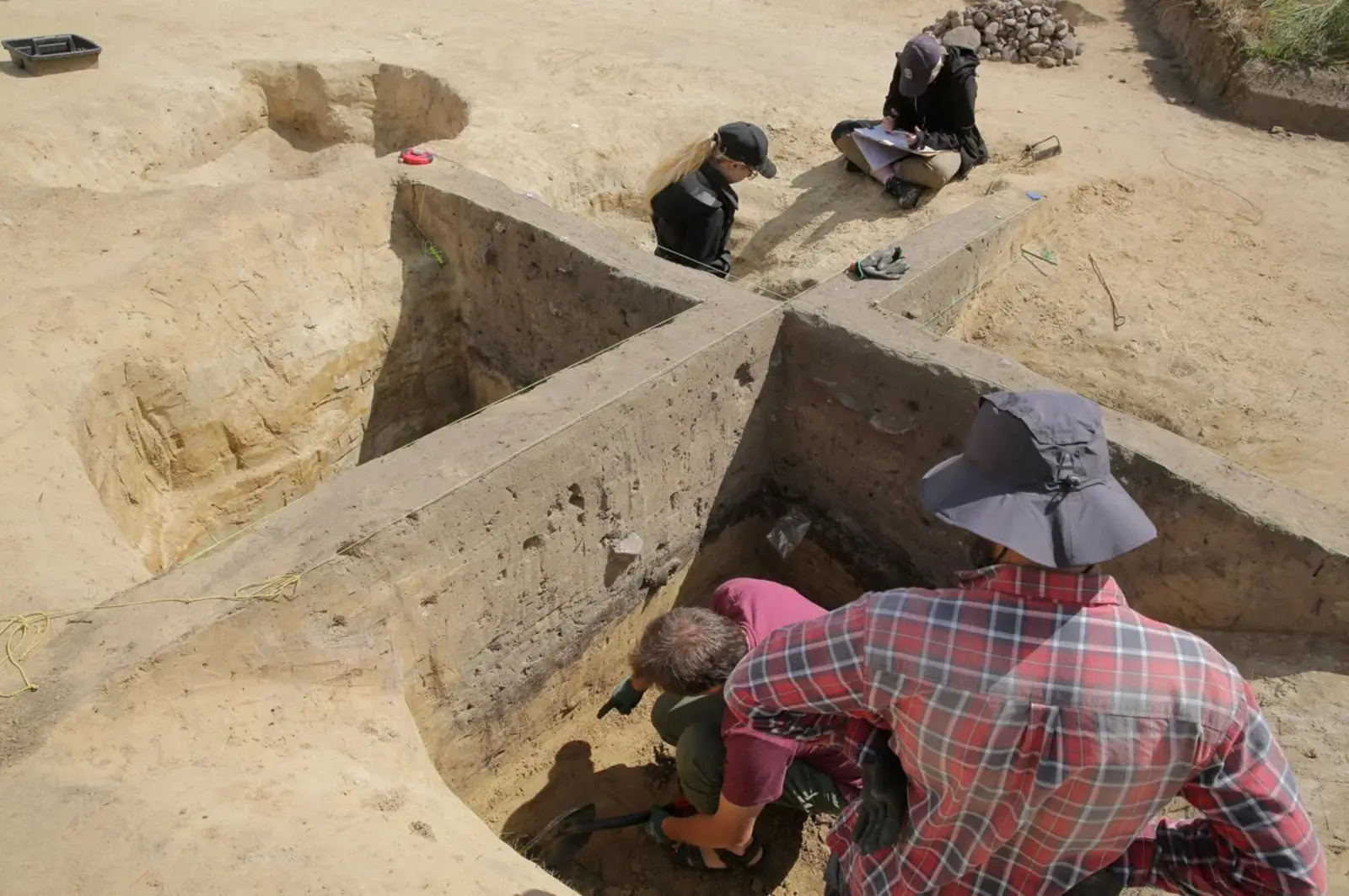
Archeologists from the University of Gdańsk located the original position of Dąbrówno, in the ancient Forest of Galinda, and revealed urban remains, a medieval cemetery, signs of fire, a forge, and more than 500 artifacts from the 14th and 15th centuries
Archeologists from the University of Gdańsk located the original position of Dąbrówno, a lost medieval town in northern Poland, and identified remains of the ancient settlement, revealing new data about the initial urban formation of the region and later changes in the inhabited core.
Location of the settlement
The medieval town was found on a plateau below Zamkowa Góra, near Lake Dąbrowa Mała, in the ancient Forest of Galinda.
Geophysical surveys showed an organized urban layout, with buildings distributed in two rows and a central market square, elements associated with medieval planning.
-
A massive warm air mass stretched from Brazil to near Antarctica and caused something that almost never happens: lightning and thunderstorms in Ushuaia, in the Falkland Islands, and in the South Georgia Islands.

-
Larger than a football field, with a wingspan of 117 meters, six Boeing 747 engines, and a capacity of 250 tons, the Stratolaunch Roc turns the sky into a gigantic hypersonic launch ramp and accelerates the way the U.S. tests weapons from Mach 5 to Mach 10.

-
Neuralink, the company specialized in brain chips founded by Elon Musk, announced that it intends to implant thousands of brain chips thanks to large-scale production.

-
Hummer H1X3: The 60-ton car, 14 meters long, and $25,000 tires – all for a single owner in the United Arab Emirates.

The magnetic anomalies detected beneath the surface allowed the structure of the medieval town to be outlined without the need for extensive excavations on the ground.

Change and abandonment
The researchers point out that the settlement seems to have been moved at some point, leaving behind the area that came to be called Stare Miasto, or Old Town.
The reasons and exact period of this change have not yet been defined. Nevertheless, similar cases have been observed in other abandoned medieval settlements.
The team also identified similarities between Dąbrówno and Barczewko, another ancient site previously studied by the same archeologists.
Urban organization and historical name
The spatial arrangement of the two sites and their adaptation to the terrain indicate shared planning principles between the settlements.
The researchers related the historical name Dąbrowna, or Ilgenburg, to the Prussian word ilgis, which means “long,” possibly referring to the elongated shape of the fortifications.
Historical records indicate that Dąbrówno was destroyed in 1410 by the forces of Władysław II Jagiełło, before the Battle of Grunwald.
The medieval town, however, has earlier origins linked to the expansion of the Teutonic Order and was granted official rights in 1326, probably at this same location.
Artifacts and destruction
The excavations found more than 500 artifacts dated from the mid-14th century to the early 15th century, including weapons, equestrian equipment, and ceramics.
Remains of a forge indicate local productive activity. Burned remains of wooden structures suggest that the settlement was destroyed by a fire.
The recovered wood was dated to the late 13th century or early 14th century, reinforcing the antiquity of the occupation.
Medieval cemetery and geophysics
The archeologists also located a medieval cemetery, with a skeleton buried according to Christian customs and fragments of ceramics.
The burial site suggests the proximity of a church and reflects the coexistence between settlers and converted native Prussian populations.
For the researchers, non-invasive techniques, especially geophysics, drive new discoveries and transform these sites into time capsules of medieval urban life.
With information from Heritagedaily.







Seja o primeiro a reagir!