





 English
  Francês
  Alemão
  Italiano
  Japonês
  Norueguês
  Portuguese
  Spanish
  3 min of reading
  0 comments


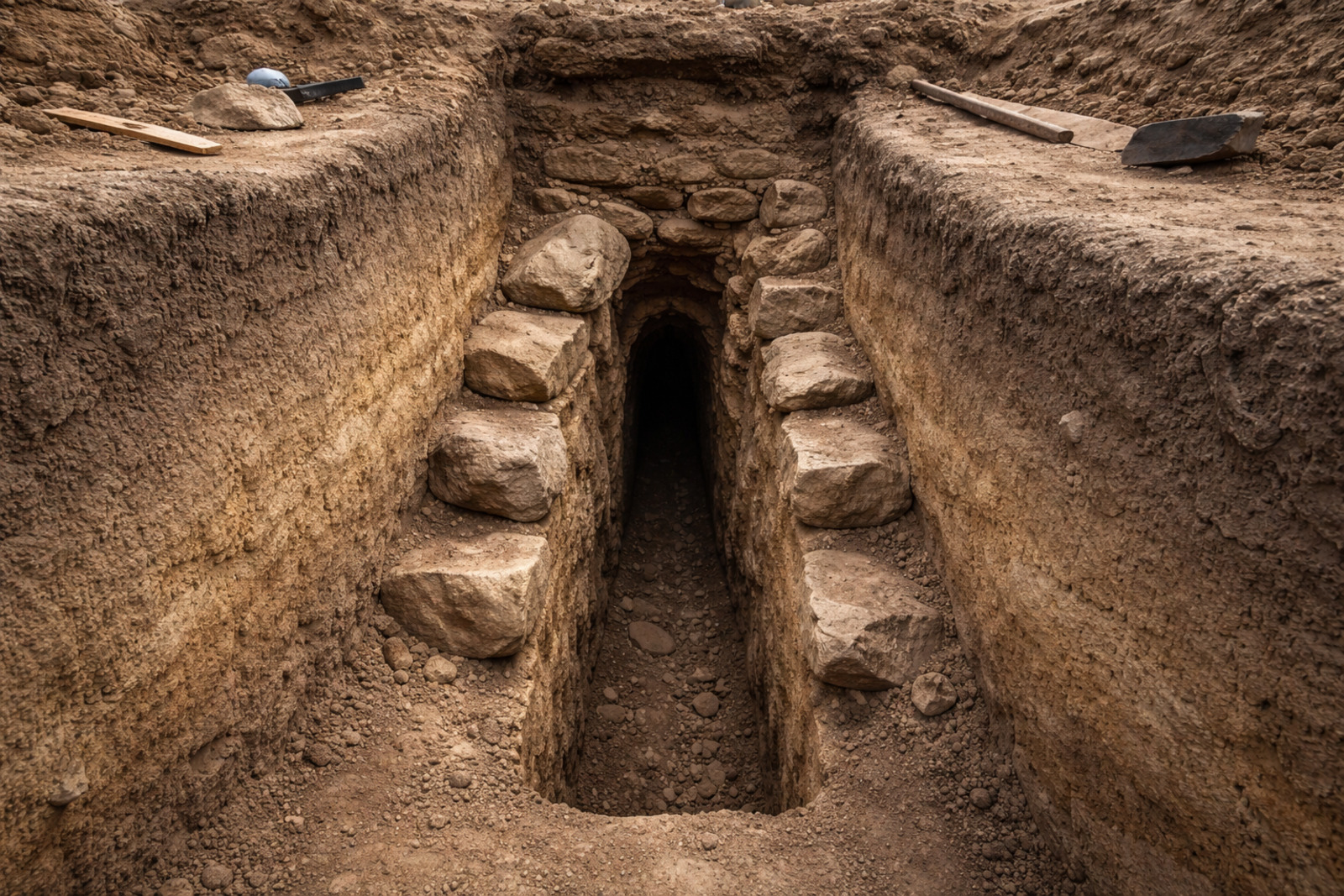
Discovery in Saxony-Anhalt reveals that a narrow underground tunnel, found within a prehistoric enclosure, connects medieval activity to a much older Neolithic site and offers archaeologists a rare insight into the reuse of ancient spaces over the centuries
A peculiar narrow underground tunnel, discovered in Saxony-Anhalt, is linking medieval activity to a much older Neolithic site, revealing that a hidden prehistoric enclosure at the site was reused centuries later and gained new archaeological significance.
Underground tunnel links different times
The discovery shows that the medieval structure does not appear in isolation. It emerges within a much older space, associated with a Neolithic enclosure, bringing together two distinct historical moments at the same point preserved by archaeology.
Hidden within this prehistoric enclosure, the underground tunnel offers a rare insight into the continuity of use of the place.
-
350-year mystery may have been solved: remains of a soldier who inspired the hero of The Three Musketeers found beneath a church in the Netherlands.

-
NASA photographed a nearly perfect square with 3 km sides on Mars, 13 times larger than the Great Pyramid of Giza, but the official explanation is natural erosion; still, no one has explained why the four sides have almost identical lengths.

-
Starlink breaks the barrier of 10,000 satellites in orbit and takes its expansion to an unprecedented level, with a direct impact on global internet, technological competition, and the race for space.

-
Japan finds an alternative to oil amid rising prices by transforming ocean balance into electricity with a new technology that maintains efficiency even when the sea changes.

For archaeologists, the finding helps observe how ancient areas were reoccupied in other periods.

Finding expands reading of the enclosure
This connection between medieval activity and the Neolithic site expands the scope of the discovery. Instead of indicating just a narrow passage, the structure now serves as material evidence of the repurposing of an ancient ancestral space.
The peculiar nature of the tunnel also reinforces the relevance of the finding. Its narrow shape, combined with its position within the enclosure, highlights an unusual configuration and contributes to better organizing the archaeological reading of the set found there.
Neolithic site reveals new layers
The Neolithic site, cited as much older, makes it clear that the location brings together layers from different times.
The presence of the medieval tunnel within this environment reinforces that the area did not lose importance after the first recorded use there.
The rarity highlighted by archaeologists lies precisely in this overlap. The finding allows tracking how a prehistoric space was reoccupied centuries later, maintaining traces capable of linking distinct contexts without completely separating one period from another at the site.

Reuse changes understanding of the site
In addition to connecting different historical times, the underground tunnel redefines the reading of the enclosure itself.
Instead of appearing only as a mark of the Neolithic past, the space now shows later uses that altered its trajectory over time.
The value of the discovery lies in this direct association between the medieval and the Neolithic, without breaking the unity of the place.
The underground tunnel thus emerges as a central piece for understanding the reuse of a much older ancient space.
At the center of this process, the prehistoric enclosure ceases to be merely a backdrop. It becomes the element that organizes the connection between eras and shows that medieval activity settled on a much older foundation there.
Discovery highlights permanence of the space
Therefore, the discovery in Saxony-Anhalt is not limited to identifying an unusual passage. It brings together, at the same point, a peculiar underground tunnel, a medieval use, and the material permanence of an enclosure linked to the ancient Neolithic.
Archaeologists state that this combination provides a rare insight. The Neolithic site, hiding within it the underground tunnel, demonstrates that ancient places could be resumed and gain new functions long after in other historical contexts.
Thus, the finding reinforces the importance of observing not only the origin of spaces but also their reutilizations.
In the case of the underground tunnel, the main revelation lies in uniting medieval activity with a preserved Neolithic past within the same hidden prehistoric enclosure.
With information from Daily Galaxy.






Seja o primeiro a reagir!