





 Portuguese
  English
  Spanish
  5 min of reading
  0 comments


“`html
Etruscan tomb sealed for 2,600 years reveals more than 110 intact artifacts and reignites the mystery of the still undeciphered Etruscan language.
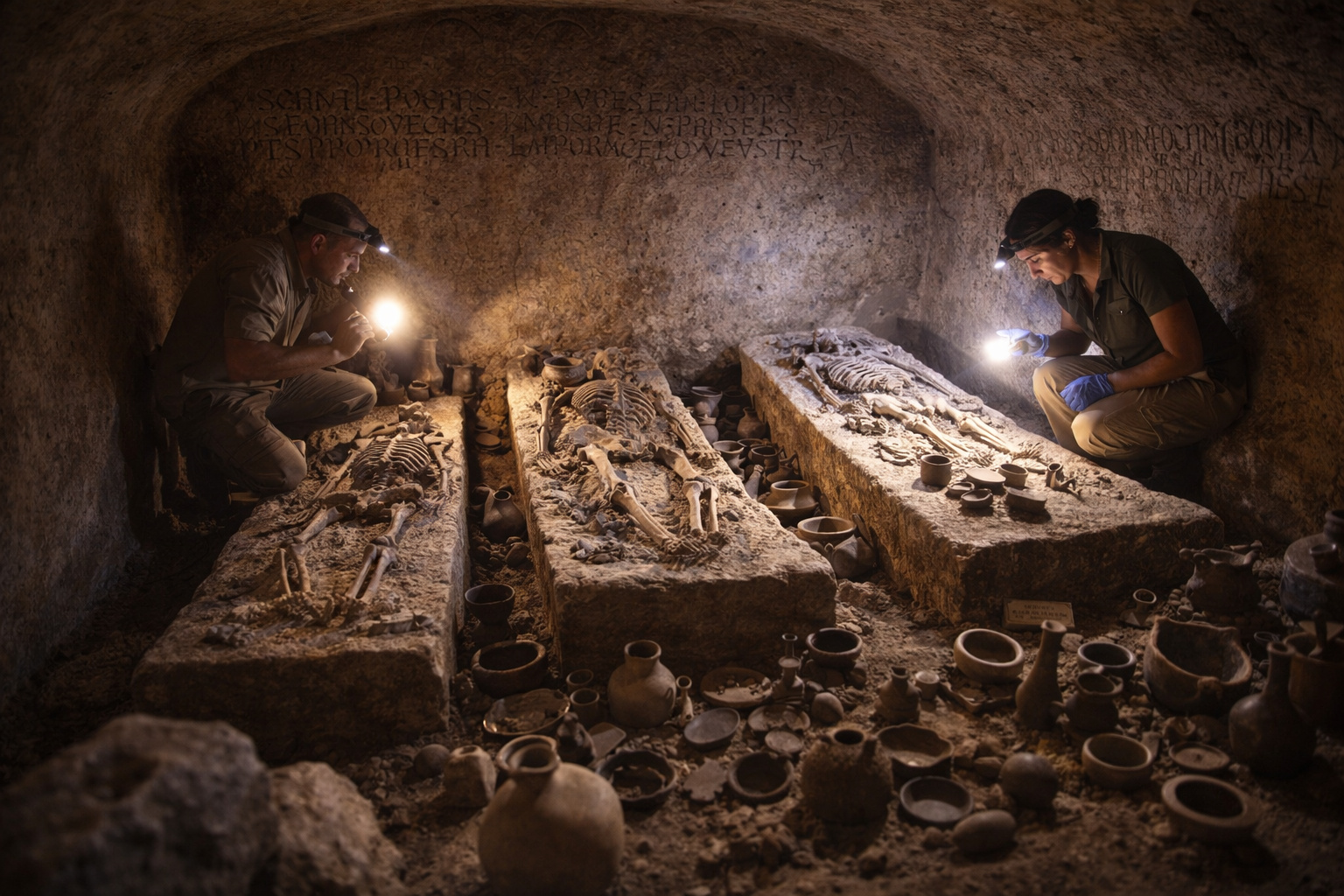
According to an official statement from Baylor University published in July 2025, Dr. Davide Zori, associate professor of history and archaeology and principal investigator of the San Giuliano Archaeological Research Project, personally removed a massive stone slab that had protected the entrance to a burial chamber for over 2,600 years. What lay on the other side was not just an intact tomb, but one of the most complete archaeological records ever found of Etruscan civilization using modern techniques.
Four individuals were lying on stone beds carved directly into the rock. Around them, more than 110 artifacts in exceptional preservation condition: painted ceramic vessels, iron weapons, bronze ornaments, and delicate silver hair coils. Everything remained exactly in its original position, as it was left in the 7th century BC.
-
Neither Brazil nor the USA: China produces over 60% of the world’s farmed fish and accounts for about 40% of all global seafood, using industrial-scale aquaculture megafarms to influence the international market and supply billions of people.

-
Health issues urgent alert for flu and calls for the vaccination of the elderly, children, and pregnant women this Saturday with Day D and drive-thru in Curitiba.

-
What seemed like waste has turned into a barrier, and now human hair collected from salons helps retain debris in the water of ancestral channels in Latin America.

-
China has deployed more than 1,400 fishing boats in formation, creating a barrier of 320 kilometers at sea, and the whole world wants to know if this is fishing, a military exercise, or a message of war.


Zori himself highlighted the rarity of the find, stating that a completely sealed Etruscan burial chamber had never been excavated with modern techniques in that region. In a necropolis with over 600 documented tombs since 2016, this was the only one found intact. All others had been looted over more than two millennia.
Intact Etruscan tomb in San Giuliano reveals artifacts preserved for 2,600 years
The discovery in San Giuliano represents an archaeological time capsule that is virtually unprecedented in the Etruscan context.
The four individuals were positioned on stone beds carved directly into the rock, surrounded by a set of objects that reflects complex and highly structured funerary practices. Among the items found were dozens of Etrusco-Geometric style ceramic vessels, characterized by repetitive patterns and Greek influence, as well as iron weapons and metal ornaments.

Reports published by Archaeology Magazine indicate that at least 74 vessels were practically intact, an extremely rare concentration in undisturbed archaeological contexts. These objects were distributed in a ritualistic manner, some near the entrance and others positioned around the bodies.
The complete preservation of the set offers a unique opportunity to reconstruct Etruscan funerary practices without interference from looters — something that rarely happens at sites of this antiquity.
Etruscan civilization: origin, influence on Rome, and the enigma of the undeciphered language
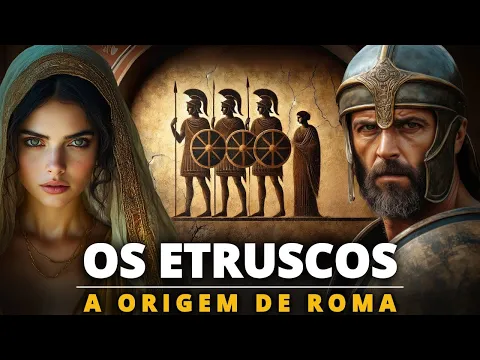
The Etruscans were the main civilization in Italy before the rise of Rome, occupying regions that today correspond to Tuscany, Lazio, and Umbria.
They developed advanced metallurgy, sophisticated architecture, and a trade network that extended throughout the Mediterranean. Their impact on Rome was profound: the Latin alphabet derives directly from Etruscan, and various elements of Roman religion, engineering, and social organization have their origins in this culture.

Despite this influence, the Etruscan language remains one of the greatest enigmas of historical linguistics. The alphabet can be read, as its letters have known phonetic correspondences.
However, the structure of the language, the meaning of the words, and the overall grammar remain largely unknown. This is because Etruscan does not belong to any identified language family, making comparison with other ancient languages difficult.
Even with thousands of inscriptions found, the lack of sufficient bilingual texts prevents complete decipherment. Documents like the Liber Linteus and the Pyrgi Tablets have partially helped, but have not solved the problem.
Artifacts found: vessels, iron weapons, and silver coils indicate high social status
The contents of the tomb provide direct clues about the social status of the individuals buried. The ceramic vessels, many of them intact, indicate not only material wealth but also elaborate ritual practices. The decorative style reinforces the cultural connection with the Greek world while preserving distinctive characteristics of Etruscan art.

The iron weapons suggest the presence of individuals linked to the military or aristocratic elite. The bronze ornaments and silver hair coils indicate high social status, as well as possible distinctions of gender and identity within the group.
The silver coils, in particular, are considered rare and highly symbolic elements. They may indicate female presence or specific cultural practices that are not yet fully understood.
Analysis of the bodies: two pairs may reveal Etruscan funerary practices
The arrangement of the bodies raised a relevant hypothesis: the four individuals may form two male-female pairs.
This possibility opens new lines of investigation into Etruscan funerary practices, especially concerning collective burials and family ties. Confirmation will depend on genetic, isotopic, and osteological analyses.
These studies could identify kinship relationships, dietary patterns, and the geographical origin of the individuals, as well as determine whether the burials occurred simultaneously or at different times.
The results of these analyses are still ongoing, which means the tomb continues to produce information even after its opening.
Why the tomb was not looted: location, structure, and statistical factor
The survival of the tomb for over 2,600 years represents a statistical anomaly within the necropolis.
All other more than 600 documented tombs had been violated, many still in Antiquity, during the Roman occupation. Others were looted throughout the Middle Ages and modern era.
The preserved chamber had a massive slab that was difficult to remove, was covered by dense vegetation, and was located in a less obvious area for looters. These combined factors may have contributed to its preservation.
Still, the random element cannot be dismissed. The intact survival of a single tomb amidst hundreds of looted ones reinforces the exceptional nature of the discovery.
Etruscan paradox: a fundamental civilization that history still does not fully understand
The discovery reinforces a historical paradox. The Etruscans were fundamental to the formation of Roman civilization and, by extension, Western culture. Yet, they remain relatively poorly understood, both by the public and by science itself.
Each new archaeological find contributes to reconstructing aspects of this society that have been lost over the centuries. In the case of San Giuliano, the complete preservation of the artifacts allows access to unfiltered information by looting or destruction.
The objects found may contain inscriptions that help advance the understanding of the Etruscan language. Some may be partially interpreted, while others will remain undecipherable until new advances in linguistics occur.
The tomb, therefore, represents not just an isolated archaeological find. It expands a still incomplete field of study and reinforces the dimension of a civilization whose influence is recognized, but whose original voice has yet to be fully understood.
“`







Seja o primeiro a reagir!