





 Portuguese
  English
  Spanish
  5 min of reading
  0 comments


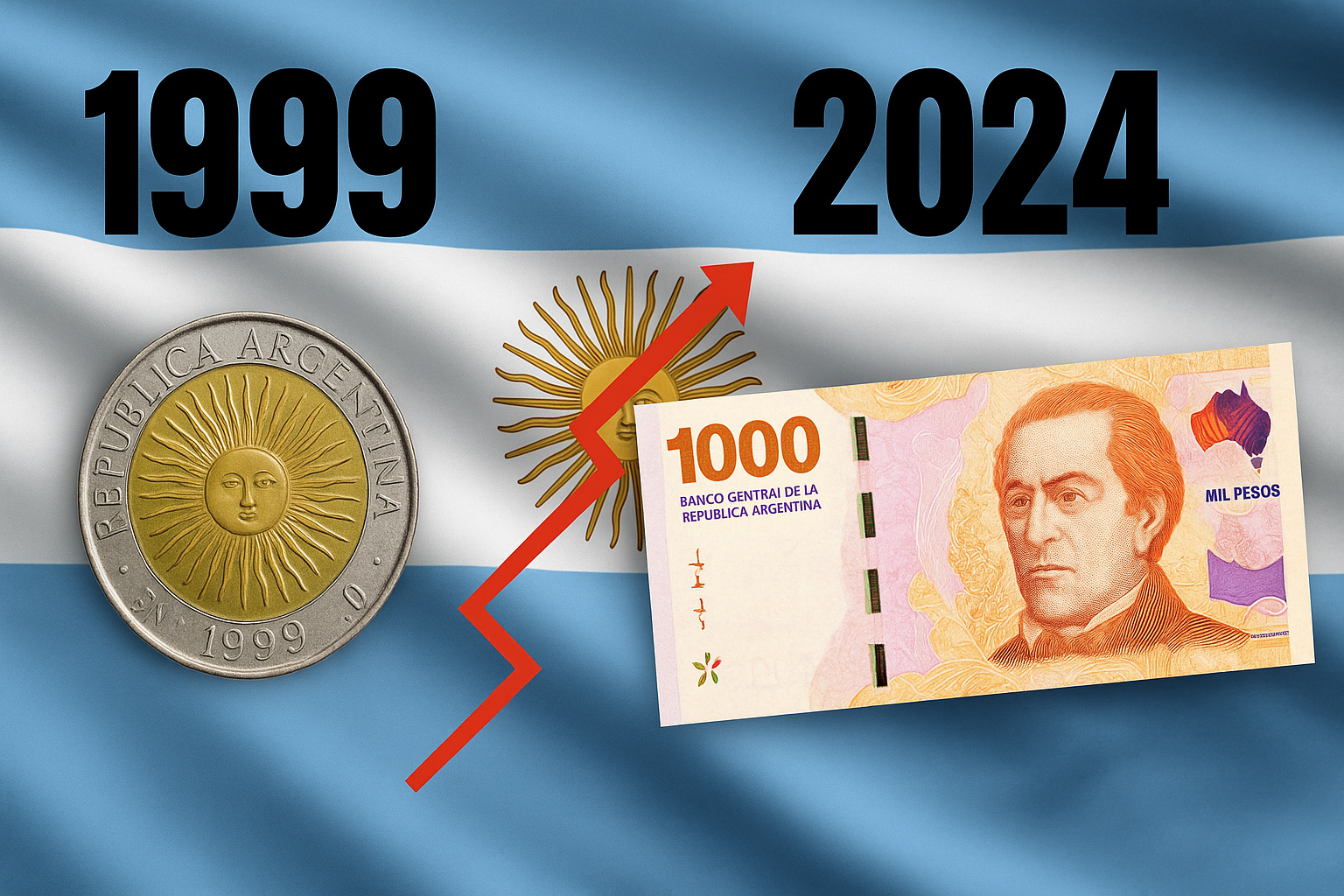
Argentina Faces Decades Of Hyperinflation And Successive Monetary Reforms, With Zero Cuts And Currency Changes, But Eroded Salaries And Destroyed Savings Keep Economic Confidence In Permanent Crisis.
If Venezuela is remembered for cutting 14 zeros from the bolívar in just over a decade, Argentina has been experiencing a never-ending monetary roller coaster for four decades. The neighboring country, which was once one of the richest economies in the world, has seen the removal of 13 zeros from its currency since the 1970s and changed its denomination at least five times. Despite so many reforms, inflation remains a permanent ghost in the lives of Argentines. In 2023, the annual rate exceeded 200%, the highest in three decades, eroding salaries, destroying savings, and fueling a cycle of distrust that repeats itself from generation to generation.
The Era Of Peso Ley And The Beginning Of The Cuts
In the 1970s, Argentina was already dealing with chronic inflation. The Peso Ley 18.188, introduced in 1970, soon lost strength due to fiscal deficits and political crises. By 1983, at the end of the military dictatorship, the annual inflation surpassed 300%, and the currency began to lose its function as a store of value completely.

The Argentine Peso (1983–1985)
In an attempt to contain the chaos, the government of Raúl Alfonsín created the Argentine Peso in 1983, cutting 4 zeros from the Peso Ley. In practice, 10,000 pesos Ley became 1 Argentine peso.
-
Pix in installments, international Pix, and contactless payment without internet: the Central Bank revealed the new features coming to the tool that is already used by almost every adult in Brazil.

-
Mercado Livre has just started selling medications with delivery in up to three hours to your door, and this move could completely change the way Brazilians buy medicines on a daily basis.

-
In Dubai, rising tensions from the war in the Middle East are causing super-rich individuals to leave the Gulf and direct their fortunes to a new financial refuge in Asia.

-
“No one will make us change the Pix,” says Lula after the US report.


However, the measure did not have a lasting effect. Without fiscal discipline and with successive currency issuances to finance the State, inflation soared again. Just two years later, hyperinflation was already being discussed.
The Austral (1985–1991)
In 1985, Alfonsín launched the Austral Plan, which replaced the Argentine peso with the Austral, cutting 3 zeros. Thus, 1,000 Argentine pesos became 1 austral.
At first, the plan brought relief: price freezes, spending cuts, and support from the IMF helped temporarily reduce inflation. But lack of confidence undermined the program, and hyperinflation returned with force in the late 1980s.
In 1989, the annual inflation hit 5,000%, one of the highest ever recorded outside of wartime contexts.
The Convertible Peso (1992–2001)
With the economy on the brink of collapse, President Carlos Menem and Minister of Economy Domingo Cavallo adopted the Convertibility Plan, creating the Convertible Peso in 1992. The currency replaced the austral with a cut of 4 zeros: 10,000 australes became 1 peso.
This time, the differentiator was linking the new currency to the U.S. dollar at a 1-to-1 parity, ensuring that each peso issued was backed by international reserves.
Initially, the measure was a success: inflation plummeted, prices stabilized, and consumption surged. Argentina began attracting investments again. But the artificial parity made the economy uncompetitive, and in the face of the 2001 crisis, the system collapsed.
The Current Peso (2002 Onwards)
After the collapse of convertibility, Argentina retained the name peso, but unlinked from the dollar. Since then, the currency has gone through constant devaluation cycles.
Today, even without formal new zero cuts, the loss of value is evident. In 2024, the Argentine peso was devaluing daily in the parallel exchange market, known as “dólar blue”, used by millions of Argentines to escape official inflation.
The Total Zero Cuts
Summing all the reforms:
- 1970: Peso Ley 18.188
- 1983: Argentine Peso (–4 zeros)
- 1985: Austral (–3 zeros)
- 1992: Convertible Peso (–4 zeros)
- 2002: Current Peso (inheritance of the Convertible)
In total, 13 zeros were removed in just over 40 years. To put it into perspective, 10 trillion pesos ley from 1970 equals just 1 current peso.
The Inflation In Argentina Today
In 2023, the annual inflation surpassed 211%, according to the National Institute of Statistics and Censuses (INDEC), the highest in over 30 years. In 2024 and 2025, even with promises of stabilization and reforms, Argentina remains among the countries with the highest inflation in the world.
Real wages are falling, savings are evaporating, and the population seeks refuge in the dollar. The Central Bank is even issuing increasingly larger notes — recently, 2,000 pesos — but this does not resolve the structural problem.
The Social Consequences
The cycle of inflation and devaluation brings profound impacts:
- Informal Dollarization – most contracts, from rent to real estate purchases, are made in dollars.
- Loss of Trust in the Banking System – the memory of the confiscation of deposits in 2001 still haunts the population.
- Unsustainable Cost of Living – families see their salary lose value before the end of the month.
- Brain Drain – thousands of young professionals leave the country in search of stability in other destinations, such as Spain, Chile, and the United States.
For Argentines, hyperinflation is not just a chapter in the past but a constant threat. The collective memory of the 1980s and 2001 blends with the current reality, where going to the supermarket is an experience of uncertainty: prices change from week to week.
And even after 13 zeros have been wiped and five currency changes, the question remains: how long will Argentina endure without a new monetary reform?
The history of the Argentine currency is a portrait of the economic fragility of a country that was once among the richest on the planet. In just 40 years, it lost 13 zeros, changed its denomination five times, and still failed to tame inflation.
Today, the peso is more a symbol of distrust than of sovereignty. For the population, the only option is to coexist with the dollar as a parallel currency and hope that a new generation of leaders can finally break the cycle.
And you, reader: could you imagine living in a country where money changes names every decade, constantly loses zeros, and never manages to maintain value?









-

-

3 pessoas reagiram a isso.