





 Portuguese
  English
  Spanish
  5 min of reading
  35 comments


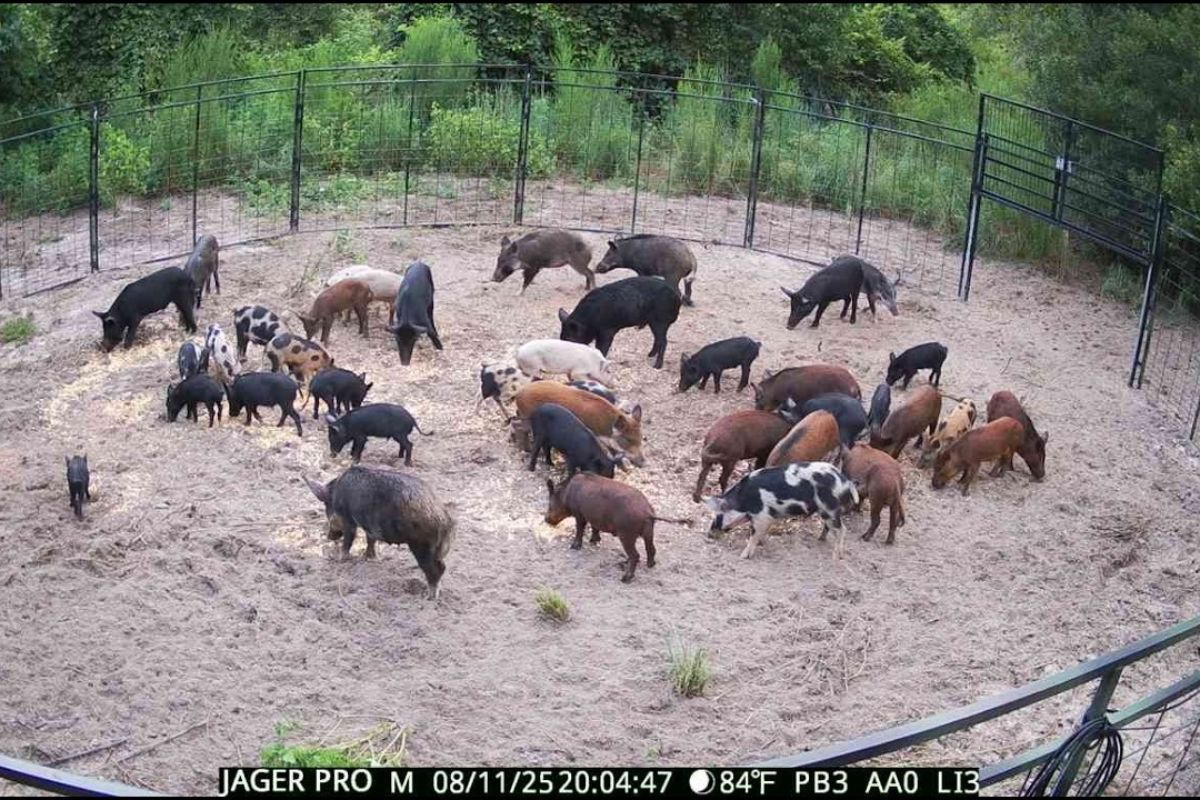


In Rural Florida, A Trap Set On An Old Wildlife Feeding Plantation Captured Wild Boars In Rare Numbers: Two Groups, Estimated At 24 And 14, Ended Up Caught And The Final Count Reached 41. Rain, Heat, And Legal Transport Exposed The Size Of The Problem For Farms And Ecosystems
A recent record involving wild boars caught attention due to an unusual detail: the capture of an entire group at once, without monitoring cameras on site and with the count varying with each check, until the final estimate of 41 animals. The operation took place in a rural area of Florida that had been used as a plantation for wildlife feeding but was completely destroyed by the constant presence of the pigs.
The action was led by an operator who had already been reporting resource saturation, with 22 cameras already installed in other fronts and several traps in use. The decision to set up a large structure, with 13 panels and two doors, sought to solve an immediate problem: the arrival of large groups capable of consuming up to 100 pounds of corn in a single day.
The Starting Point Was A Devastated Area And Tracks Of A Large Group

The chosen location was not random.
-
Spain surprises the world by erecting 62 artificial dunes, mixing sand with natural remains of posidonia, and causing the structure to lose only 1.4% of its volume in 1 year.

-
With 16 Bulava missiles, improvements in acoustic stealth, and a design focused on silent patrols, Russia’s nuclear submarine was born to ensure Moscow’s invisible retaliation and has become one of the pillars of its maritime strength.

-
‘Populous’ city in Rio among the worst in Brazil in national ranking and exposes silent development crisis.
-
Couple buys house in the South Zone of São Paulo, opens a hidden door in the garage, and finds a secret wine cellar with dozens of old wines forgotten since the 1970s.

The area was described as an old planting space for wildlife, with a visual reference of a tree about 120 yards away, used to gauge the size of the stretch.
The diagnosis there was straightforward: there was not a single piece of plantation left, a type of impact that, in practice, signals recurring presence and excavation and soil disruption behavior.
This scenario reinforced the perception that the wild boars were not just “passing through.”
The operational reading was one of permanence and volume, with reports of animals already circulating the installation during the setup and the mention of an individual around 27 kilograms lingering near the trap, sensing human smell and retreating, but with the expectation of returning.
The Trap Was Set Up To Capture The Most Without Forcing Immediate Entry

The structure was described as large precisely because of the expected size of the group: 13 panels, two doors, locking pins, a safety pin, and the installation of electronic components to complete the triggering.
The goal was not to “shock them into the trap,” but rather condition the approach, with a deliberate strategy of baiting from the outside first.
The logic was clarified: not to force animals to enter uncomfortably, allowing them to feed around, see the structure and only then enter.
The main bait was corn, with indications that consumption was so rapid that after placing around 100 pounds, by the next day there was nothing left, suggesting high density and frequent returns of the wild boars to the same spot.
The Count Turned Into A Suspense And Ended In A Record, Although With Variation
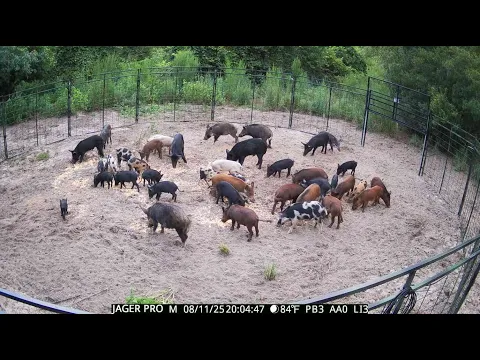

The critical moment came when the groups began to accumulate.
There were two groups mentioned, one of 24 and another of 14, totaling 38 known animals in the vicinity.
The count, however, was treated as difficult because the wild boars moved simultaneously, overlapped, and “changed” within the cluster, which made the operator avoid a hasty closure to not lose part of the group.
After the triggering, the capture was described as the largest he had ever recorded.
The final count fluctuated between 39, 40 and 41, with the most repeated estimate pointing to 41 wild boars caught at once, surpassing the previous record.
The key data here is the size of the event, regardless of one more or one less animal: it is an operation designed to deal with an unusual mass in a single point.
Rain, Heat, And Livestock Transport Show Why This Type Of Removal Becomes A Risky Operation
The removal occurred under challenging conditions.
There was intermittent rain, described as useful for cooling the animals, and the operation was done later than the standard adopted by the team, with the caveat that removal at the end of the day, especially in large numbers, is not the preferred practice.
The reason was logistical: there were so many simultaneous tasks that this was the first possible time.
The heat appeared as a decisive technical factor because it was noted that wild boars do not have sweat glands, overheat easily, and tend to seek mud and water out of physiological necessity.
In addition, there is the regulatory component: the transport of live wild boars was presented as something that requires specific permission, and movement without authorization was classified as illegal.
The urgency, therefore, was not only operational but also for welfare and compliance.
The Fate Of The Animals And The Reading Of “Infestation” Behind The Number
With the mass capture, the fate was divided.
Ten of the smaller ones were set aside for a buyer identified as Jimmy, while the rest were sent to Brawler Creek Ranch in Elkton, Florida, described as a completely fenced area with about 190 acres, aimed at pigs and alligators.
The relocation required prior planning precisely because of the volume, and execution continued the next morning, after a break for exhaustion.
The most relevant point to understand why extreme actions are necessary is not in the “act,” but in the implicit diagnosis: when an entire wildlife planting area is “mutilated” and a single point attracts dozens of wild boars, the problem ceases to be episodic and becomes structural.
The record capture becomes a symptom, not a definitive solution, and indicates continued pressure on productive lands and nearby natural areas.
In your context, what do you consider a definitive sign that wild boars have gone beyond the limit in your area: tracks on the ground, damage to planting, risk to domestic animals, or the mere frequency of sightings? And, if you could choose a rule, should the transport of wild boars be more restricted or more strictly controlled with permission, as described here?








Just another damned excuse to kill animals that have been out there for how long?
Suppose your family sets out on a camping trip to one of these areas. Will they be eaten?
There’s a reason why we have hunting season for certain animals. 🤷♀️
Lmao I think they should bring em to yall house lmao 🤣
I heard a biologist say if you are not killing/removing 80% of the wild hogs on your property every year you are not going to keep their numbers in check. That’s how fast they populate & take over an area.
Oh like Humans LMFAO !