





 Portuguese
  English
  Spanish
  4 min of reading
  1 comment


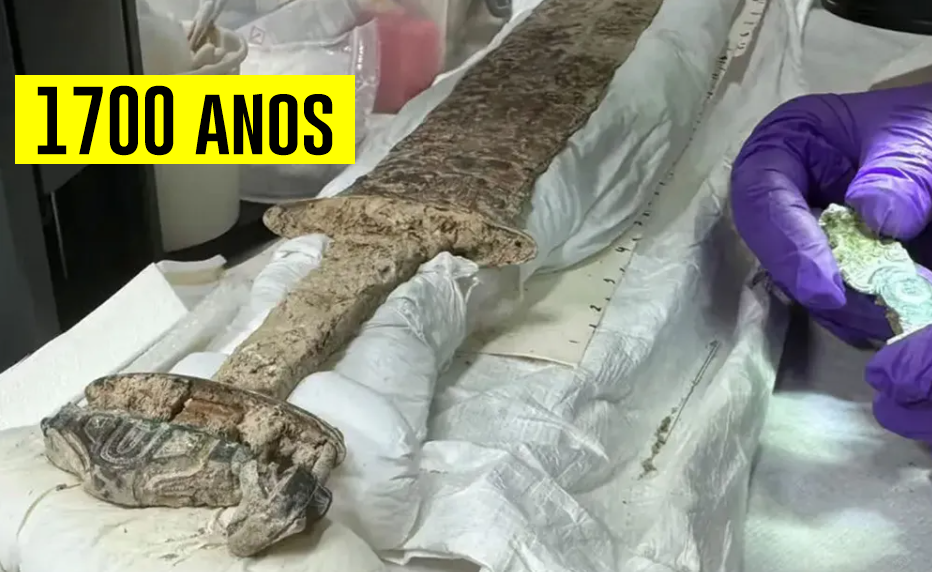


An Amazing Medieval Sword, Engraved with Enigmatic Runes, Was Found in a Cemetery. The Discovery Promises to Reveal Fascinating Secrets About the Past.
Archaeologists made an impressive discovery in the southeast of England. They unearthed an ancient cemetery dated to the 5th and 6th centuries AD (401 to 600 AD), containing about 12 identified graves, but promising to reveal up to 200 burials throughout the excavations. The most striking find was an intricately decorated medieval sword, buried alongside a man.
The sword was surprisingly well-preserved. Its grip, made of silver and gold, displayed elaborate patterns, while a ring was fused to the pommel.
The long, narrow blade bore runic inscriptions that will intrigue researchers for some time. In addition, fragments of the sword’s scabbard—made of wood, leather, and lined with beaver fur—were also found.
-
He started running at 66 years old, broke records at 82, and is now a subject of study for having a metabolic age comparable to that of a 20-year-old, in a case that is intriguing scientists and inspiring the world.

-
Oldest tree on the planet reappears after 130 years of searches: Wattieza, 385 million years old, was 10 meters tall and had no leaves or seeds; Gilboa fossils in New York solved the mystery in 2007.

-
A 48-square-meter house assembled in hours with 4,000 bricks made of recycled plastic that does not absorb moisture, has natural thermal insulation, and costs less than 90,000 reais in a complete kit.

-
Luciano Hang revealed that Havan’s air fleet has already accumulated more than 20,000 landings, 10,000 flight hours, and 6 million kilometers traveled, and he says that without the planes, the company would never have grown so quickly.


Duncan Sayer, chief archaeologist at the University of Central Lancashire, was impressed by the state of the weapon and its position in the grave. “It appears that the man was embracing the sword. It is positioned so that the grip and guard align with his face and shoulders,” he explained.

Symbol of Power and Status
Swords like this were not common objects. They were symbols of power, often gifts from kings or important nobles, according to Sayer.
The weapon may have been used for generations before being buried with its last owner, a likely prominent warrior.
In addition to the sword, the grave also contained a gold pendant with a figure of a dragon or serpent, which researchers believe may have belonged to a woman in the family of the buried man.

by Dana Goodburn-Brown
Differentiated Finds in the Graves
Other burials in the cemetery highlighted gender and social status differences in the funerary goods. Male graves contained larger weapons, such as spears and shields, while those of women were marked by more delicate objects, such as brooches, buckles, and smaller knives.
Dana Goodburn-Brown, the conservator responsible for preserving the sword, is conducting detailed analyses in the lab. “The body may not have been covered immediately, indicating that relatives had time to perform rituals and farewells,” she reported.
Runes and Mysteries
The runic inscriptions on the sword are another point of fascination. Although they have yet to be fully analyzed, Sayer emphasizes that these inscriptions usually do not convey messages we can understand today but certainly had profound meanings for those who lived at the time.
“They carried stories, represented something personal, and sometimes even an identity for the weapon itself,” he said.
The ring attached to the sword’s grip is another peculiar detail. Some scholars suggest that this type of accessory indicates that the sword was a gift from a king or high-ranking leader, reinforcing its symbolic and material value.

Reflection of a Transitioning Political Scenario
The cemetery revealed not only local weapons and jewelry but also foreign objects, such as Scandinavian and Frankish funerary goods.
These items indicate an England in transformation, marked by diverse political and cultural contacts during the 5th and 6th centuries.
“This is an extraordinary Anglo-Saxon cemetery. The artifacts are impressive, especially this sword, which is incredibly preserved and unique,” commented Alice Roberts, an anthropologist and presenter of the BBC Two program Digging for Britain, which will showcase the discovery.
Next Steps
After the excavation and conservation process is completed, the items will be displayed at the Folkestone Museum in Kent. The cemetery is located near Canterbury, but the exact location is kept secret to prevent looting.
Meanwhile, analyses continue, with archaeologists eager to uncover more secrets of this intriguing sword and the cemetery that holds it.
The burials and funerary goods found there offer valuable clues about the cultural and political practices of a medieval England in formation.









Fascinante! O passado falando para o presente.