





 Portuguese
  English
  Spanish
  3 min of reading
  0 comments


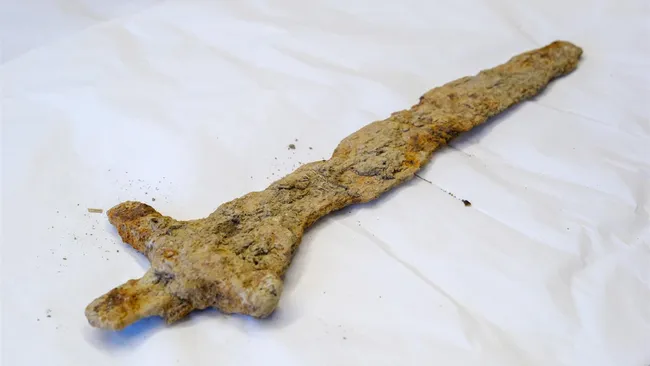
A Very Rare Viking Sword, Possibly of Frankish Origin, Discovered on Norwegian Farm. Learn the Details of This Relic with Mysterious Inscriptions That Intrigue Experts!
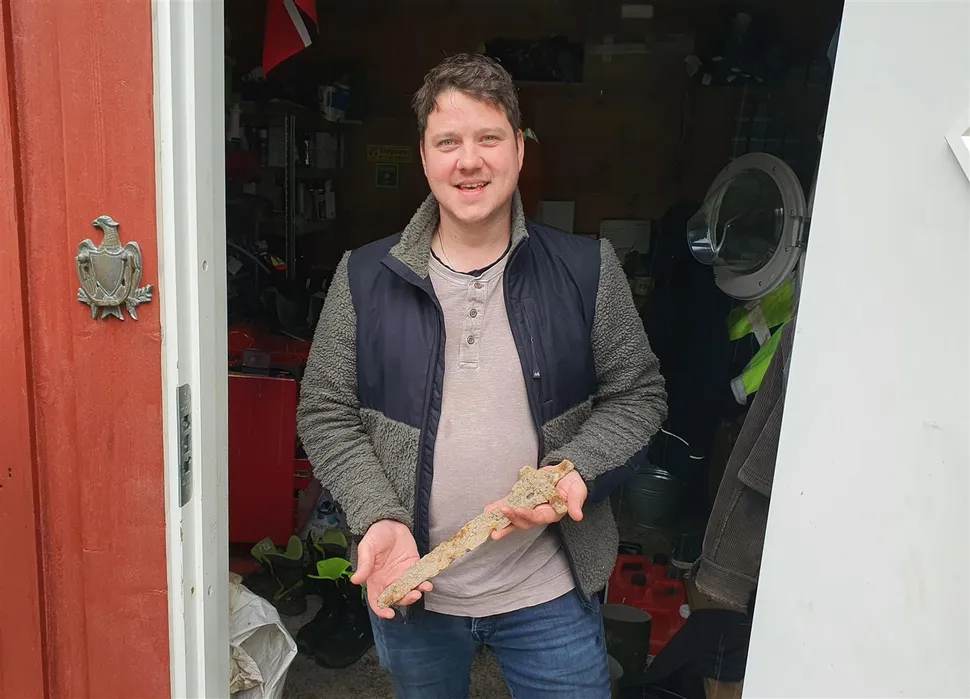
A rare Viking sword, with a possible Ulfberht inscription, was found on a farm in Norway, shedding light on local history. The weapon, approximately a thousand years old, was discovered on a family farm by Øyvind Tveitane Lovra, an engineer and local politician, while preparing a field for planting grass.
Lovra recounts that he found a piece of ancient iron and almost discarded it, thinking it was just a remnant of metal trash. However, a closer inspection revealed that it was an ancient sword, which led him to contact local archaeologists, as required by Norwegian law for historical artifacts.
Status Symbol and Historical Rarity
Experts confirmed that the sword belongs to the Viking Age, a period that spans from 793 to 1066 AD. According to Lars Søgaard Sørensen, an archaeologist from Rogaland, the sword appears to be of a rare type originating from the Frankish Empire, known as Ulfberht, characterized by a distinct inscription on the blade. This type of sword was a status symbol among the Vikings, something rare and intended for high-ranking warriors.
-
Friends have been building a small “town” for 30 years to grow old together, with compact houses, a common area, nature surrounding it, and a collective life project designed for friendship, coexistence, and simplicity.

-
This small town in Germany created its own currency 24 years ago, today it circulates millions per year, is accepted in over 300 stores, and the German government allowed all of this to happen under one condition.

-
Curitiba is shrinking and is expected to lose 97,000 residents by 2050, while inland cities in Paraná such as Sarandi, Araucária, and Toledo are experiencing accelerated growth that is changing the entire state’s map.

-
Tourists were poisoned on Everest in a million-dollar fraud scheme involving helicopters that diverted over $19 million and shocked international authorities.

“The sword was the greatest status symbol in the Viking Age, and it was a privilege to own a piece like this,” Sørensen stated.
The found artifact measures about 37 centimeters in length and includes the hilt, the cross guard, and part of the blade, with approximately half of the blade’s length missing. For Rogaland, this preservation is surprising, as the soil in the region tends to have unfavorable conditions for the preservation of iron. It is believed that the sword was preserved due to the dense clay of the soil, which protected it from oxidation.
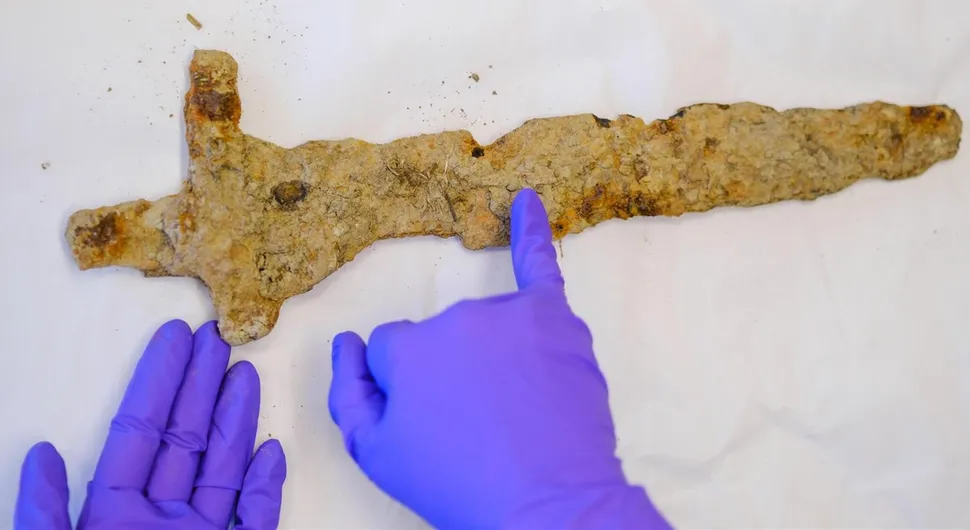
Archaeologists conducted an X-ray examination to identify more details of the sword and confirmed the presence of an inscription on the blade. Sigmund Oehrl, a professor of archaeology, highlights that this is an indication that the sword could be a Ulfberht, famous for its quality and advanced manufacturing for the time.
“These are high-quality swords produced in the Frankish Empire, marked with the maker’s name,” Oehrl explained. It is rare to find a Ulfberht in Rogaland, with only about 170 swords with this type of inscription across Europe, of which only 45 have been found in Norway.
Historical Context and Local Legend
The dating of the sword suggests that it was made between 900 and 1050, coinciding with the end of the Viking Age. Lovra believes that the piece may have arrived at the farm as a gift from the Vikings, which is supported by local tales of Vikings gifting artifacts to residents, including decorative pieces and jewelry from other regions like Ireland.
Lovra shares that the farm, named Lovra, has a rich folkloric tradition of significant events and says it is fascinating to discover a concrete connection to the ancient Vikings.









Seja o primeiro a reagir!