





 Portuguese
  English
  Spanish
  8 min of reading
  0 comments


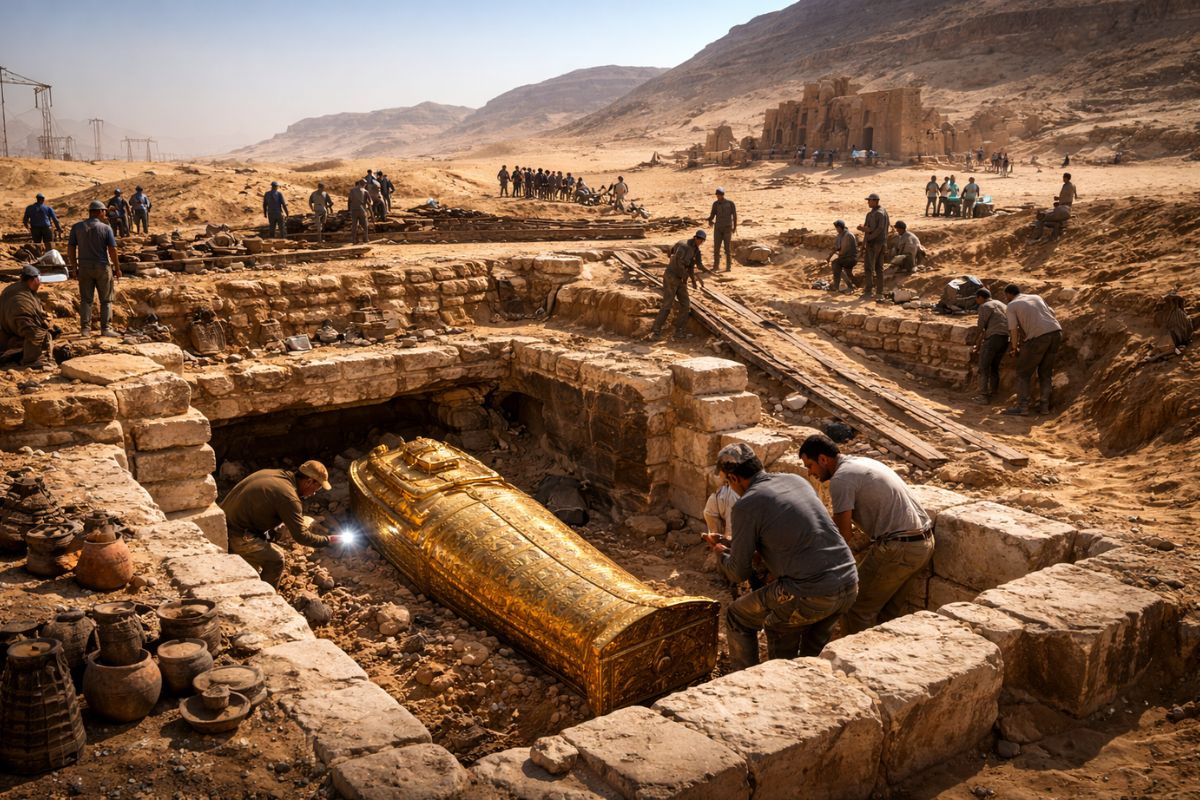
The Discovery of the Tomb of an Unnamed Pharaoh Near Abydos, at Seven Meters Deep, Exposes a Fragmented Chapter of the Second Intermediate Period, When Rival Kingdoms Fought for Control of Egypt and Left Empty Tombs, Destroyed Names, and Open Questions About the Ancient Dynasty of Abydos.*
The pharaoh found near Abydos remains unnamed, but his tomb has already changed the historical weight of the area. Dating back to around 3,600 years, the tomb was discovered in an ancient necropolis of the Mount Anubis, buried seven meters deep, and was revealed through excavations conducted by Egyptian archaeologists and the Museum of the University of Pennsylvania.
The discovery draws attention not only for its age, but for the historic moment it illuminates. The tomb relates to the Second Intermediate Period, a phase in which Egypt was fragmented, with rival kingdoms competing for space and authority. This is precisely the confusing scenario in which an unidentified king reappears, even after his name was practically erased from history.
Abydos Returns to the Center of an Incomplete Story

Abydos was already a central city of ancient Egypt, and the new discovery reinforces this role. The tomb was found near this important area of Upper Egypt, about 10 kilometers from the Nile River, within a burial zone associated with Mount Anubis.
-
A forgotten cord on the floor of a basement in Vienna leads a plumber to a box containing 30 kilograms of gold with Mozart’s face, hidden before World War II. The treasure, worth 2.3 million euros, was just centimeters away from a worker who ignored the sign a day earlier.
-
A couple buys an old chalet, breaks the kitchen floor for renovation, and finds over a thousand coins of gold and silver hidden since the English Civil War over 4 centuries ago.

-
Rigid bags with their days numbered: new trend prioritizes comfort in 2026.

-
YouTuber creates an excavator equipped with a giant 4.5-meter sword to challenge his brother to a rematch, and the invention quickly goes viral on social media.


This is not an isolated burial in a peripheral point, but a find embedded in a sacred and politically significant landscape.
The discovered structure is a large limestone burial chamber, with a decorated entrance and rooms covered by five-meter-high vaulted ceilings made of mud bricks. Even empty, the preserved architecture suggests royal ambition.
The absence of the body and objects does not diminish the weight of the discovery, as the size, position, and finishing of the construction clearly indicate an elite burial, linked to royalty.
The current state of the tomb also speaks volumes about the site’s past. When archaeologists arrived, the chamber was already empty, apparently looted long ago by tomb robbers. This helps explain why the ruler’s name was lost.
Hieroglyphic texts existed at the entrance, on plastered bricks, but did not withstand ancient depredations.
Nonetheless, some elements survived enough to keep the case open. Next to the erased inscriptions, there were painted scenes of the sister goddesses Isis and Nephtys, figures directly associated with the Egyptian funerary universe.
Even with the name destroyed, the tomb preserved enough signs to prove that a pharaoh was buried there, not just a high-ranking occupant.
The Name Disappeared, But the Candidates Remain on the Table

The great frustration of the find is also what makes it fascinating. The pharaoh was found, but his identity remains unknown. According to Josef Wegner, a professor of Egyptian archaeology at the University of Pennsylvania and one of the leaders of the excavation, the name was originally on the inscriptions but was lost to the actions of ancient looters.
Among the possible candidates are kings like Senaiib and Paentjeni, known for monuments in Abydos and associated with this same period, but whose tombs had not yet been located. The hypothesis is plausible because both ruled during the time to which the tomb belongs.
The problem is that, without the preserved inscription, archaeology must work with cross-contextual clues of context, architecture, and chronology, not with a definitive identification.
This absence of a name turns the discovery into a sort of political puzzle. Egypt during that period was not a stable block controlled by a single uncontested authority.
There was fragmentation, regional disputes, and a succession of lesser-known kings compared to the great names of the New Kingdom or the Old Kingdom. A nameless tomb, in this context, is not an absurd exception. It is almost a portrait of the very time.
The loss of identity also enhances the value of the site for future research. When a royal tomb appears without the name of the occupant, every detail of the construction gains more weight.
The shape of the entrance, the type of vault, the position within the cemetery, and the relationships with other tombs cease to be supporting elements and become central clues.
The Period When Egypt Was Divided Helps Explain the Discovery

The tomb dates back to the Second Intermediate Period, between 1640 B.C. and 1540 B.C., a phase that linked the Middle Kingdom to the New Kingdom. It was a politically unstable era, marked by territorial fragmentation and a struggle among different regional powers.
Instead of a unified Egypt under one strong center, the picture was of several kingdoms competing against each other.
Wegner described this phase as a sort of period of “warring states”, which later would give rise to Egypt’s New Kingdom. Among these centers was the Dynasty of Abydos, a group of kings who ruled parts of Upper Egypt.
At the same time, the Nile Delta was controlled by the Hyksos, while other rival centers also fought for power.
The newly discovered tomb did not emerge in a phase of monumental stability, but in a broken Egypt.
This is precisely why the find has a broader significance than the discovery of an ancient burial chamber. It helps fill in a piece of a timeline that is still poorly understood.
The fragmentation of the period complicates complete lists of kings, secure successions, and monument attributions. Every new tomb can reorganize the understanding of who ruled, when they ruled, and how these kingdoms interacted.
The discovery also reinforces that the Second Intermediate Period should not be seen merely as an obscure interval between more famous phases.
It was a decisive moment of social, political, and technological change, and understanding its fragmentation helps comprehend how Egypt reunified later under much more powerful rulers.
The Architecture Suggests an Important King Within the Dynasty of Abydos
One of the most relevant aspects of the find is its position within a larger funerary complex associated with the powerful Neferhotep I, a pharaoh from an earlier period.
The new tomb was constructed in this broader environment, indicating not only spatial continuity but also an attempt to symbolically link to an already established royal tradition.
According to Wegner, the architecture of the tomb shows connections with royal burials from the Middle Kingdom as well as later Intermediate Period constructions.
This gives the monument a dual value: it belongs to the political chaos of its time but preserves formal traits that dialogue with earlier royal traditions.
This is not an improvised work of a lesser kingdom without a repertoire; it is a construction that seeks legitimacy in a well-known architectural language of Egyptian royalty.
The archaeologist also stated that the tomb appears to be the largest and oldest of the group linked to the Dynasty of Abydos.
This observation is decisive because it suggests that the occupant may have been a significant ruler within this regional lineage, perhaps even predating names that are already well documented. If confirmed, the find could alter the order in which these kings are positioned by scholars.
This possibility gains weight when remembering that Wegner’s team had previously discovered in 2014 the tomb of Seneb-Kay, another ruler of the Dynasty of Abydos. Now, the new king seems to be likely a predecessor of this pharaoh.
Instead of an isolated discovery, what is emerging is the expansion of a royal funerary map that is still far from complete.
2025 Already Adds Another Royal Discovery and Reignites the Egypt of Kings
The new find was the second discovery announced in 2025 of a tomb of an ancient Egyptian king. On February 18, the Egyptian Ministry of Tourism and Antiquities announced that an Egyptian-British archaeological team identified an ancient tomb from the 15th century B.C. near Luxor as belonging to the pharaoh Tuthmosis II of the New Kingdom.
The comparison between the two announcements helps gauge the difference between very distinct periods in Egyptian history. Tuthmosis II belongs to a phase of greater centralization and political projection, when pharaohs of the New Kingdom were among the most powerful figures in the region.
On the other hand, the new pharaoh of Abydos emerges from a fragmented phase, less understood and much more difficult to reconstruct. A known name was confirmed in Luxor; a lost name resurfaces now in Abydos.
This difference makes the recent discovery gain particular interest. While a confirmed identification reinforces what is already known, a nameless tomb broadens the investigative field.
It forces researchers to rethink uncertain chronologies, regional dynasties, and architectural patterns that may still hide other kings.
Wegner was clear in stating that work in royal cemeteries is slow and meticulous. This explains why results do not appear quickly, even when the historical potential of the area is enormous.
Excavations continue, and the team itself admits that there may be other tombs in the same region, near the burial of Neferhotep I.
The Emptiness of the Tomb Does Not Diminish the Strength of the Find
It is tempting to imagine that an empty tomb is worth less than an intact burial, but this reasoning oversimplifies archaeology. In the case of Abydos, the absence of the body and objects does not erase the relevance of the whole.
The depth of the structure, its scale, the decoration of the entrance, and the dynastic context make the site a historically significant piece.
Moreover, the fact that tomb robbers erased the pharaoh‘s name makes the discovery even more expressive in another sense.
The old looting itself becomes part of the monument’s narrative. It shows that this tomb was already a valuable target in remote times and that its memory was attacked long before modern archaeology attempted to recover it.
The current silence of the chamber is, paradoxically, part of the information it conveys.
There is also an inevitable historical contrast. Almost a millennium before this period, the pyramids of Giza had already been erected in the vicinity of Cairo to receive pharaohs from the Old Kingdom.
Centuries later, many rulers of the New Kingdom would be buried in the Valley of the Kings, near Luxor, including Tutankhamun.
The tomb of Abydos belongs to a less monumental interval in popular imagination but is no less important for understanding the evolution of royal power in Egypt.
When an unknown pharaoh emerges in a time of political fragmentation, the discovery helps to remind us that Egyptian history was not made solely by famous names and eras of unification.
It was also shaped by periods of transition, regional competition, and uncertain royalty, just as this tomb now suggests again.
The tomb found near Abydos has not yet returned the name of the pharaoh, but it has already restored historical density to one of the most challenging periods to reconstruct in ancient Egypt.
The depth of the chamber, the decoration linked to Isis and Nephtys, the position alongside the complex of Neferhotep I, and the potential link to the Dynasty of Abydos transform the find into much more than an archaeological curiosity of 2025.
In the end, perhaps the strongest point is precisely the absence. A nameless king, in a looted tomb, in a divided Egypt forces researchers to reopen questions about power, succession, and royal memory.
If you had to bet, what weighs more in this case: the chance that this pharaoh is a name already known like Senaiib or Paentjeni, or the possibility that Abydos still hides an entire lineage of kings nearly erased from history?








-

-

-

-

8 pessoas reagiram a isso.