





 Portuguese
  English
  Spanish
  4 min of reading
  0 comments


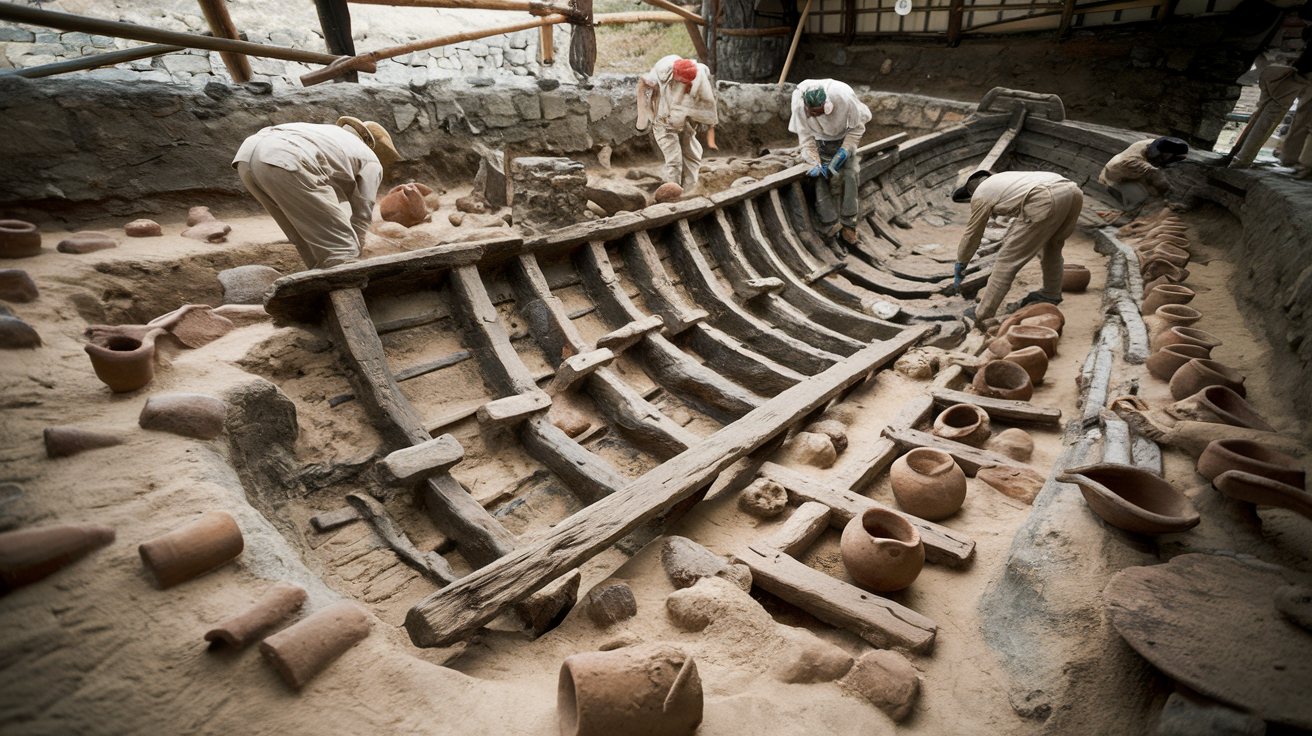
Archaeological Discovery of the Kyrenia Shipwreck Reveals New Secrets About the 2,000-Year-Old Ancient Ship — Scientific Update May Rewrite Ancient Greek Maritime Trade History.
An archaeological discovery that was already considered historic has just gained new contours. It is the famous 2,000-year-old vessel found near the coast of Cyprus, known as the Kyrenia shipwreck, a 4th-century B.C. ship filled with surprisingly well-preserved artifacts. What once seemed to be just a time capsule of ancient Greek trade is now the focus of a scientific update that could rewrite part of the maritime history of Antiquity.
The latest study, published in the prestigious scientific journal PLOS ONE, used modern methods to re-evaluate the age of the ship. The results indicate that the original date of the vessel’s last voyage may have been wrong by decades, raising new questions about trade, navigation, and even the accuracy of archaeological techniques used in the last century.
2,000-Year-Old Vessel Accidentally Found by Diver Became Symbol of Naval Archaeology
The story of this discovery begins in 1965, when diver Andreas Cariolu, during an expedition to collect sponges, stumbled upon wreckage on the seafloor. He could never have imagined that he was facing one of the most important finds in 20th-century nautical archaeology: a 2,000-year-old vessel found virtually intact, loaded with dozens of valuable objects from the Hellenistic era.
-
Friends have been building a small “town” for 30 years to grow old together, with compact houses, a common area, nature surrounding it, and a collective life project designed for friendship, coexistence, and simplicity.

-
This small town in Germany created its own currency 24 years ago, today it circulates millions per year, is accepted in over 300 stores, and the German government allowed all of this to happen under one condition.

-
Curitiba is shrinking and is expected to lose 97,000 residents by 2050, while inland cities in Paraná such as Sarandi, Araucária, and Toledo are experiencing accelerated growth that is changing the entire state’s map.

-
Tourists were poisoned on Everest in a million-dollar fraud scheme involving helicopters that diverted over $19 million and shocked international authorities.


The 4th-century ship was about 14 meters long and had a robust structure, with a square mast, likely operated by a crew of four sailors. Inside, archaeologists found more than 100 amphorae containing wine, olive oil, and almonds, as well as coins and ceramic utensils — a true treasure preserved underwater for over two millennia.

Underwater excavations conducted between 1968 and 1969 recovered a total of 391 amphorae, along with other objects that helped specialists to situate the shipwreck around 300 B.C. This chronological reference, until now accepted, began to be contested based on new scientific evidence.
Researchers Use Radiocarbon and Dendrochronology to Redefine Date of the Kyrenia Shipwreck
The team from Cornell University in the United States was responsible for leading the new technical analysis. The group used dendrochronology — a method that studies tree growth rings — in conjunction with calibrated techniques for dating by radiocarbon to achieve more accurate results.
However, the process was not simple. Before applying the tests, scientists needed to remove polyethylene glycol (PEG), a substance used in wood conservation that could interfere with the results. After treatment, it was possible to carry out the measurements and reach a surprising conclusion: the shipwreck did not occur around 300 B.C., as previously believed, but between 286 B.C. and 272 B.C.
This re-evaluation changes not only the dating of the shipwreck but also requires a review of the archaeological techniques used for decades to interpret the maritime past of the Mediterranean region. This means that other ancient vessels already studied may have inaccurate dates, influencing historical and chronological analyses of significant events.
Treasure Found on 4th-Century Ship Helps Understand Trade Routes and Ancient Greek Culture
The contents of the treasure recovered from the 4th-century ship offer valuable clues about trade in Ancient Greece. The amphorae of wine and olive oil indicate that the vessel was part of a trade route between the Aegean and the Eastern Mediterranean. The presence of almonds, fine ceramics, and coins helps identify the cultural and economic habits of its crew and the peoples they traded with.
More than just simple objects, these artifacts represent fragments of a civilization that was expanding across the sea, connecting cities, cultures, and products. Now, with the new dating, researchers believe that this discovery could shed even clearer light on the true chronology of maritime trade in Antiquity.
Furthermore, the vessel may have been one of the first to operate in a post-Alexander the Great context, making its contents even more relevant for historians interested in the transition from the classical world to late Hellenism.
Review of the Radiocarbon Curve May Impact Future Archaeological Discoveries Across Europe
One of the most significant side effects of this discovery is the need for a review of the radiocarbon calibration curve used for the Northern Hemisphere, specifically for the period between 400 B.C. and 250 B.C. The curve, which serves as a basis for archaeological datings worldwide, was outdated for this time frame, which may have caused distortions in previous analyses.
According to the scientists involved, updating this tool will allow for a more refined understanding of key periods in European and Mediterranean history. This advancement is essential for researchers working with other shipwrecks, temples, tombs, and archaeological sites from the same period.
In addition, the study authors emphasize that the developed technique could be applied in other similar cases, broadening the scope of discoveries and contributing to the reconstruction of ancient maritime routes with more precision.










Seja o primeiro a reagir!