





 Portuguese
  English
  Spanish
  4 min of reading
  0 comments



Artemis II completed a seven-hour lunar flyby, captured images of the far side, reached 406,700 km from Earth, and observed the solar corona during an eclipse lasting about 53 minutes.
Artemis II experienced one of the most remarkable days in recent space exploration by completing a historic lunar flyby and capturing scenes that no crewed mission has seen since the Apollo era. The milestone included images of the far side of the Moon, a planned period without contact, and a record distance from Earth.
In addition to the technical achievement, Artemis II witnessed a rare phenomenon exclusive to the four crew members: a total solar eclipse seen from space, with no visibility from Earth. It was a perfect alignment between the spacecraft, the Moon, and the Sun, with observations that are expected to fuel scientific analyses in the coming days.
Historic lunar flyby and the human return to the Moon
Artemis II completed a seven-hour lunar flyby, marking humanity’s first return to the Moon since Apollo 17 in 1972. During the passage, the crew captured images of the far side and described terrain features such as impact craters, ancient lava flows, and structures like cracks and ridges on the surface.
-
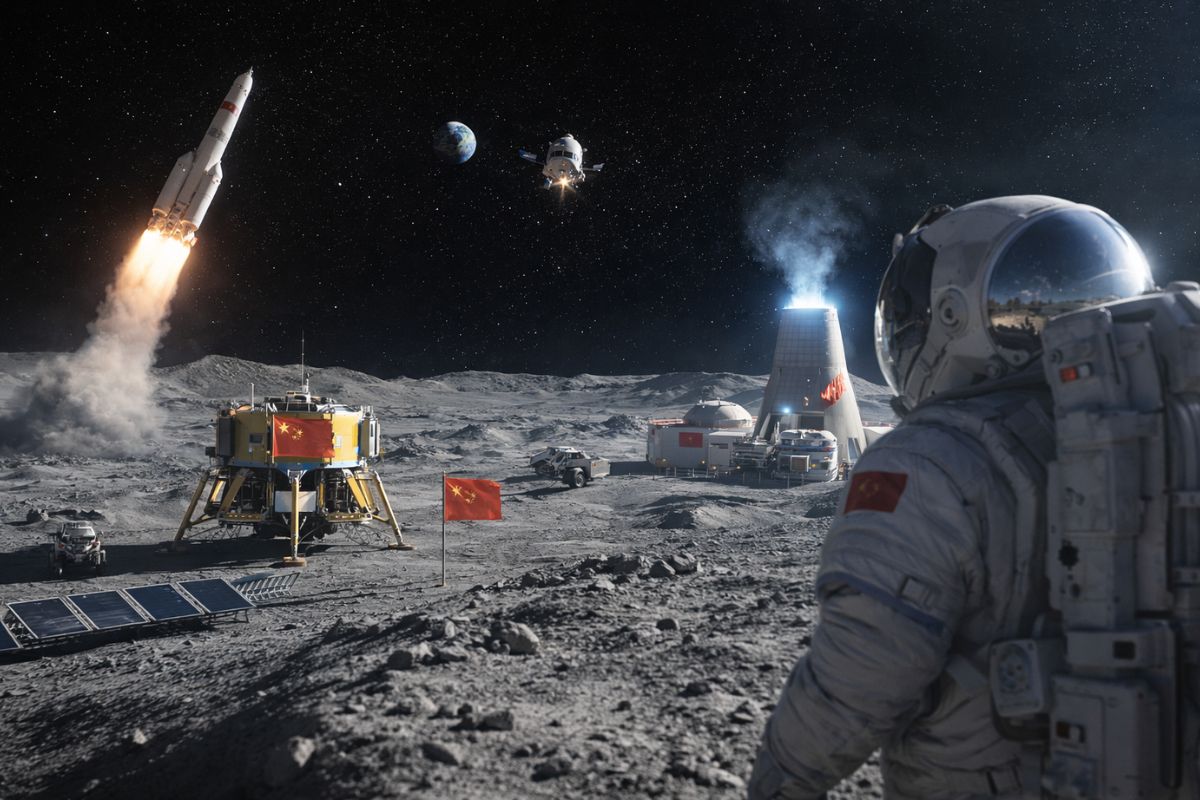
NASA admits it may lose the space race: China has a crucial advantage to reach the Moon first and build a nuclear base before the United States.
-
Ford’s CEO calls China an existential threat while Stellantis, Mercedes, and Volkswagen rush to adopt Chinese technology in their own cars, and what is happening now could determine who survives in the future of the global automotive industry.

-
While NASA resumes its path to the Moon, Elon Musk pushes SpaceX for a new leap towards Mars, millions of satellites, and a trillion-dollar scale, and Brazil emerges along the way as a billion-dollar market, regulatory pressure, and a space trump card with Alcântara.

-
Super El Niño gains strength in new forecasts and could cause droughts, floods, and extreme global heat, making 2027 the hottest year in history.

The astronauts also reported variations in color, brightness, and texture, clues that help scientists better understand the composition and history of the lunar soil. The feeling of seeing a “different” Moon appeared in the crew’s report, which highlighted the impact of observing rarely seen regions.
Distance record and the farthest point ever reached by humans
The day began with a record. At 1:56 PM Eastern Time, the four crew members of Artemis II established the greatest distance ever traveled by a human from Earth, surpassing the previous mark of Apollo 13 at 248,655 miles.
Later, during the passage behind the Moon, Orion reached the mission’s closest approach, flying about 6,545 kilometers above the lunar surface. Two minutes after that point, the spacecraft reached its maximum distance from Earth, 406,700 kilometers, setting a new record for crewed spaceflights.
40 minutes without signal and the “Earthset” behind the Moon

During a planned period of about 40 minutes without contact, when Orion passed behind the Moon, the crew witnessed two rare moments: the “Earthset,” when the planet disappeared below the lunar horizon, and the “Earthrise,” when the spacecraft reappeared from the other side.
This interval without signal is part of the script for a flyby of this type but gains symbolic weight because it is exactly when the mission enters the most isolated region of the journey, with the Moon blocking any direct communication.
Total solar eclipse seen from space and the solar corona in focus
At the end of the lunar observation period, Artemis II witnessed a total solar eclipse lasting approximately 53 minutes during the alignment between the spacecraft, the Moon, and the Sun. The phenomenon was not visible from Earth and was restricted to the four crew members.
With the Moon nearly darkened, the crew observed the solar corona, the outermost layer of the Sun’s atmosphere, which is normally not visible due to the intensity of sunlight.
This type of window is valuable because it reveals details that only appear in total eclipses, and, in this case, with a duration longer than typical observations from the planet.
Flashes on the surface and the chance to see impacts in real time
During the eclipse, the astronauts reported six flashes of light, attributed to meteoroids impacting the lunar surface at high speeds. The record drew attention for occurring under rarely favorable conditions, with part of the Moon unlit and more evident contrast.
Scientists are awaiting the complete arrival of data to analyze images, audio, and other records, identify the times and locations of the flashes, and compare them with observations from amateurs who were also monitoring the Moon simultaneously.
Live conversation and next steps of the mission
After the flyby, the crew of Artemis II participated in a live broadcast within NASA’s continuous coverage. They answered questions sent via social media and spoke with President Donald J. Trump and NASA Administrator Jared Isaacman.
The mission also plans a conversation with the lunar science team on Tuesday, April 7, with a live broadcast, to detail the observations made during the close passage to the Moon and during the eclipse.
Do you think the most impressive moment of Artemis II was the distance record from Earth, the capture of the far side, or the solar eclipse that no one on the planet could see?







Seja o primeiro a reagir!