





 Portuguese
  English
  Spanish
  3 min of reading
  0 comments


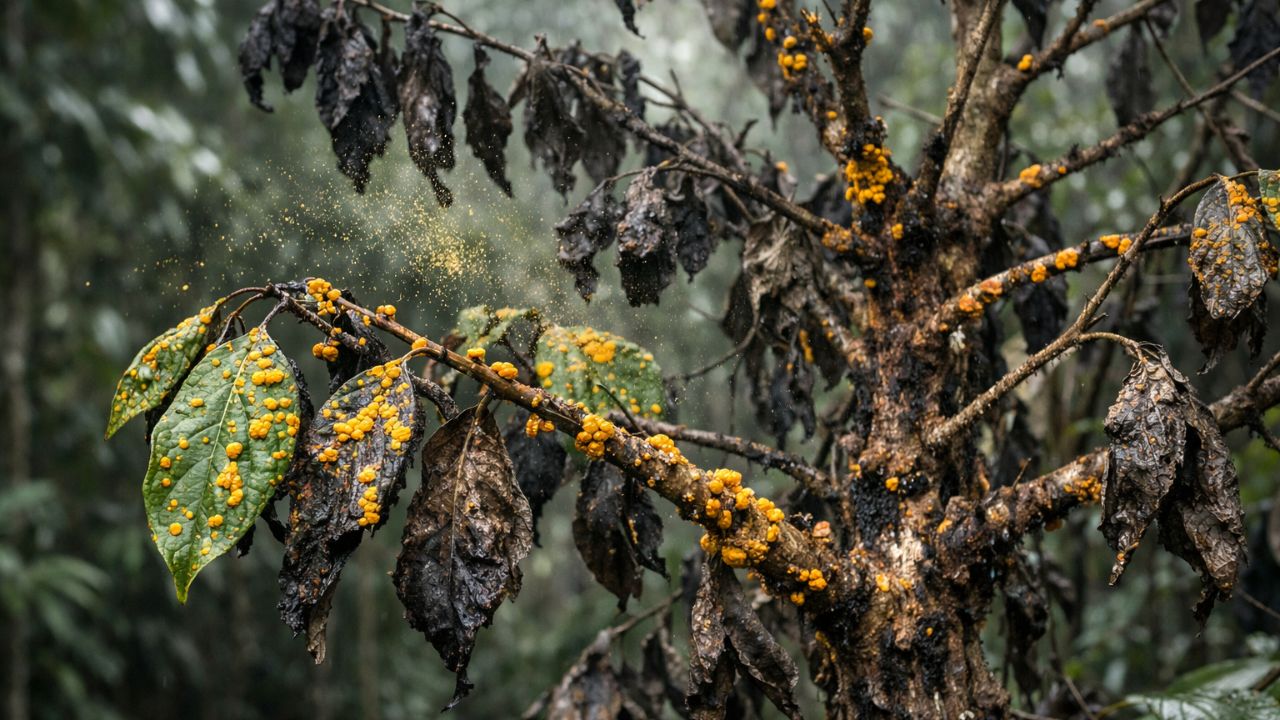
Scientists Try to Save a Rare Tree Nicknamed “Zombie” in Australia, Threatened by a Lethal Fungus That Prevents Its Growth and Reproduction.
A rare tree known as Rhodamnia zombi — nicknamed “zombie tree” by botanists — is at serious risk of disappearing soon due to a fungal disease that prevents it from growing or reproducing.
Researchers from the University of Queensland, in Australia, warn that without human intervention the species could become extinct in just one generation, and therefore rescue techniques are already underway in specialized nurseries.
What Is the “Zombie” Tree and Why Is It Threatened?
The tree Rhodamnia zombi was recently identified in tropical forests in the state of Queensland, in northeastern Australia.
-
He started running at 66 years old, broke records at 82, and is now a subject of study for having a metabolic age comparable to that of a 20-year-old, in a case that is intriguing scientists and inspiring the world.

-
Oldest tree on the planet reappears after 130 years of searches: Wattieza, 385 million years old, was 10 meters tall and had no leaves or seeds; Gilboa fossils in New York solved the mystery in 2007.

-
A 48-square-meter house assembled in hours with 4,000 bricks made of recycled plastic that does not absorb moisture, has natural thermal insulation, and costs less than 90,000 reais in a complete kit.

-
Luciano Hang revealed that Havan’s air fleet has already accumulated more than 20,000 landings, 10,000 flight hours, and 6 million kilometers traveled, and he says that without the planes, the company would never have grown so quickly.


The nickname “zombie” arose because this tree remains biologically active but has lost the ability to complete basic stages of its life cycle.
Even though it is alive, it cannot develop normally or produce flowers or seeds, which directly compromises its continuity and makes its survival increasingly improbable.
The culprit is a pathogenic fungus known as Austropuccinia psidii, commonly referred to as myrtle rust, which repeatedly attacks young shoots and incapacitates the plant from developing normally.
When this happens, the tree enters a state that scientists describe as “alive — but practically dead.”
Where Is This Tree Located?
This species grows in forests of Queensland, especially in the Burnett region, where only a few individuals still exist.
Recent data indicate that about 10% of the trees have already died due to the fungal rust since its initial identification.
Currently, none of the remaining trees in the wild are free from the disease, and none of them are managing to reproduce — a clear sign that the wild population’s continuity is compromised without urgent human actions.
How Are Scientists Trying to Save the “Zombie” Tree
Faced with the imminent risk, Australian researchers have developed a rescue plan.
The main strategy consists of collecting healthy cuttings from trees that are not yet fully affected by the fungus and cultivating them in protected environments, such as nurseries in Lismore and Townsville.
In these controlled locations, the seedlings receive constant care and protection from rust so that they can grow until they can reproduce seeds.

The hope of botanists is that by cultivating many seedlings in disease-free conditions, some of them may express genetic resistance to the fungus in the coming generations.
This type of directed natural selection could result in stronger tree individuals that could eventually be reintroduced into the forests.
Why Is This Fight Important?
Preserving the tree Rhodamnia zombi has ecological and scientific value. It is part of a broader ecosystem where native plants of the Myrtaceae family play critical roles in forest structure, providing food and shelter for various species.
Its loss would mean not only the disappearance of a unique species but also the weakening of the entire local biodiversity.
Moreover, the conservation effort may provide valuable lessons on how to deal with other plants threatened by similar fungal diseases, a problem that is becoming increasingly common as invasive fungi spread through natural areas.
The Future of the “Zombie” Tree: Is There Still Hope?
Despite the critical situation, scientists remain cautiously hopeful. The possibility of finding natural resistance to the fungus among cultivated seedlings and the ability to return resistant trees to their original habitat represent a path — still challenging, but possible — to prevent the total extinction of the species.
Without these actions, experts warn that the tree could disappear from the wild within a few decades, leaving an ecological void that would be difficult to replace.
The fight for the survival of the zombie tree demonstrates both the challenges faced in conserving threatened species and the determination of the scientific community to seek innovative solutions.
With information from Olhar Digital.








-

Uma pessoa reagiu a isso.