





 Portuguese
  English
  Spanish
  3 min of reading
  0 comments


The Advance of Renewable Energies Brought an Unexpected Challenge: The Deforestation Caused by the Installation of Large Solar Power Plants. While Some Countries Are Cutting Down Hectares of Forests to Make Room for Panels, Researchers Are Working on Solutions Capable of Balancing Electricity Production and Environmental Preservation. One of These Alternatives Gained Attention in a Recent Study Conducted in South Korea: Solar Trees.
Solar energy has the potential to meet the entire global demand for electricity. Nevertheless, this scenario is still distant. Governments are setting ambitious goals because they want to reduce dependence on coal and fossil fuels. In this context, solar panels emerge as protagonists.
But there is a problem. In several regions, the installation of large structures requires the clearing of entire areas of forest. This creates a contradictory environmental impact.
In South Korea, the numbers show the scale: 529 hectares of forest were cut down in 2016, 1,435 in 2017, and 2,443 in 2018.
-
While the world looks at oil, the war with Iran is already disrupting helium supply from Qatar, affecting car and iPhone chips, threatening AI expansion, and putting pressure on aluminum packaging at the highest value in four years.

-
Global warming will expose a treasure hidden under the ice of Antarctica and may spark an international dispute over gold and valuable minerals.

-
A street vendor from Praia Grande built a robot made of scrap from scooters and washing machines that pulls his popcorn cart on the beach, emits sounds, and interacts with customers, becoming an attraction on the coast of São Paulo.

-
The specifications of the Xiaomi 18 Pro Max have been leaked, and the highlight is a dual 200 MP camera with a new 22-nanometer technology that promises to consume less energy and capture details in shadows and bright areas using LOFIC HDR.


Not all installations cause deforestation. Some are located in deserts or areas without trees. However, when vegetation is cleared, the negative effect is severe as it eliminates carbon sinks and harms biodiversity. Moreover, it increases erosion and destroys natural habitats.
The Promise of Solar Trees
This does not mean that solar energy has ceased to be essential. On the contrary, it remains central to the energy transition. The difference now is that solutions are emerging to circumvent deforestation. One of them is the solar tree.
These structures are designed like artificial trees. The panels occupy the branches and leaves, positioned in the upper canopy. This way, they allow light to pass through to the vegetation on the ground.
Until recently, research focused only on the performance of isolated solar trees. But a recent study changed the perspective by simulating large-scale installation. The research was conducted by scientist Dan-Bi Um and published in the journal Scientific Reports.
The Study in Goseong
The simulation took place in a coastal region of Goseong County, South Korea. The researcher compared two situations: an existing installation of flat solar panels and a scenario with solar trees.
In the actual project, approximately 98% of the forest area was converted into panels. According to Um, this change altered the visual environment and caused ecological disturbances. Among the effects, he mentioned the loss of native vegetation, habitat fragmentation, and reduced biodiversity.
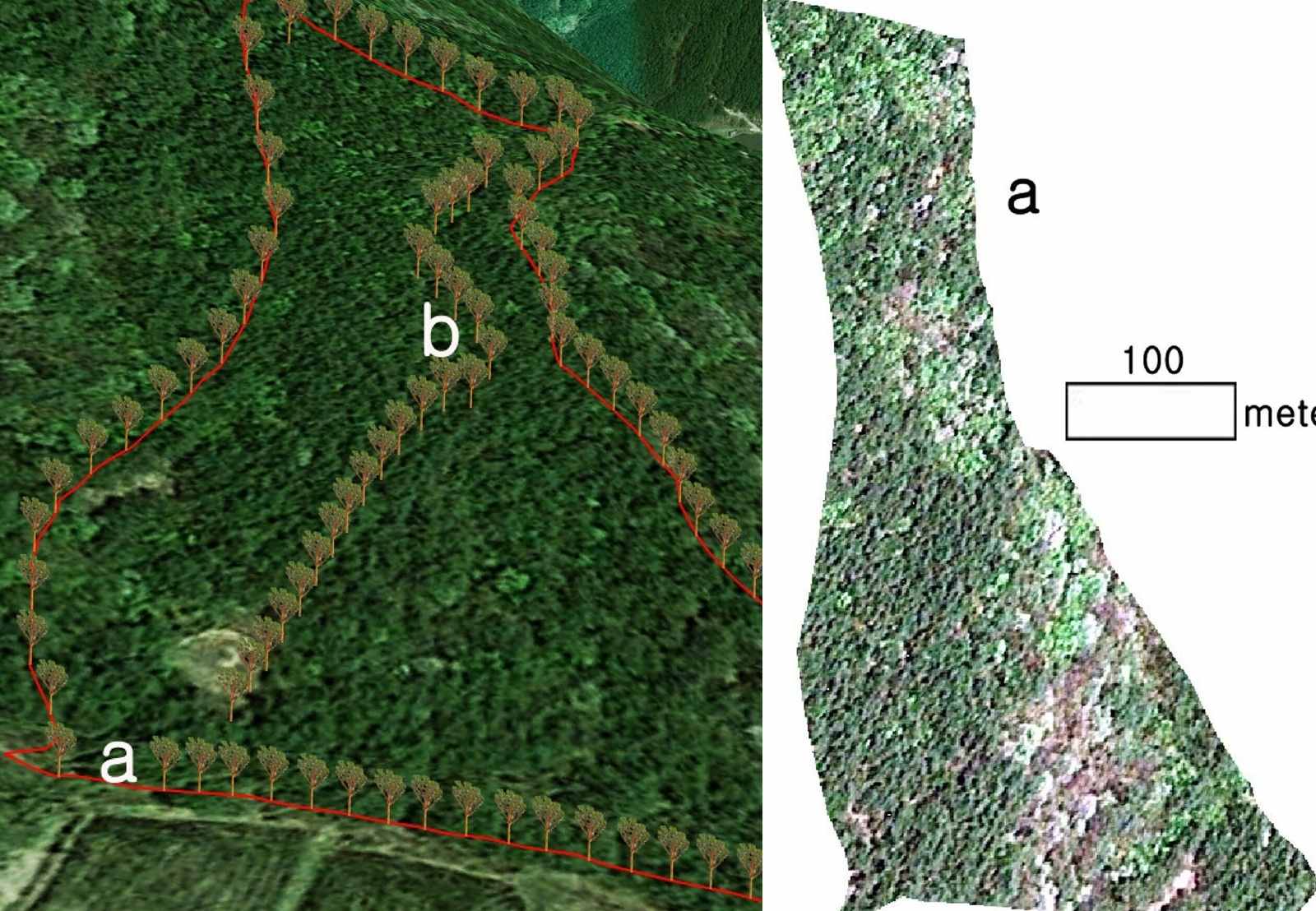
In the simulation, however, the solar trees preserved 99% of the forest. They were distributed in linear rows, spaced 20 meters apart, following trails and property lines.
Even with this preservation, they achieved the same energy capacity as the flat panel installation.
Results and Implications
The most impressive data lies in the equivalence of generation. Sixty-three solar trees, equipped with high-efficiency panels, produced the same energy as a flat panel power plant of 1 MW. Moreover, they occupied a much smaller area, reducing land costs.
This result indicates that solar trees can balance renewable energy goals with environmental preservation. Therefore, they emerge as a viable alternative in places where deforestation would be inevitable.
Next Steps
Despite the potential, the technology still needs more testing. It is necessary to evaluate performance in different types of landscapes and verify the durability of materials.
Researchers emphasize that only then will it be possible to ensure that solar trees function on a global scale.
Nevertheless, the idea already points to a clear path. The generation of renewable energy can grow without compromising valuable ecosystems. Solar trees thus represent an important step toward achieving a more sustainable energy transition.








-

Uma pessoa reagiu a isso.