





 Portuguese
  English
  Spanish
  6 min of reading
  7 comments


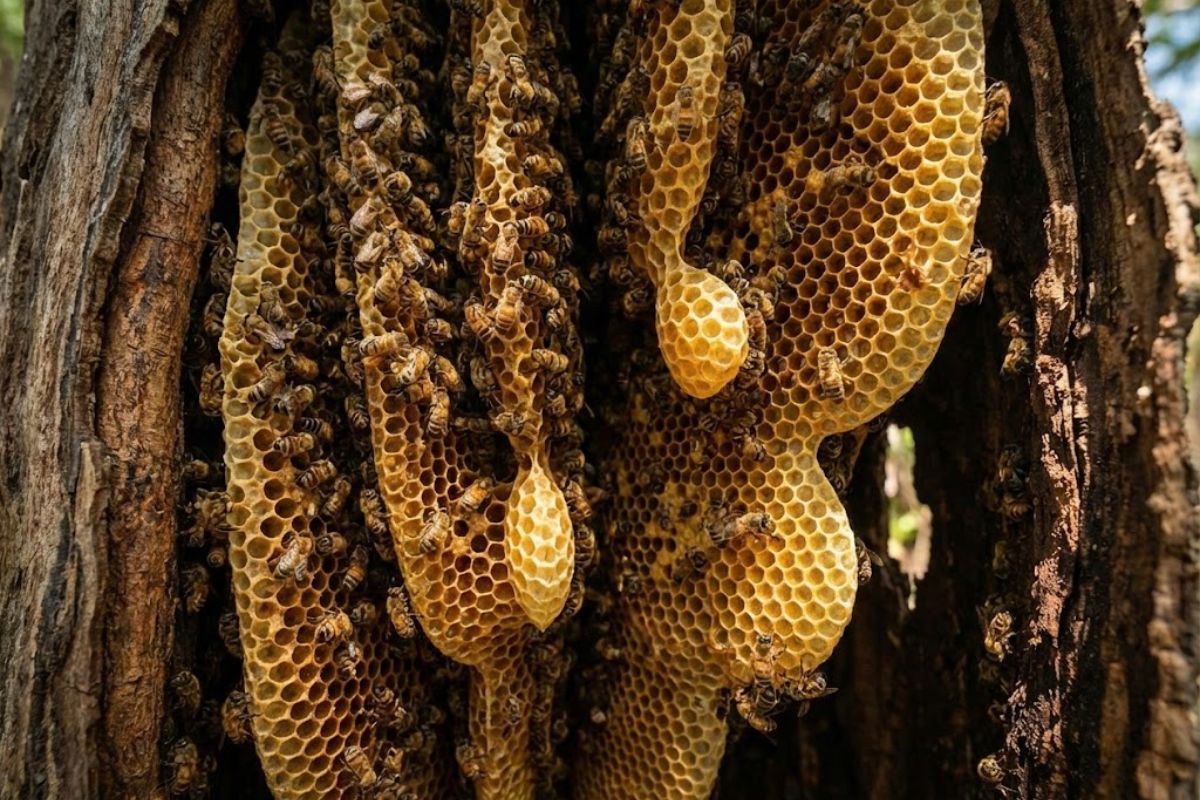


With Only 960,000 Neurons, Bees Build Each Cell with a 120° Angle and a 0.073 mm Wall, Saving Wax. Mathematics Confirmed Efficiency in 1999. In 2016, Hypotheses of Heat and Vibration Emerged. Since 2006, Colony Collapse Threatens Pollination and Food. Inspires Engineering, NASA, and Architects.
Bees seem to have “responded” in practice to a question that humans have debated since Antiquity: which shape divides a flat space best with the least material. As early as 300, Pappus of Alexandria pointed to the hexagon as the ideal candidate, but only in 1999 did Thomas Hales present the mathematical proof that closed the case.
The most disconcerting thing is that this solution does not appear as an approximate drawing: in the hives, bees repeat a pattern with extremely high precision, as a team, in the dark, without a central “design.” Studies cited in the background speak of an internal angle of 120° with a margin of error of 0.3° and walls of 0.073 mm with a variation of 0.002 mm, in addition to hypotheses of formation linked to 40°C and vibration at 280 Hz (2016). However, since 2006, colony collapse has turned into a global alarm.
What is the “Honeycomb Conjecture” and Why Has It Intrigued Humans for Centuries
The idea is simple to state and difficult to prove: if you need to divide a surface into “cells” of the same size, which shape provides the best space utilization using the least perimeter. A smaller perimeter, in the case of the honeycomb, means less wax to build walls and more efficiency for storing honey, pollen, and raising brood.
-
How to build a floating island from scratch with reeds, giant blocks, and stakes in the lake in a process that needs to be repeated almost every day.

-
A forgotten cord on the floor of a basement in Vienna leads a plumber to a box containing 30 kilograms of gold with Mozart’s face, hidden before World War II. The treasure, worth 2.3 million euros, was just centimeters away from a worker who ignored the sign a day earlier.

-
A couple buys an old chalet, breaks the kitchen floor for renovation, and finds over a thousand coins of gold and silver hidden since the English Civil War over 4 centuries ago.

-
Rigid bags with their days numbered: new trend prioritizes comfort in 2026.


For a long time, the discussion stayed in the realm of intuition and classical geometry.
The hexagon always “seemed” like the best answer among regular shapes that tile the plane without holes (triangles, squares, and hexagons). The difference is that “seeming” was not enough for mathematics: it needed proof.
This is where two layers of the story come in:
- The human layer: ancient suspicions (like the reference to the year 300) and modern proof.
- The layer of bees: nature applying the solution repeatedly, as if the problem had already been solved for “100 million years,” as the background describes.
The Proof That Came in 1999 and Confirmed What Bees Already Did
According to the background, in 1999 mathematician Thomas Hales proved that the hexagon is the most efficient shape for this type of division, consolidating what became known as the Honeycomb Conjecture.
This turns a beautiful observation into something stronger: it’s not just aesthetics; it’s optimization. The hexagonal honeycomb is not a biological “whim,” it is an arrangement that delivers maximum efficiency with minimum material, exactly as the background summarizes by listing where else this pattern appears.
The Precision That “Scares”: 120° and a 0.073 mm Wall
The background text points to measurements in thousands of cells, with very specific results:
- Internal angle of 120°, with a margin of error of just 0.3°
- Wall thickness of 0.073 mm, with a variation of 0.002 mm
- Depth following a golden ratio constantly, according to the background
These numbers are the part that generates shock: the hive is not a “draft” hexagon. It is treated as if it were a standardized structure, repeated en masse, with production consistency.
And then the inevitable question arises: if there is no “chief engineer,” how does the hive maintain this level of regularity?
How Bees Build Hexagons: Two Theories Cited by Science
The background presents two hypotheses that attempt to explain how the hexagon emerges without each bee “calculating.”
Theory 1: Heat and Wax Behavior at 40°C
The explanation is that bees secrete wax around 40°C. Under this condition, the wax would behave like a viscous fluid and, due to surface tension, would tend to organize in hexagonal patterns, similar to what happens with compressed soap bubbles.
The main point here is: physics would help “pull” the shape into the hexagon, reducing the need for conscious millimetric control.
Theory 2: Vibration at 280 Hz While Working
Another hypothesis mentioned is that, in 2016, it was observed that bees emit specific vibrations in the range of 280 Hz during work. The narrative of the background describes how this frequency “teaches” the wax to organize, almost as if the bees “sang” the structure into existence.
Even if you don’t think of it as “music,” the central idea is straightforward: vibration + material + heat can generate geometric order.
The Hexagon Isn’t Just in the Honeycombs: Nature Repeating the Same Solution
The background reinforces that the hexagonal pattern appears in places that, at first glance, have nothing to do with hives, such as:
- Basalt columns in Ireland
- A giant hexagon at Saturn’s North Pole
- Molecular structure of graphene
- Compound eyes of insects
- Snowflakes
- Vespa nests that would have evolved independently
The message is: when nature faces the same physical problem, it tends to fall to the same geometric “answer.” Maximum efficiency with minimum material becomes a recurring theme.
Swarm Intelligence: What Bees Can Do Beyond Building Honeycombs


The background text also expands the theme to cognition and behavior, pointing out capabilities attributed to bees, such as:
- Counting up to four and understanding the concept of zero
- Recognizing human faces
- Communicating the location of flowers up to 10 km away through dance
- Making complex collective decisions
- Learning addition and subtraction with sugar rewards, with an accuracy of 80% in training reported in the background (2019)
Here, the argument is that neurons do not tell the whole story. The background compares 960,000 neurons in a bee with 86 billion in humans: intelligence may be more about solving what matters for survival than about “having greater overall capacity.”
The Critical Point Since 2006: Colony Collapse Disorder
The background takes an important turn: it’s not just a mathematical curiosity. Since 2006, colonies have been disappearing in a phenomenon called Colony Collapse Disorder.
It cites strong impacts and numbers:
- 40% of commercial colonies lost annually just in the United States
- 25 species of bees at risk of extinction
- 75% of agricultural crops depend on pollination
- 1/3 of our food depends on them, according to the background
It also lists multiple possible causes: pesticides (including neonicotinoids), Varroa mites, habitat loss, and climate change.
And it highlights a specific point: modern pesticides don’t need to kill immediately but disorient bees, hindering their return home and communication.
In other words: when the background says that “chemicals are erasing their internal geometry,” it is summarizing a concrete fear in strong language.
The consequence is clear: without bees, we lose much more than honey, including foods such as almonds, apples, strawberries, pumpkins, cucumbers, coffee, and cocoa.
Why Engineering Tries to Imitate the Honeycomb: Less Material, More Strength
The background states that engineers are already trying to mimic hive patterns for:
- Lighter and stronger structures (including aircraft)
- Natural cooling systems in buildings
- Network optimization algorithms
- Autonomous robots in “swarm”
- More efficient construction materials
And it cites NASA as being interested in satellites that self-organize into hexagonal patterns in space.
What part of this story about bees impresses you the most: the mathematical proof from 1999, the precision of 120°, or the warning about colony collapse since 2006?







Somente a observância de não usar veneno durante as floradas das plantas, soja, milho, laranjas e todas as plantas que cuidamos para nossa sobrevivência já seriam de bom tamanho para ajudar as abelhas a terem um melhor desempenho na agricultura e por sinal, terem vida mais longa, evitando destruição das coméias. Simples assim.
Me impressiona o colapso nas colônias.
Apenas Física
O que impressiona é o ser humano achar que “abelhas solucionaram” algum problema humano, quando elas estão muito mais próximas do nível molecular e, justamente por isso, tendem a trabalhar mais próximas aos níveis fractais
Assim como um cristal de gelo sempre vai ter 6 lados, a distribuição espacial dos favos é hexagonal puramente por isotropia