






 Portuguese
  Spanish


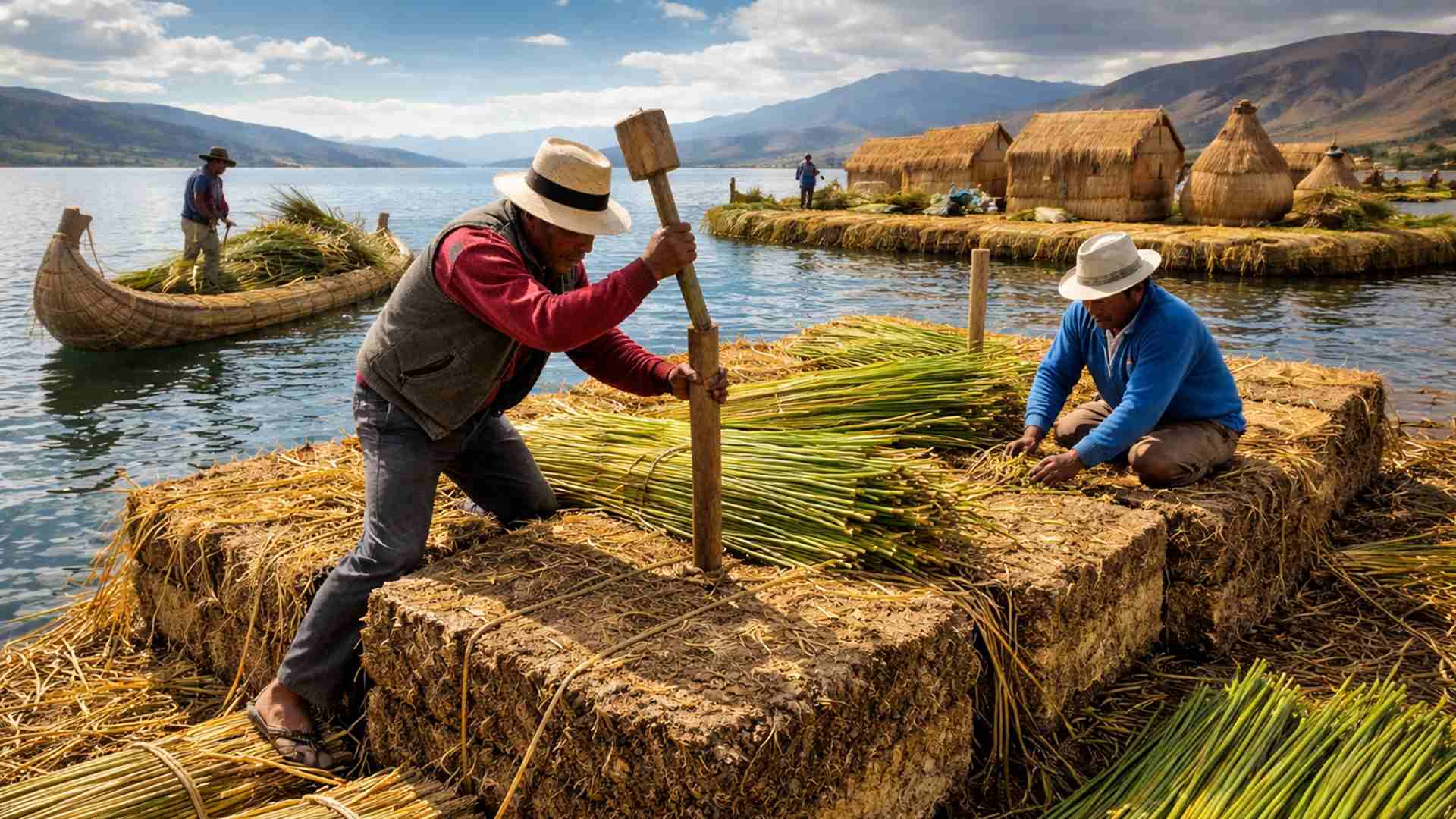


The construction of a floating island depends on organic blocks taken from the bottom of the lake, continuous layers of reeds, and anchoring with stakes, in a daily maintenance process that supports houses, displacements, and the lives of entire families on the water.
The routine on a floating island begins before sunrise, when residents spread a new layer of reeds over the surface of the lake to reinforce the living soil they walk on. In this high-altitude environment, the ground gives way underfoot, exuding the sweet smell of drying vegetation and requiring daily renewal to contain the advance of water.
The maintenance of this base is not occasional but a central part of daily life. The freshly harvested reeds, with a golden-green hue, cover the darker layers that are already decomposing, while the hands of the residents close fragile areas and reinforce the edges of the floating island.
This constant work defines a direct relationship between permanence and wear. Living there means sustaining one’s own ground every day, in a continuous process where the house, the soil, and the routine depend on the same cycle of renewal.
-
Workers renovating a playground in northern England uncover 176 World War II bombs buried underground; training artifacts still contained explosives.

-
Brazilian Architect Transforms Waste into Sustainable Homes with Solar Power and Rainwater Systems for 40 Years

-
Security Guard Becomes Doctor at Louisiana Hospital Where He Once Worked, Studied Chemistry Between Shifts

-
Woman Rescued from Luxury Complex in Brazil Worked Without Pay for 55 Years, May Be Entitled to Over $300,000




How the floating island is built and maintained
The structure of these islands is not formed by loose bundles of vegetation, but by large compact blocks taken from the bottom of the lake.
These blocks, called kilis, are harvested with roots and soil still intact and serve as a thick, floating base.
Up to two meters thick, the kilis are tied together with ropes to form the foundation. Then, long eucalyptus stakes are driven through the layers and into the lake bed, anchoring the floating island against the force of the wind and current.
On this base, new layers of reeds are repeatedly added. The daily reinforcement not only protects the surface for immediate use but also compensates for the natural decomposition of the older material, which gradually gives way with time and moisture.
The ground, therefore, is not a static surface. It breathes, sinks slightly, and needs to be gradually rebuilt, in a permanent coexistence with the fragility of the organic material that supports the entire community.
The reed that sustains the economy, the houses, and the boats
The reed is the material center of this way of life. It serves as flooring, raw material for housing, a base for boats, and an essential resource to keep the floating island functioning.
Men go out in curved boats made from the same material and navigate through the extensive fields of reeds that surround the open waters. With long sickles, they cut the stalks and gather them into large bundles, in an activity that sustains both the economy and local culture.
Nothing in this landscape is separate from the lake’s vegetation. The same element that covers the ground is used to build shelters, construct boats, and ensure that daily life remains possible on the water.
This total dependence on the reed also gives rhythm to the work. Harvesting represents not only supply but the physical continuity of the floating island, which needs this material to exist concretely day after day.
Neighborhood on the water and bonds between families
Community life happens in a small space, with islands often occupied by just a few families. In this configuration, contact between neighbors does not occur through streets or sidewalks, but through narrow water channels that separate and at the same time connect the houses.
Greetings are made from one bank to another, and a small boat paddled with a single oar serves as a bridge between residents. It is through this boat that shared meals, news, and silent visits circulate between nearby families.
The community is not organized by fences but by the very presence of water. The lake defines distances, creates passages, and establishes a coexistence where movement, meeting, and domestic routine always depend on navigation.
This connection goes beyond the practical aspect. The large reed boats with prows adorned with dragon heads carry marks of identity and preserve a symbolic bond with ancestors who crossed these same waters in previous centuries.
Between the resistance of tradition and the challenges of the present
The lake provides sustenance but also imposes constant risks. Sudden storms can transform the calm surface into a dangerous scene, subjecting the anchors of the floating island to abrupt tests against the wind and waves.
The permanent humidity also invades everything around. This damp and cold environment affects comfort and health, requiring continuous adaptation from those living in a space where the slow dissolution of matter is part of daily life.
As night falls, the temperature drops, and the high-altitude sky gains extreme clarity. From the entrance of a reed hut, all that remains is the sound of water touching the edges of the island and the deep silence of the highlands.
Even so, the contemporary world is already present in this scene. A small solar panel can power a lamp or a radio, while children learn to weave reeds with their mothers and, at the same time, study from textbooks, broadening horizons beyond the floating island.
This coexistence between heritage and change defines the present of this way of life. Sustaining a house on a ground that needs to be redone daily transforms permanence into a conscious choice and makes continuous renewal the real basis of stability.


