





 Portuguese
  English
  Spanish
  4 min of reading
  0 comments


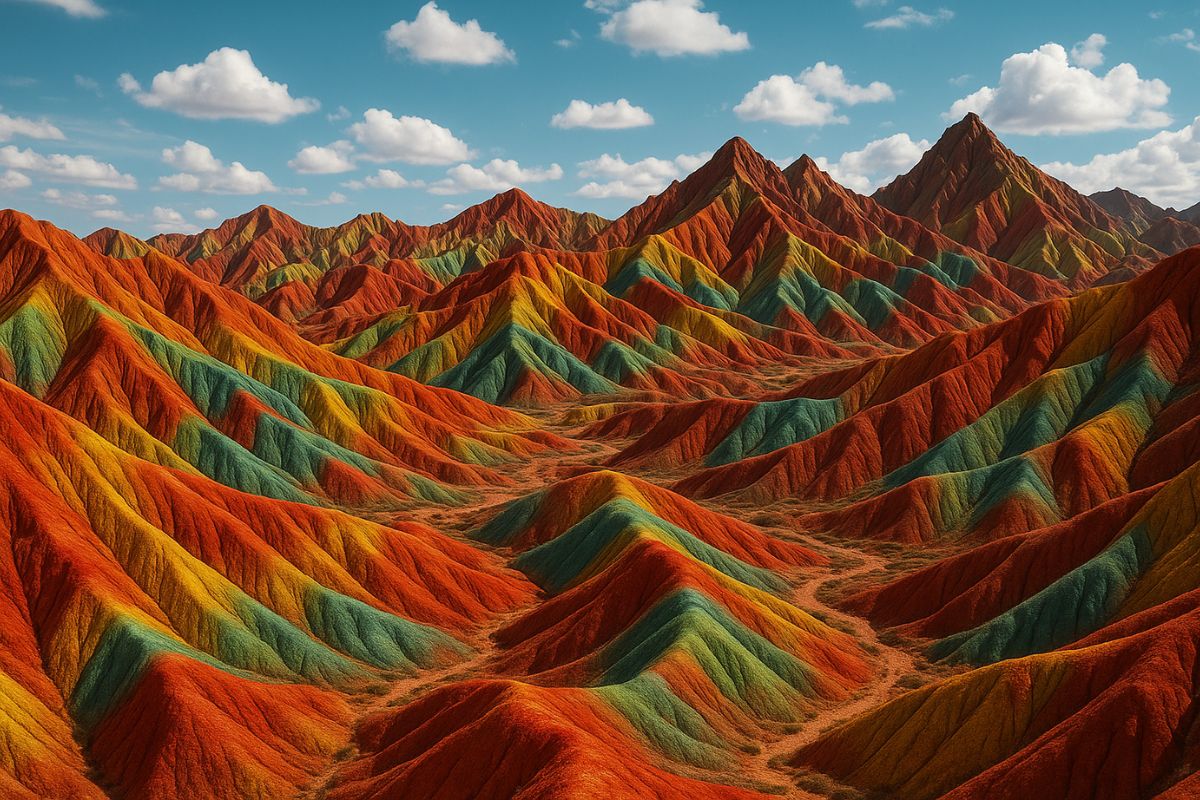
Sandstone Formations in Zhangye Danxia, Northwest China, Show Multicolored Stripes That Have Become a Symbol of the Rainbow Mountains.
The Rainbow Mountains are real and located in the Zhangye Danxia National Geological Park in Gansu Province, Northwest China. Here, layers of sandstone and minerals accumulated over millions of years have been compressed, uplifted, and exposed, creating a landscape of red, yellow, green, and bluish stripes that looks like a brushstroke.
The landscape, covering about 518 km² and recognized as a UNESCO World Heritage Site since 2009, shows a deep geological history on its surface. The visual result is as striking as it is educational: each stripe indicates a deposition phase, a predominant type of mineral and the continuous action of wind and rain that sculpted ravines, ridges, and colorful “folds.”
Where the Rainbow Mountains Are and Why They Impress
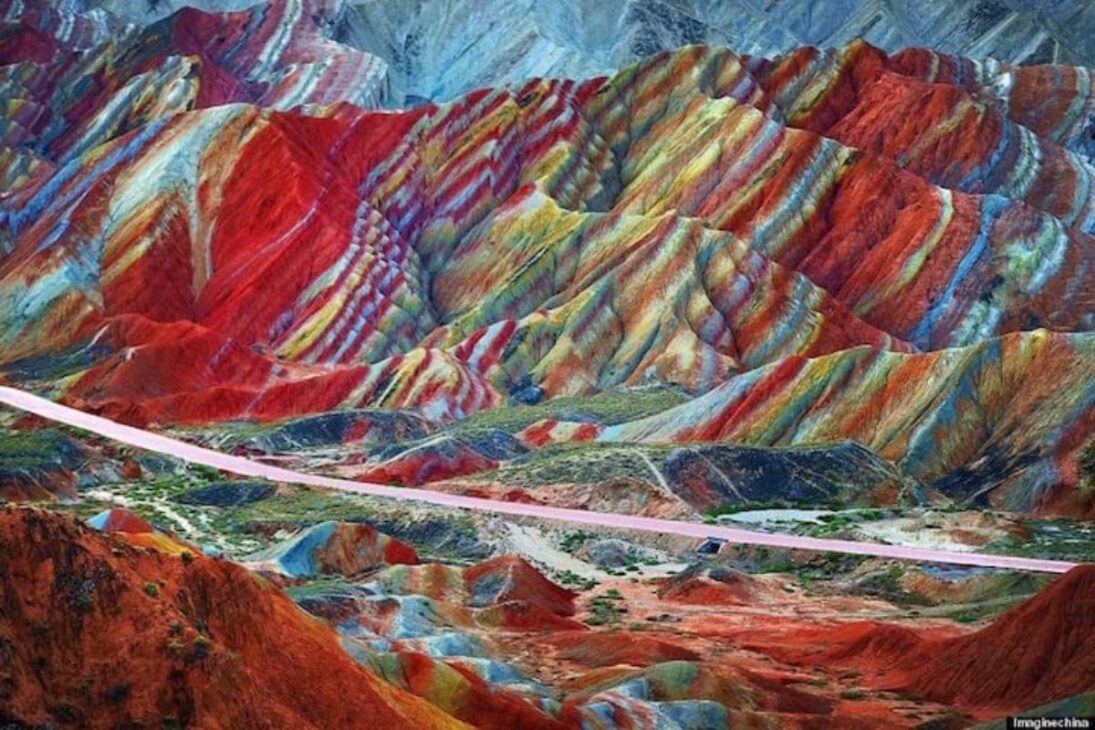
The Rainbow Mountains are located in the Zhangye Danxia National Geological Park in Gansu.
-
The water that may have gone to the Moon with NASA during the Apollo 11 mission and been consumed by the astronauts springs in a Brazilian city at an altitude of 945 meters, famous for its thermal springs, above-average quality of life, and a natural radioactivity so unusual that it attracted Marie Curie.
-
In 200 days, a Finnish man builds with his own hands an 11-meter boat powered by solar energy with “infinite autonomy,” capable of dispensing with refueling and already used as a floating house.

-
Neurologist Richard Restak issues a severe warning to all people over 65: there is a daily habit he recommends completely eliminating from your life because it is destroying your neurons and accelerating memory loss.

-
With 6.1 meters and 33 steps, the spiral staircase of the Loretto Chapel in the United States gained fame worldwide for making two complete 360-degree turns without a central support.


The position, at the northern edge of the Tibetan Plateau, favored both sediment deposition and tectonic efforts that lifted and tilted the layers, exposing them like open pages of a geology book.
The impact comes from the contrast: rusty red dominates, but is crossed by yellow, green, and gray lines that “flow” down the slopes.
The repetition of parallel ridges reinforces the sense of painting, while the variable sunlight throughout the day ignites and dims different tones, a spectacle that changes with the weather and the season.
How the Colors Were Born: The Science Behind the Rock Rainbow
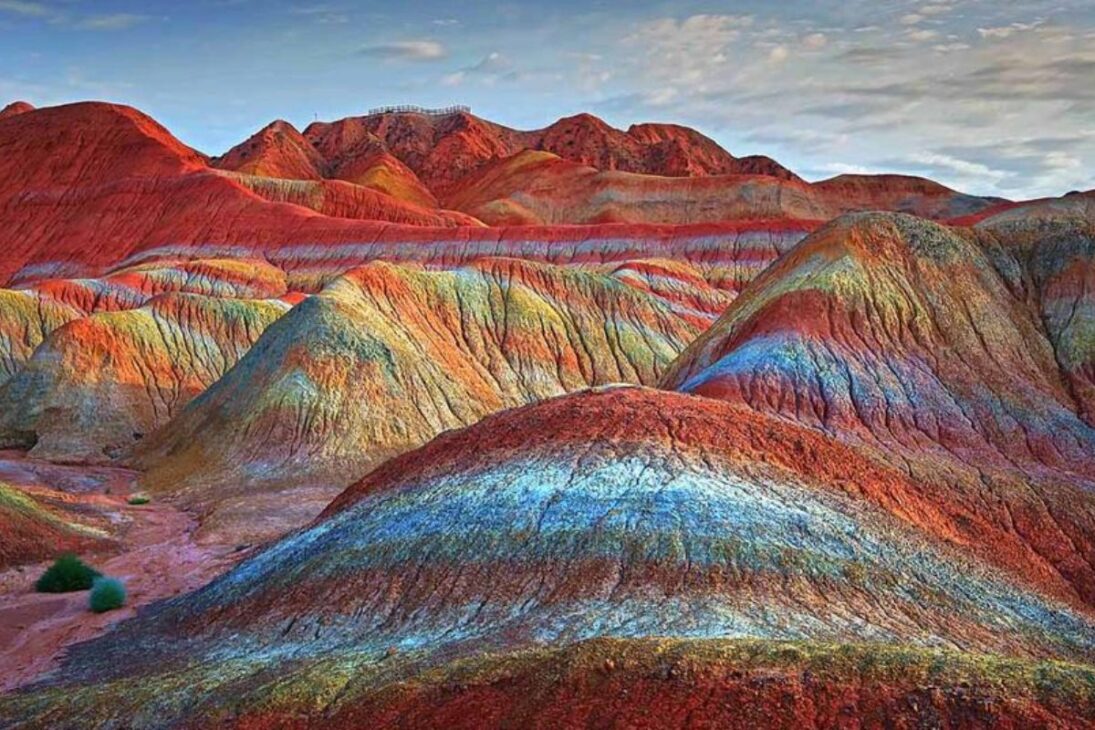
The coloration of the Rainbow Mountains results from more than 24 million years of sandstone and siltstone deposition with different minerals.
Iron oxide accounts for the red tones; hydrated forms like limonite tend toward yellow; and mineral variations can produce greens, bluish and gray. Each color tells a phase of the deposition environment.
Later, tectonic uplift tilted and fractured the layers. Wind and rain excavated grooves and cliffs, revealing the “core” of the stratigraphic sequences.
What we see today is the intersection of deep time and active erosion, exposed as continuous stripes that follow the wave of the hills.
When to Go and How to See Better
The best time to visit the Rainbow Mountains is from May to October.
Dry days and clear skies intensify the contrast between the stripes, while the low sun in the early morning and late afternoon enhances the relief of the colors.
On cloudy days, the tones become softer, but the contours stand out.
For the ordinary visitor, viewpoints and walkways offer safe views and wide angles of the ridges.
Off-trail hiking accelerates erosion and fades the colors—a damage that is difficult to reverse.
Respecting the official path is part of the pact that keeps the park vibrant for those who come after.
Danxia, Vinicunca, Rainbow Range: What Changes from One Rainbow to Another
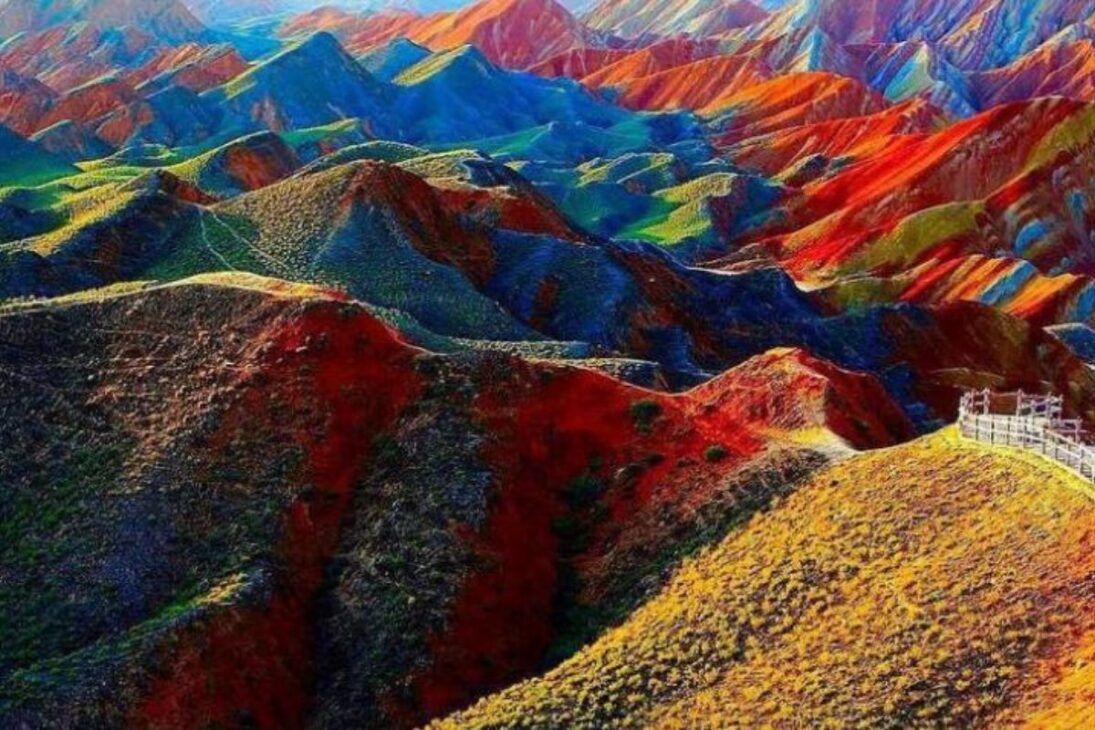
The Rainbow Mountains of Zhangye Danxia have simpler access and lower altitude than other colorful landscapes.
In Vinicunca (Peru), the so-called “Mountain of Seven Colors” is over 5,000 m, requiring steep trekking and acclimatization.
At the Rainbow Range (Canada), the colors appear in a mountainous and less touristy environment, associated with volcanic-metamorphic contexts.
The mechanism, however, rhymes: layers rich in minerals (such as hematite and goethite) oxidized and exposed generate different palettes according to chemistry, climate, and tectonics.
The Zhangye palette is dominated by continuous reds of sandstone; in Vinicunca, greens and turquoises appear strongly, and in Canada, tones vary with volcanic and metamorphic materials.
Tourism and Conservation: How Not to “Fade” an Icon
The increase in visitors to the Rainbow Mountains brings revenue and infrastructure, but also pressure on trails, slopes, and natural drains.
Off-path trampling, litter, and graffiti quickly degrade a surface that took millions of years to become exposed.
Good practices make a difference: sticking to the walkways, taking back your waste, and avoiding touching the colored slopes help to maintain the integrity of the outcrop.
Geological landscapes are open archives of the planet preserving them is ensuring that the reading remains possible.
The Rainbow Mountains condense geological time, tectonics, and erosion into a natural canvas that looks painted. For you, what impresses more: the aesthetics or the story behind the colors? If you have visited Gansu, do the colors live up to the photos? And for those who went to Vinicunca in Peru, how do you compare the two experiences access, altitude, palette, visual impact? Share in the comments: your account helps other readers plan and better understand this phenomenon.





-

Uma pessoa reagiu a isso.