





 Portuguese
  English
  Spanish
  4 min of reading
  28 comments


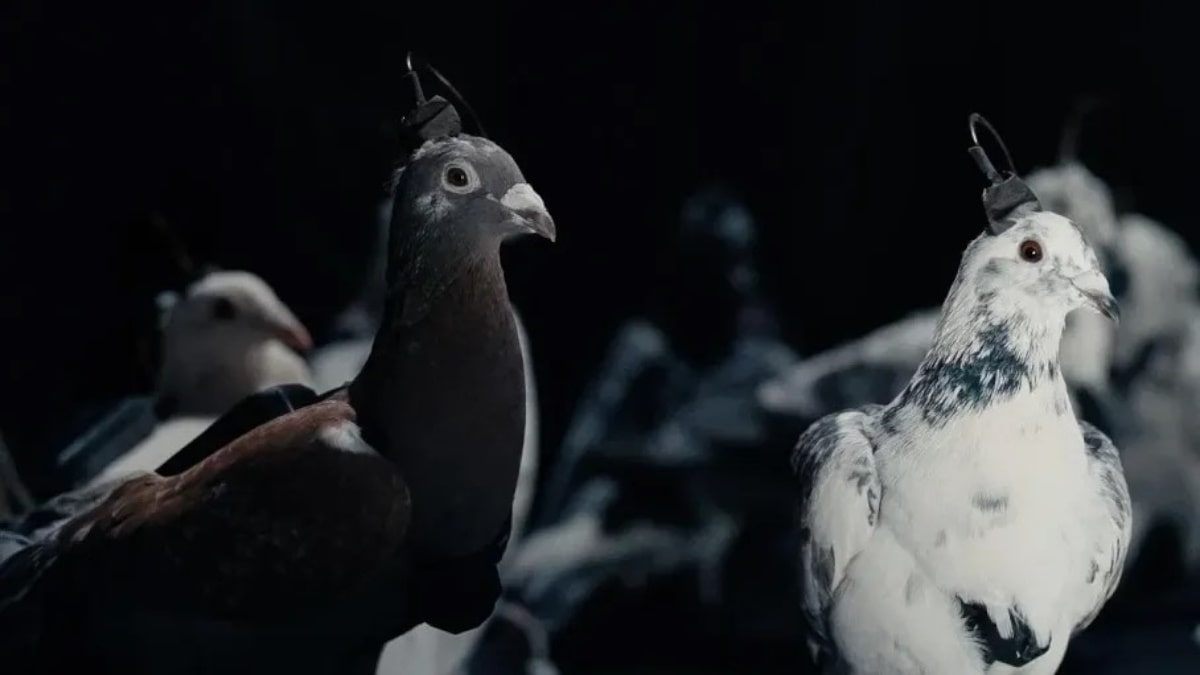


Neurotechnology Project In Russia Proposes Using Pigeons With Brain Implants To Carry Out Monitoring And Surveillance Tasks, As An Alternative To Conventional Drones, According To Information Released By The Company Itself Responsible For The Development Of The Technology.
A Russian neurotechnology company claims to be developing a system that uses pigeons with brain implants to perform tasks similar to those of drones.
The initiative comes from Neiry, which unveiled the project in late 2025 and claims that the birds can be remotely directed through neural stimuli, carrying a small electronic device attached to their bodies and monitored by GPS.
According to the company, electrodes were implanted in the pigeons’ brains and connected to a small device fixed to the birds’ backs.
-
With a cost per shot close to zero, the DragonFire laser could change naval warfare in 2027 and provide British ships with nearly unlimited defense against drones.

-
A British startup creates tires that generate electricity in electric vehicles when passing over potholes, speed bumps, and cracks.

-
Scientists have created robots made with living cells that have their own nervous system, swim on their own, explore the environment, and self-organize without any genetic engineering, and now they want to do the same with human cells.

-
Students create a solar-powered ambulance that operates without a plug, without fuel, and still keeps medical equipment running in remote areas.


This equipment would concentrate the electronic components responsible for receiving commands, recording location data, and maintaining communication with a control center.
Neiry also states that the system can be powered by solar panels installed on the device itself.
Neural Control And Flight Direction

According to Neiry, the direction of the birds occurs through electric pulses sent to specific areas of the brain, capable of inducing motor responses associated with spatial orientation.
The company explains that these stimuli allow for influencing changes in flight paths without using traditional radio commands, similar to those employed in conventional drones.
In a report published on November 26, 2025, the website Meduza described the proposal as a system in which operators can define trajectories and adjust the birds’ movements through neuromodulation.
The text reproduces a statement attributed to the company, which claims that prior training after the implant would not be necessary, as commands would be transmitted directly to the animal’s nervous system.
Additionally, according to Neiry, flight tracking is done through GPS and other positioning methods, allowing real-time tracking.
Based on this data, the control center could adjust the stimuli sent to the birds to maintain the planned route.
Brain Implants And Safety Claims
The company asserts that surgeries to implant the electrodes are performed using high-precision techniques, utilizing stereotaxic equipment to reach specific regions of the brain.
According to Neiry, the aim is to minimize risks and preserve the birds’ natural functions after the procedure.
The company also claims that the pigeons would continue to live a normal life after the surgery, without significant detriment to their life expectancy.
However, the publicly available information is based on reports from the company itself and coverage in the international press.
No independent studies or technical reports detailing methodology, number of tested animals, or indicators of animal welfare were found in the sources consulted.
Use Of Pigeons In Surveillance And Monitoring
In the materials released, Neiry points out that the modified pigeons could be used in surveillance and inspection activities.
Examples mentioned include monitoring infrastructure such as power transmission lines, industrial facilities, and hard-to-access areas.
The company also cites possible uses in environmental inspections, search and rescue operations, and urban observation.
According to Neiry, one of the advantages of the system would be that the birds are common in urban areas, which would reduce the visibility of the operation compared to traditional drones.
Flight Autonomy And Technical Limitations
Neiry claims that the “biodrones” would have greater flight autonomy than conventional drones since they utilize the birds’ natural ability to cover long distances.
The company further asserts that the use of solar energy in the electronic equipment would help prolong operational time.
On the other hand, there is no independent public data that allows for comparing performance, reliability, or operational costs between modified pigeons and commercial drones.
No verified information has been released regarding failure rates, the impact of the equipment on the birds’ aerodynamics, or practical limitations in complex urban environments.
Expansion Of The Project To Other Birds
According to statements released by the company itself, the project would not be limited to pigeons.
The founder of Neiry, Alexander Panov, stated that the technology could be adapted for other birds, depending on the type of mission.
“Now the solution works on pigeons, but the carrier can be any bird. To transport greater payloads, crows are planned to be used; to monitor coastal objects, gulls; and albatrosses for large maritime areas.”
Neiry describes the project as being in an advanced stage of development and has reported plans to move on to experimental applications in sectors requiring prolonged monitoring.
The company also stated that it has received support from the National Technological Initiative Fund of Russia and presented the technology at events in the unmanned systems sector, as disclosed on its official channels.
With this proposal’s release, questions arise about the actual stage of the technology, the validation criteria adopted, and the degree of control effectively achieved over the birds’ behavior.







Se fosse o Elon Musk vocês iam estar aplaudindo, são tão **** e manipuláveis que em vez de criticar a situação de exploração dos animais criticam só o que não gostam…
Eu acho errado usar aves e carne e ossos atrapalhar a natureza
Deus vai tomar as providências na hora certa
Enquanto mais se vive na terra, mais asneiras se vê da ciência. Agora apareceu mais uma, pra perturbar a vida das aves! Só Deus para livrar o homem de suas astúcias e ganâncias malignas!