





 Portuguese
  English
  Spanish
  5 min of reading
  0 comments


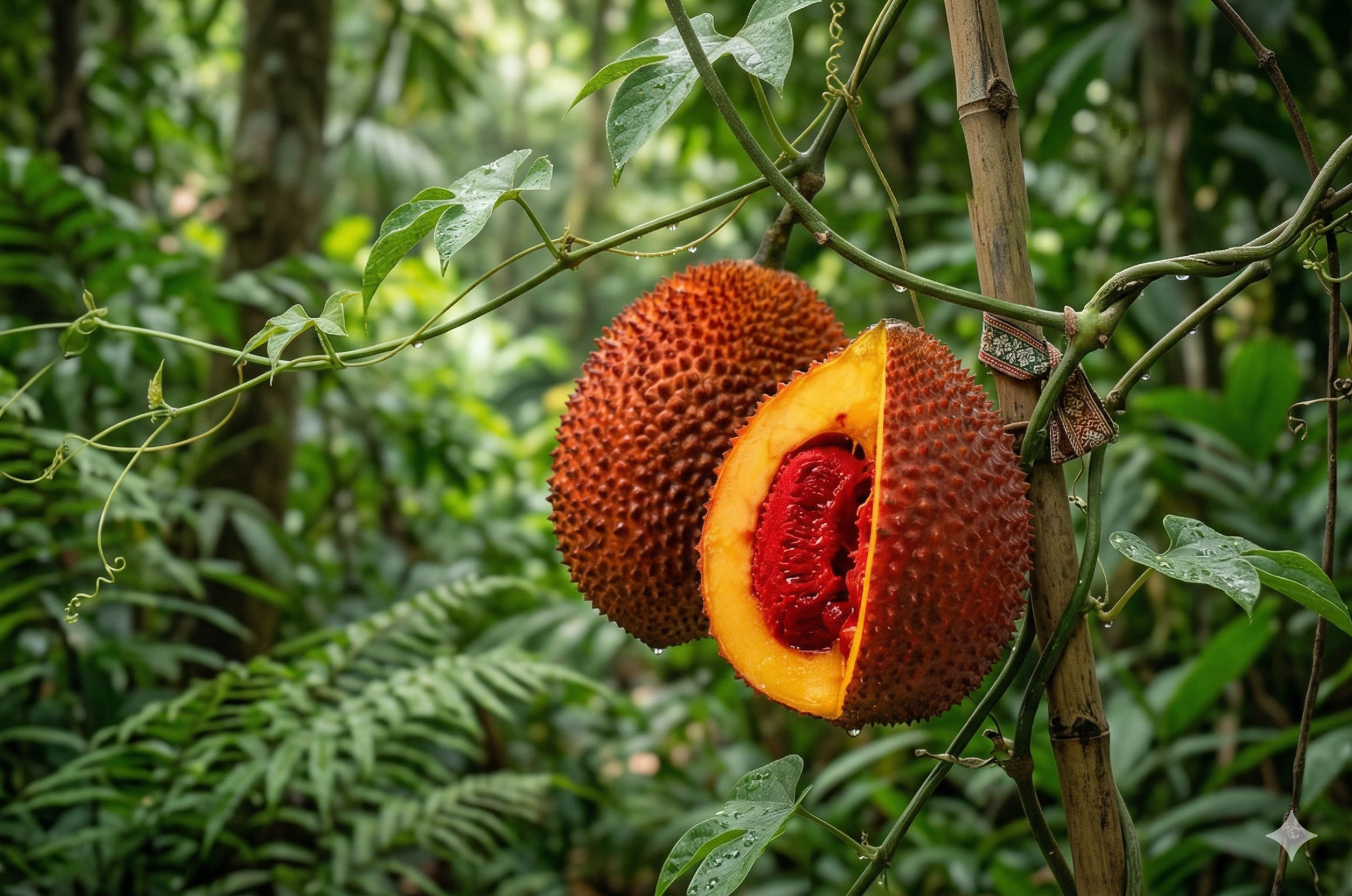
Gac is an Asian fruit rich in lycopene and beta-carotene, with levels much higher than those of tomatoes, according to scientific research.
Scientific studies conducted over the past decades have placed gac (Momordica cochinchinensis), a fruit native to the Southeast Asia, at the center of food science research. In 2004, a paper published in the Journal of Agricultural and Food Chemistry and made available by the USDA Agricultural Research Service highlighted that the red, oily aril of the fruit concentrates exceptionally high levels of carotenoids, especially lycopene and beta-carotene, compounds widely investigated in the scientific literature.
Subsequent research reinforced this picture. In the survey by the USDA Agricultural Research Service, the aril of ripe gac showed lycopene content more than 76 times higher than that found in commercial tomatoes, while studies indexed in PubMed confirmed that the red part around the seeds is precisely the fraction with the highest concentration of lycopene and beta-carotene.
This quantitative difference has placed gac in a rare position among the fruits studied by food science, increasing interest in its nutritional, technological, and industrial potential, especially in research aimed at utilizing high-concentration bioactive compounds with high bioaccessibility.
-
China drilled more than 3,400 meters of ice in Antarctica using hot water and set a world record by nearly one thousand meters, paving the way for discoveries about the limits of life in extreme environments.

-
Companies want to use satellites with mirrors to illuminate the Earth at night, and scientists around the world warn that eliminating darkness could destroy entire ecosystems and affect the health of billions of people.

-
Blackout in the interior of SP? Off-grid hybrid solar system takes over in 16–20 ms without blinking: Victron integrates Fronius on-grid, 30 kWh Pylontech, and 15 kVA three-phase, limits injection, and helps avoid the B wire.

-
Satellite images show heavy clouds and a cold front advancing: a cyclone brings storms from RS to SP, winds of up to 100 km/h, and an alert from Inmet, today with a risk of hail; Recife remains flooded.

What is gac and where is this fruit found
Gac is the fruit of a climbing plant from the cucurbitaceae family, the same as melon and pumpkin. Its appearance is striking: a thick skin with an irregular texture and a color that varies from orange to deep red when ripe.
Inside, the highlight is the seeds surrounded by an extremely pigmented red pulp, known as aril. It is in this part that the most studied bioactive compounds are concentrated.


The fruit is traditionally used in Vietnamese cuisine, especially in festive preparations, such as the dish xôi gấc, a rice naturally colored by the fruit’s pigment.
Despite its established cultural use in Asia, gac is still little known in other parts of the world, contributing to its character as a recent scientific discovery on the global stage.
Lycopene at levels much higher than tomatoes
Lycopene is a carotenoid responsible for the red coloration of various foods and has been widely studied for its antioxidant properties.
In the case of gac, studies indicate that its concentration can be up to 70 times greater than that found in tomatoes, depending on the extraction and analysis method.

This data signifies not only a quantitative difference but also a qualitative one. The lycopene present in gac is often associated with a natural lipid matrix, which may influence its absorption by the body.
This characteristic differentiates the fruit from other plant sources, where the bioavailability of the compound may be more limited.
Beta-carotene and other carotenoids in high concentration
In addition to lycopene, gac also stands out for its beta-carotene content, a precursor of vitamin A. This compound is essential for functions such as vision, immune system, and tissue maintenance.
Studies show that the pulp of the fruit presents high levels of this carotenoid, reinforcing its differentiated nutritional profile.
The combination of lycopene and beta-carotene in high concentrations is considered unusual, which explains the growing scientific interest.
Other carotenoids have also been identified, further expanding the spectrum of bioactive compounds present in the fruit.
Lipid structure favors the absorption of compounds
One of the most relevant points in the research on gac is the presence of natural lipids in the pulp. Unlike many fruits, which have low fat content, gac has a significant lipid fraction.
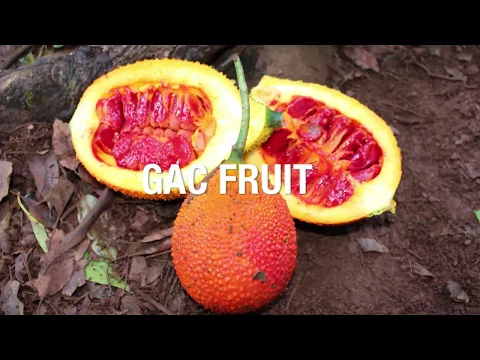
This is important because carotenoids are fat-soluble compounds, meaning their absorption by the body depends on the presence of fat.
The fruit’s own structure already provides this medium, which may favor the bioavailability of nutrients, without the need for external food combinations.
This aspect is often highlighted in studies as a differentiator compared to other plant sources.
Industry interest and applications in food and cosmetics
With the advancement of research, gac has begun to attract interest from different industrial sectors. The oil extracted from the pulp has been studied for use in functional foods, supplements, and even cosmetic products.
The fruit’s intense color also makes it a natural candidate for replacing artificial colorants, especially in products seeking a more natural appeal.
The presence of bioactive compounds in high concentration expands the possibilities for application, although there are still challenges related to large-scale production and standardization.
Variations in composition depend on cultivation and processing
Just as with other fruits, the levels of compounds present in gac can vary according to factors such as:
- Cultivation conditions
- Climate and soil
- Maturity stage
- Extraction method
Studies show that processing, especially in the case of oil, can significantly influence the final concentration of carotenoids.
This means that higher values generally represent specific analysis conditions, and not necessarily a uniform standard.
Potential still under investigation by science
Although the data on chemical composition is consistent, many studies related to effects on the body are still ongoing.
Experimental research has investigated the role of gac carotenoids in various biological processes, but much of this analysis still occurs in laboratory settings.
This indicates that the fruit’s potential continues to be explored, with new discoveries being published regularly.
A fruit that unites cultural tradition and scientific interest
Gac is an example of how traditional foods can gain new meaning when analyzed from a scientific perspective.
What has been used for centuries in specific cultural contexts has begun to be investigated for its chemical composition and possible modern applications.
This transition reinforces the value of biodiversity and traditional knowledge as a starting point for new research.
One of the most unusual nutritional profiles ever recorded in fruits
The combination of high levels of lycopene, beta-carotene, and natural lipids places gac in a unique position among plant foods.
Few fruits present this density of bioactive compounds together, which helps explain the growing interest of the scientific community.
Even still little known outside Asia, gac is already considered one of the most concentrated natural sources of carotenoids studied to date.








Seja o primeiro a reagir!