





 Portuguese
  English
  Spanish
  4 min of reading
  0 comments


Discover The Colossal Impact: Asteroid 20 Times Larger Than The One That Destroyed The Dinosaurs Caused Deep Transformations On The Largest Moon In The Solar System
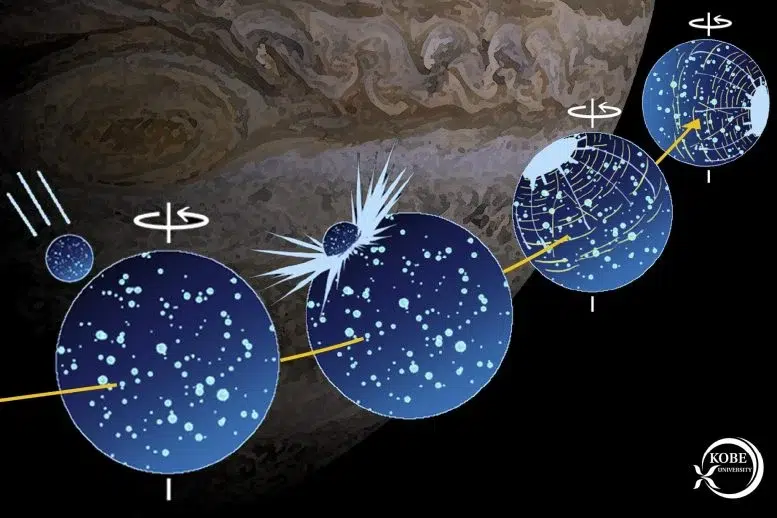
About 4 billion years ago, a colossal asteroid collided with Ganymede, Jupiter’s largest moon, generating an impact so powerful that it significantly altered its rotation axis.
According to a study conducted by Hirata Naoyuki from Kobe University in Japan, this event drastically reshaped the moon’s surface, resulting in visible changes that persist to this day.
Ganymede: The Giant of The Solar System
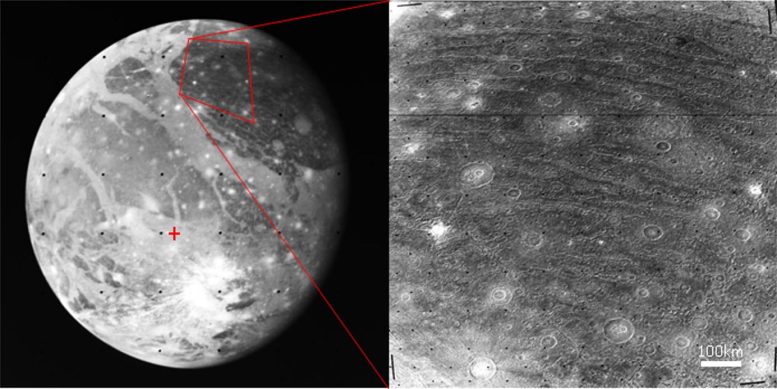
Ganymede, the largest moon of Jupiter and the Solar System, is even larger than the planet Mercury. Like Earth’s Moon, Ganymede also always shows the same face to Jupiter, while the other part of its surface remains “hidden” from our view. Its surface, marked by craters that form concentric circles, raised suspicions of a catastrophic impact since the 1980s.
-
Archaeologists find an intact tomb over 2,500 years old, with more than 100 preserved objects, weapons, jewelry, and human remains never touched.

-
Volcanic lava transforms into threads as fine as human hair that travel over 30 kilometers by wind and fall like cutting rain on roofs and backyards in Hawaii and Iceland.

-
NASA issues a warning for the feared Godzilla El Niño that could change the planet’s climate in 2026 with extreme warming of the Pacific capable of causing devastating droughts in some regions and historic floods in others simultaneously.

-
Archaeologists discover a 100-meter ship graveyard in a submerged Greek city, and what has appeared on the seabed of Libya could change what was known about this ancient port.


Researchers speculated that these patterns were due to a collision with a gigantic asteroid, but the true extent of this impact and its effects on Ganymede remained unknown for a long time. Now, thanks to Hirata’s observations and detailed analyses, we finally have a clearer understanding of what happened.
The Discovery Of The Impact
Hirata’s interest was piqued when he noted similarities between Ganymede’s craters and a crater on Pluto, which was also caused by an impact that altered the axis of the dwarf planet. This finding led him to consider that Ganymede might have undergone a similar phenomenon.
The study, published in the journal Scientific Reports, reveals that the asteroid that collided with Ganymede had a diameter of about 150 kilometers, an imposing mass compared to the asteroid that caused the extinction of the dinosaurs on Earth, estimated to be 10 to 15 kilometers in diameter. Striking the moon of Jupiter at a speed of 20 kilometers per second, the impact caused a massive redistribution of material, changing Ganymede’s rotation axis and creating the concentric marks we see today.
Although Ganymede has been known since 1610, when Galileo Galilei first observed it with his telescope, the jovian moon still hides many secrets. It was only with the arrival of the Voyager probes that scientists were able to closely observe its craters, grooves, and other geological features. Ganymede’s surface is marked by long furrows and ridges that continue to intrigue astronomers to this day.
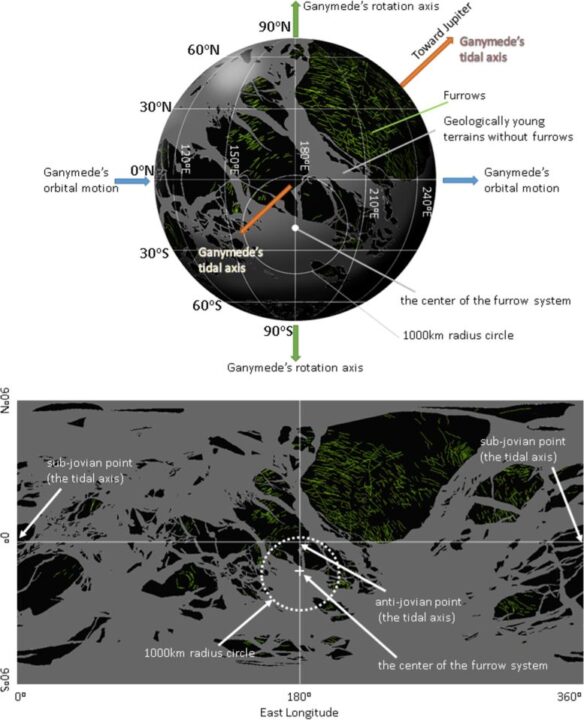
These grooves, which cover a significant part of the moon, are remnants of its turbulent past and of major collisions. Through computational simulations, Hirata and his team were able to determine that the impact 4 billion years ago was so powerful that it caused a reorientation of Ganymede’s axis.
Impact Changed The Solar System
The Solar System, especially during its formation, was the scene of numerous catastrophic impacts that shaped its planets and satellites. Uranus, for instance, may have been hit by a large errant moon, altering its tilt. Earth’s Moon itself is a result of a major impact that redefined the planet. Pluto, in turn, had its shape influenced by the tidal forces of its satellite, Charon.
In the case of Ganymede, Jupiter’s gravity plays a crucial role, forcing the moon to always keep the same face turned towards the planet. Ganymede’s concentric furrows align with an area directly opposite Jupiter, as if the moon were “staring” intently into space, away from its giant host.
Hirata’s research sheds light on the colossal impact that reshaped Ganymede and opens new perspectives for the study of jovian moons. Planetary models indicate that after the impact, the rocks and ice ejected by the collision fell back onto the surface, altering its mass distribution and forcing a reorientation of the moon’s axis.
However, many questions remain open. For example, how did the impact affect Ganymede’s internal structure? How do the liquid oceans, believed to exist beneath its crust, influence the mass distribution and geological activity of the moon?
Future Research
Future research promises to delve deeper into these mysteries, using more detailed data from Jupiter’s icy moons to better understand the complex evolution of Ganymede and other satellites in the Solar System.
The colossal impact that struck Ganymede billions of years ago not only left permanent marks on its surface but also altered its rotation axis. Studies like Hirata’s continue to unveil the mysteries of the Solar System, providing us with a clearer view of how these catastrophic events shaped the celestial bodies we know today.
Ganymede, despite being one of Jupiter’s most well-known moons, still holds deep secrets that may change the way we understand the formation and evolution of the moons and planets around us.









Seja o primeiro a reagir!