






 Portuguese
  Spanish


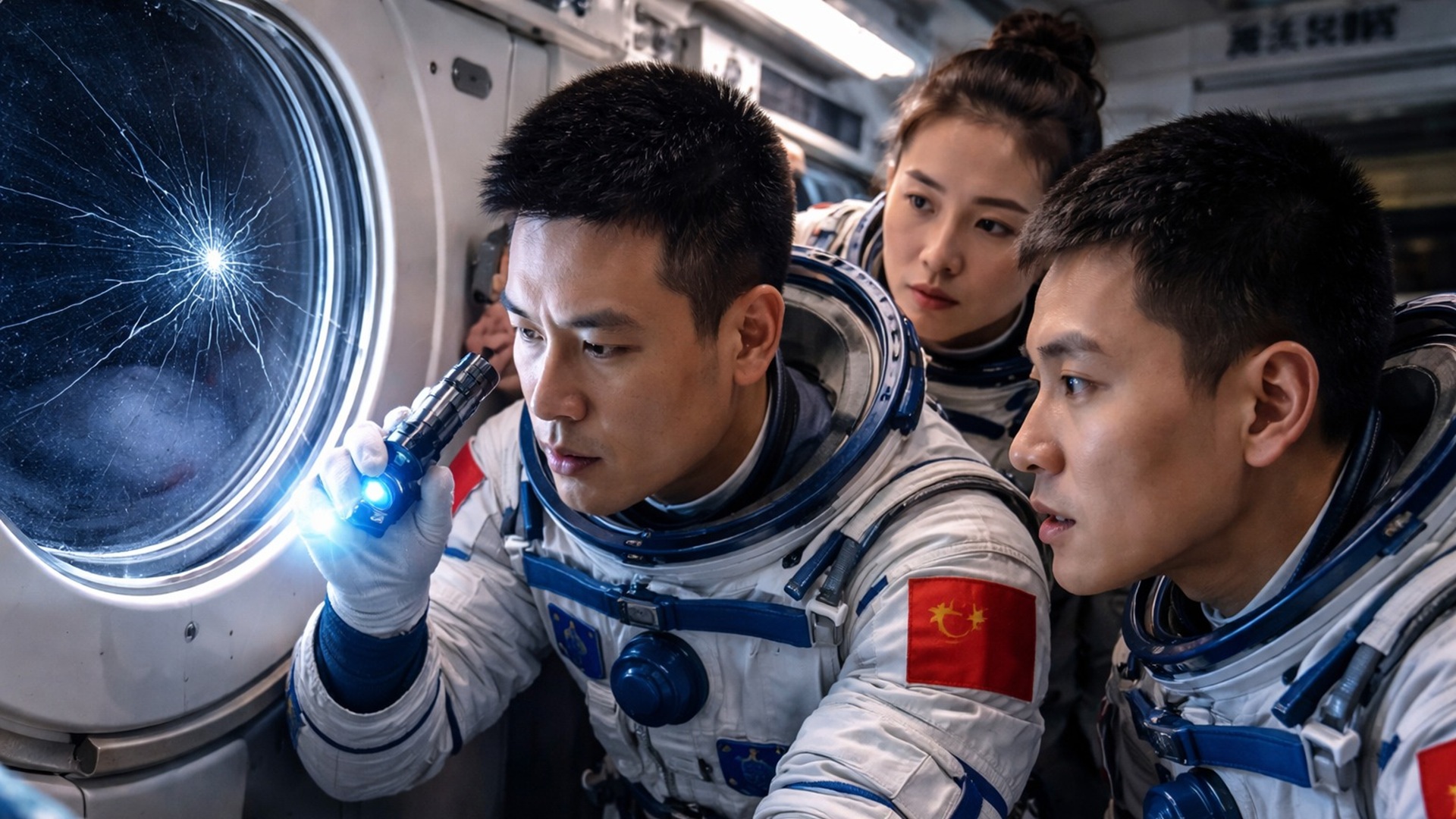

After Detecting Cracks in the Window of the Shenzhou-20 Capsule One Day Before the Expected Return on November 5, Chinese Astronauts Triggered Safety Protocols, Used a 40-Times Microscope, Delayed Reentry, and Mobilized the Emergency Launch of Shenzhou-22 on November 25
Chinese astronauts on the Shenzhou-20 mission had their return to Earth delayed on November 5 of last year after detecting cracks in the return capsule window, leading to the use of Shenzhou-21 for reentry and the emergency launch of Shenzhou-22.
The occurrence was announced as the first emergency operation of China’s crewed space program. The mission planned for the crew’s return on November 5, but the discovery of cracks in the spacecraft’s observation window altered the schedule.
Chen Dong, commander of Shenzhou-20, identified the damage while performing final checks on the return capsule. The suspicion is that space debris hit the window. The crew eventually returned to Earth in another spacecraft.
-
A Brazilian city decided to purchase a piece of the Atlantic Forest with more than 153,000 square meters, and owners of preserved areas will be able to submit proposals to transform the forest into a conservation unit.

-
Brazilian siblings aged 11 and 7 read 240 books in just one year and caught attention on social media: while many children spend hours on screens, they turned their family’s routine into an example of reading, discipline, and curiosity.
-
The legendary oak that, according to the story, hid Robin Hood from the Sheriff of Nottingham, died at the impressive age of 1,200 years in England, and the first chilling sign of its end was that no leaves sprouted on the tree this spring.

-
While the world looks at forests, the UN warns that the Earth is also threatened by the silent degradation of natural grasslands and savannas, ecosystems that cover half of the planet, support billions of people, and can exacerbate water, food, and climate crises.


Chinese Astronauts Identify Anomaly in the Window One Day Before Return
China launched Chen Dong, Chen Zhongrui, and Wang Jie on April 24, 2025. The mission was planned for six months, with docking to the Tiangong space station.
During the inspection of the return ship, Chen reported seeing something resembling a triangle on the window. Initially, he thought it was a small leaf stuck on the exterior, but dismissed the idea since they were in space.
He alerted his colleagues about the anomaly. Confirmation occurred one day before the scheduled return. Subsequent analysis indicated the presence of cracks in the viewing window of the capsule.
Technical Analysis and Use of 40-Times Microscope
The crew used available equipment on the space station to document the damage. A digitizing tablet, work phone, and magnifying glass were employed. Final confirmation occurred with a pen-shaped microscope with 40 times magnification.
According to Chen Dong, small fissures could be clearly observed. Some were relatively long and one was shorter. He stated that some of the cracks had penetrated the outer layer.
Wang Jie, flight engineer of the mission, stated that he was not very nervous. He explained that the outer layer is protective and that there are two inner layers that support cabin pressure.
He added that as long as the cabin pressure did not change, they would be safe. He also expressed confidence in the analyses and experiments conducted by the team on the ground before any final decision.
Action Plan Prioritizes Safety and Reorganizes Return
The ground teams began evaluation and reorganized the return of the crew. The China Manned Space Agency reported that the measures followed the principle of prioritizing the safety of Chinese astronauts.
An uncrewed Shenzhou-22 spacecraft was urgently prepared and successfully launched on November 25, 2025. The ship carried space food, medical supplies, fresh fruits, vegetables, and devices to repair the cracked window.
In uncrewed mode, Shenzhou-22 docked at the forward port of the central Tianhe module of the Tiangong station. Meanwhile, it was decided that the crew would return on Shenzhou-21.
The return occurred on November 14, using Shenzhou-21, described as new but borrowed. Shenzhou-20 remained docked to the station, considered unsafe for reentry at that time.
The China National Space Administration reported that a crack repair device for the hatch was urgently sent to the launch site. The astronauts installed the equipment in the damaged capsule.
According to the CMSA, the device effectively improved the thermal protection and sealing capability of the spacecraft during reentry.
Landing of Empty Capsule Occurs on January 19 Under Extreme Conditions
The emergency operation was completed when the Shenzhou-20 return capsule, without a crew, parachuted down in Dongfeng, Inner Mongolia Autonomous Region, on January 19 of this year.
The search teams faced freezing temperatures and strong winds. Xu Peng, the commander on-site, stated that it was the first time the Dongfeng Landing Center performed a recovery during the coldest season of the year.
He declared that special cold protection measures were adopted to ensure good conditions for personnel and equipment throughout the mission.
As the capsule was uncrewed, there was no astronaut to manually deploy the parachute. The main parachute did not detach automatically after landing.
With strong winds, there was a risk of the capsule being dragged along the ground. The team needed to quickly reach the landing point to cut the parachute.
An inspection at the site confirmed that the exterior of the capsule was generally intact after reentry. The internal items were also reported to be in good condition, according to the CMSA.
In total, Shenzhou-20 spent 270 days in orbit, validating its long-term docking capability, as reported by CCTV. Engineers stated that the subsequent work will provide an important basis for the Chinese space program to refine operational procedures.
Comparison With Starliner Case and Response Evaluation
Jan Osburg, senior engineer at RAND in Pittsburgh, stated that it was a coincidence that the U.S. and China programs had reentry capsule problems within about a year.
He cited the case of the Starliner capsule, built by Boeing, which experienced a different mode of failure. According to him, in both cases, the affected capsules managed to return to Earth safely.
In Osburg’s opinion, the Chinese demonstrated good response capability by launching a backup spacecraft in a few weeks. He stated that the U.S. also brought their astronauts back after the issue with Starliner.
However, he stated that there was no demonstration of the same type of practical response capability. He mentioned the possibility of sending a new Crew Dragon from SpaceX in a few weeks, but emphasized that the details were never publicly discussed.
For Osburg, both cases underline the importance of space rescue capabilities implemented before something happens, concluding that experience reinforces the need for emergency preparedness in space.
This article was prepared based on information disclosed by China Media Group, China Central Television (CCTV), China Manned Space Agency (CMSA), China National Space Administration (CNSA), and statements published by Space.com.








