





 Portuguese
  English
  Spanish
  3 min of reading
  0 comments


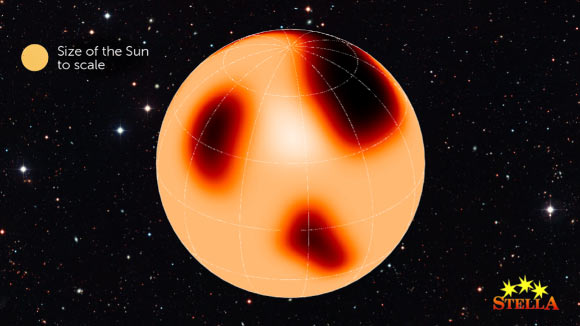
Astronomers Made a Fascinating Discovery by Observing Stellar Spots on the Surface of a Giant Star, Revealing New Clues About the Dynamics of Stellar Atmospheres.
Astronomers from the Leibniz Institute for Astrophysics Potsdam, the University of Potsdam, and the Konkoly Observatory made an intriguing discovery. Using an innovative technique, they observed giant spots on the surface of the star XX Trianguli, located 640 light-years away in the constellation Triangulum.
This star, a bright K0 giant, is part of a binary system. Studies revealed that its stellar spots are chaotic and unpredictable, unlike the solar spots observed on the Sun.
“Stellar spots behave similarly to solar spots, but on a much larger scale,” explains Professor Klaus Strassmeier, the lead author of the study. The team used a technique called Doppler imaging, capable of mapping the stellar surface through the inversion of spectral line profiles.
-
After decades of failed attempts, Brazil is once again looking to space with an orbital rocket measuring 12 meters, weighing 12 tons, costing R$ 189 million, and scheduled for launch in 2026, in a new race to finally achieve autonomous access to orbit.

-
The Earth will plunge into a few minutes of darkness in broad daylight in August 2026, when a total solar eclipse transforms the sky into one of the most impressive astronomical phenomena in recent years.

-
How the terraforming of Mars can transform the planet: artificial aerosols can increase the temperature by up to 35°C in 15 years, creating conditions for liquid water.

-
Scientists drilled nearly 8,000 meters into the ocean floor above the fault that caused the 2011 tsunami in Japan and discovered that a layer of clay 130 million years old was responsible for making the wave much worse than any model had predicted.


A “Painted” Star
XX Trianguli is not an ordinary star. With a mass only 10% greater than that of the Sun, it has a radius ten times larger and a temperature of 4630 K. Its rotation period of 24 days is synchronized with the orbital period of the binary system.
Previously, scientists discovered that the star had a gigantic spot, with an area 10,000 times larger than the largest group of spots ever recorded on the Sun. This dimension is equivalent to ten times the diameter of the solar disk.
Now, astronomers have gone further, capturing 99 detailed images of the star’s surface. These images revealed significant changes in the photocenter, the point that represents the “center of light” of the star.
What Are Stellar Spots?
Just like the Sun, the spots on XX Trianguli are dark areas on the surface of the star, caused by lower temperatures compared to the surrounding regions. These spots can alter the star’s brightness, slightly displacing the center of light perceived by observers.
In the case of XX Trianguli, the displacement of the photocenter reached 24 microarcseconds, about 10% of the visible radius of the star. This demonstrates the magnitude of the phenomenon.
However, unlike the Sun, the spots on XX Trianguli do not follow a regular cycle. Instead, they form in an apparently chaotic manner, indicating that the star’s internal dynamo is disordered and non-periodic.
Impact on the Search for Exoplanets
The discovery also has important implications for astronomy. The variations in the photocenter caused by the spots can mimic or hide the small movements caused by orbiting exoplanets. This represents a significant challenge for detecting new planets.
“These variations add an intrinsic limitation to the astrometric techniques used in the search for exoplanets,” says Strassmeier.
Importance of the Discovery
This research highlights the complexity of stellar dynamics and shows how advanced techniques, such as Doppler imaging, can reveal fascinating details about distant stars. In addition, the collected data can help better understand the internal processes of these celestial giants and refine methods for observing exoplanets.
The results were published in the journal Nature Communications, marking yet another significant advance in the exploration of the universe.










Seja o primeiro a reagir!