





 Portuguese
  English
  Spanish
  3 min of reading
  0 comments


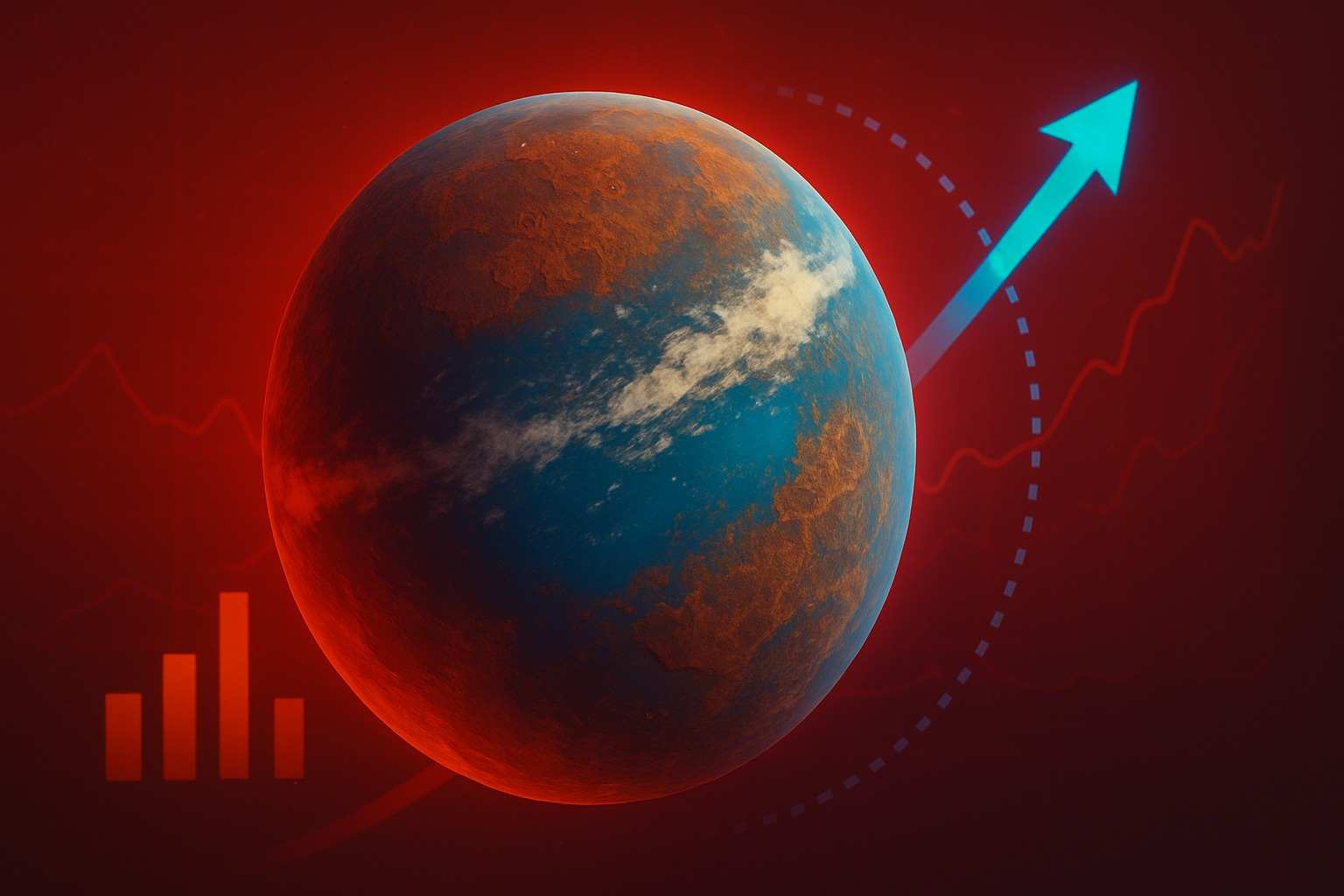
Researchers Used The James Webb Telescope To Observe Four Transits Of The TRAPPIST-1e Planet And Found Promising Signs
Astronomers have identified promising signs of an atmosphere on a rocky exoplanet. The finding involves TRAPPIST-1e, which orbits a red dwarf star about 40 light-years away.
The observations came from the James Webb Space Telescope (JWST) and were published in the journal The Astrophysical Journal Letters.
So far, no rocky planet has shown convincing signs of an atmosphere. TRAPPIST-1e may be the first to change that.
-
Motorola launched the Signature with a gold seal from DxOMark, tying with the iPhone 17 Pro in camera performance, Snapdragon 8 Gen 5 that surpassed 3 million in benchmarks, and a zoom that impresses even at night.

-
Satellites reveal beneath the Sahara a giant river buried for thousands of kilometers: study shows that the largest hot desert on the planet was once traversed by a river system comparable to the largest on Earth.

-
Scientists have captured something never seen in space: newly born stars are creating gigantic rings of light a thousand times larger than the distance between the Earth and the Sun, and this changes everything we knew about stellar birth.

-
Geologists find traces of a continent that disappeared 155 million years ago after separating from Australia and reveal that it did not sink, but broke into fragments scattered across Southeast Asia.

Indications Of Something Heavier Than Hydrogen
Between June and October 2023, the JWST observed the planet four times using transit spectroscopy.
This technique detects small changes in the light of the star when the planet passes in front of it. This can reveal the presence of gases around the planet.
The data showed that there is no hydrogen-dominated atmosphere, like those found in gas giants. This absence opens the possibility for something denser, such as nitrogen, methane, or carbon dioxide.
According to researcher Ana Glidden from MIT, the idea was to test if the planet might not be “airless.” She stated the answer was “yes,” although the evidence is still incomplete.
The Star Complicates The Search
The analysis of the signals faces an obstacle: the star itself. TRAPPIST-1 is small and unstable. Eruptions and stellar spots alter its light and can confuse the data.
To deal with this, scientists applied gaussian processes, a statistical method that separates variations caused by the star from those that may come from the planet. Even so, it took more than a year to distinguish the signals.
In the end, two possibilities remained: TRAPPIST-1e may have an atmosphere of heavy molecules or it may simply be a rocky and dry planet. The data is still not precise enough to choose between the two.
Clues About Climate, Not Just Composition
TRAPPIST-1e is slightly smaller than Earth and receives similar radiation from its star. This may make it warm enough to maintain liquid water.
Like many planets close to their stars, it likely always shows the same face to it.
An atmosphere would help distribute heat and avoid extremes between the daytime and nighttime sides. Without this balance, one side may freeze while the other burns.
For Ryan MacDonald from the University of St. Andrews, the most exciting hypothesis is of a secondary atmosphere with heavy gases. Even so, he admits that the planet may not have any atmosphere at all.
New Strategy For Future Observations
The first four transits were not enough to solve the mystery. Now, scientists plan to observe 15 more transits of TRAPPIST-1e by the end of 2025.
In this phase, they will compare the data to that of TRAPPIST-1b, a neighboring planet already known not to have an atmosphere. The idea is to use TRAPPIST-1b as a control to isolate signals that come only from TRAPPIST-1e.
MacDonald summarizes the logic: any excess gases seen only during the transits of TRAPPIST-1e will come from the planet’s atmosphere.
If the strategy works, researchers will be closer to knowing if this small rocky world can indeed support life.








-

Uma pessoa reagiu a isso.