





 Portuguese
  English
  Spanish
  5 min of reading
  0 comments


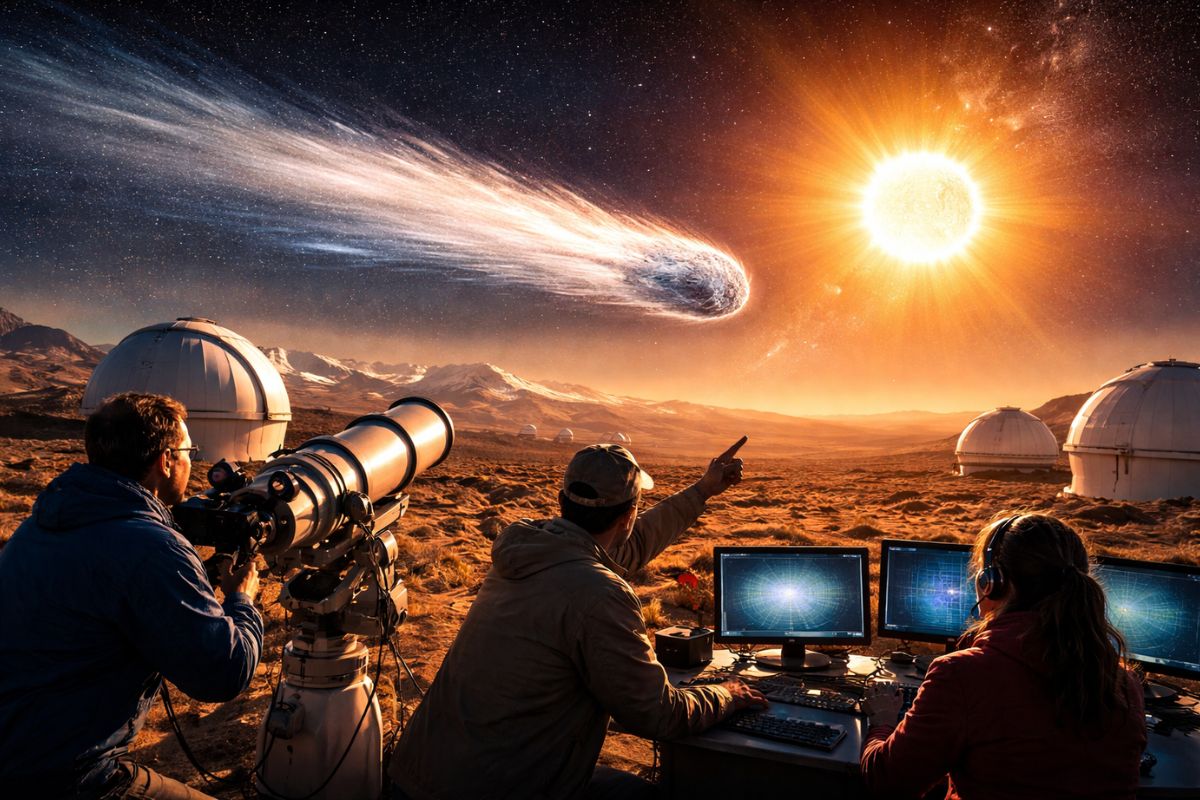
Astronomers in Atacama Identify a “Kamikaze” Comet Linked to the Legendary Giant Observed in 1106, Traveling Toward the Sun at 3.2 Million km/h with a Chance of Appearing in 2026 Brighter Than the Moon if It Survives Perihelion.
From high in the Atacama Desert, one of the best places on the planet to view the Universe, astronomers recorded an object that caught attention for several reasons: a “kamikaze” comet, associated with a legendary giant seen in the year 1106, traveling at about 3.2 million kilometers per hour toward the Sun. The term “kamikaze” is not a rhetorical exaggeration: the orbit of this body is so extreme that it is expected to pass dangerously close to our star, literally risking disintegration in front of instruments.
If it survives perihelion, however, the scenario changes completely. Calculations indicate that this “kamikaze” comet may appear in the sky in 2026 brighter than the Moon itself, transforming an object currently invisible to the naked eye into the star of a global spectacle. Balancing the risk of disappearing forever and the chance of becoming the astronomical show of a generation, the comet puts scientists and curious observers in a state of maximum expectation.
What Makes the “Kamikaze” Comet So Special
The first reason is simple: it is “not just another comet”. The “kamikaze” comet was identified through careful observations in Atacama, crossing data on brightness, apparent motion in the sky, and trajectory.
-
Motorola launched the Signature with a gold seal from DxOMark, tying with the iPhone 17 Pro in camera performance, Snapdragon 8 Gen 5 that surpassed 3 million in benchmarks, and a zoom that impresses even at night.

-
Satellites reveal beneath the Sahara a giant river buried for thousands of kilometers: study shows that the largest hot desert on the planet was once traversed by a river system comparable to the largest on Earth.

-
Scientists have captured something never seen in space: newly born stars are creating gigantic rings of light a thousand times larger than the distance between the Earth and the Sun, and this changes everything we knew about stellar birth.

-
Geologists find traces of a continent that disappeared 155 million years ago after separating from Australia and reveal that it did not sink, but broke into fragments scattered across Southeast Asia.

The orbital pattern is typical of objects that approach very close to the Sun and often do not leave this encounter intact.
Comets are, in essence, blocks of ice, dust, and rock that spend most of their time in the farthest regions of the Solar System.
When one of these nuclei is “pulled” closer to the Sun, the intense heating causes the ice to sublimate, releasing gas and dust and forming the famous tail.
In the case of this “kamikaze” comet, the orbit is so tight and tilted that perihelion is expected to put it in a zone of extreme heat, with a real risk of rupture.
Connection with the Giant of 1106: Echo of a Bright Past
Another point that makes the “kamikaze” comet unique is its connection with the legendary giant observed in 1106. Historical records describe a comet so bright that it was visible even during the day in some regions, leaving a strong mark in the chronicles of the time.
By comparing the reconstructed orbit of this ancient visitor with current data, astronomers have found similarities that indicate that the “kamikaze” comet may be a remnant fragment of that 1106 giant.
In other words, what we see now would be a piece of a much larger body that passed near the Sun centuries ago and has since been returning on increasingly extreme trajectories.
If this connection is confirmed, we will not only be observing a “kamikaze” comet, but also a direct messenger of an astronomical event recorded over 900 years ago.
The Race Toward the Sun at 3.2 Million km/h
A speed of about 3.2 million kilometers per hour may seem almost abstract, but it is what allows the “kamikaze” comet to cross enormous distances in relatively short timeframes.
The closer it falls toward the Sun, the faster it accelerates under gravitational influence, like a stone rolling down a hill.
This extreme speed is not just an impressive number: it has practical consequences. The higher the speed at perihelion, the more intense the interaction with the solar radiation field, which can increase mass loss and the risk of fissures or total rupture of the nucleus.
For astronomers, tracking this process in real time is a rare opportunity to study how comets behave in extreme situations, something we normally can only infer after they have already disintegrated.
Can It Really Be Brighter Than the Moon in 2026?
The big question, both for the scientific community and the public, is whether the “kamikaze” comet will fulfill the promise of being brighter than the Moon in 2026.
For that to happen, two factors need to combine: it must survive perihelion with a good portion of the nucleus intact and must release a huge amount of gas and dust.
If this occurs, the surface that reflects sunlight increases significantly, forming a long tail and a bright coma.
A “kamikaze” comet that withstands the heat and gravitational tide of the Sun can literally “explode in brightness” in the night sky, becoming easily visible to the naked eye and even dominating the horizon on certain nights.
On the other hand, if the nucleus is too small or already too fragmented, the object may simply disappear, leaving only a diffuse trail barely noticed.
Why Is It Called the “Kamikaze” Comet
The nickname “kamikaze” comet comes precisely from the risky nature of its orbit. Comets of this type make extremely close passes to the Sun, in trajectories that approach the limit between surviving and completely disintegrating.
In many cases, they are only seen once and never return, as they disintegrate on the first more aggressive dive.
In the specific case of this “kamikaze” comet, perihelion acts as a kind of astronomical roulette. If its internal structure has large fissures or weak zones, thermal and gravitational stress can break it into multiple fragments.
Some of these pieces may enter new orbits, while others may be completely vaporized. If the nucleus is more cohesive than it appears, it may endure, lose mass, but move on to a longer orbit and return in future centuries.
What Astronomers Hope to Learn from the “Kamikaze” Comet
From a scientific perspective, the “kamikaze” comet is an open window to the past and to the extreme behavior of small bodies in the Solar System.
The connection with the giant of 1106 allows for comparing historical records with modern data and a better understanding of how these objects fragment over time.
Furthermore, tracking in detail the approach, perihelion, and possible brightness in 2026 helps refine models of comet evolution, brightness predictions, and risk estimates for future passages of similar bodies.
Each data point obtained from the “kamikaze” comet (comet C/2026 A1) improves our ability to interpret other comets that follow similar paths, whether in terms of spectacle in the sky or safety and monitoring.
And you, if the “kamikaze” comet actually appears in 2026 brighter than the Moon, do you plan to go out to observe the sky, or do you think all this is an exaggeration surrounding a visitor of ice and dust?







-

-

2 pessoas reagiram a isso.