





 Portuguese
  English
  Spanish
  3 min of reading
  0 comments


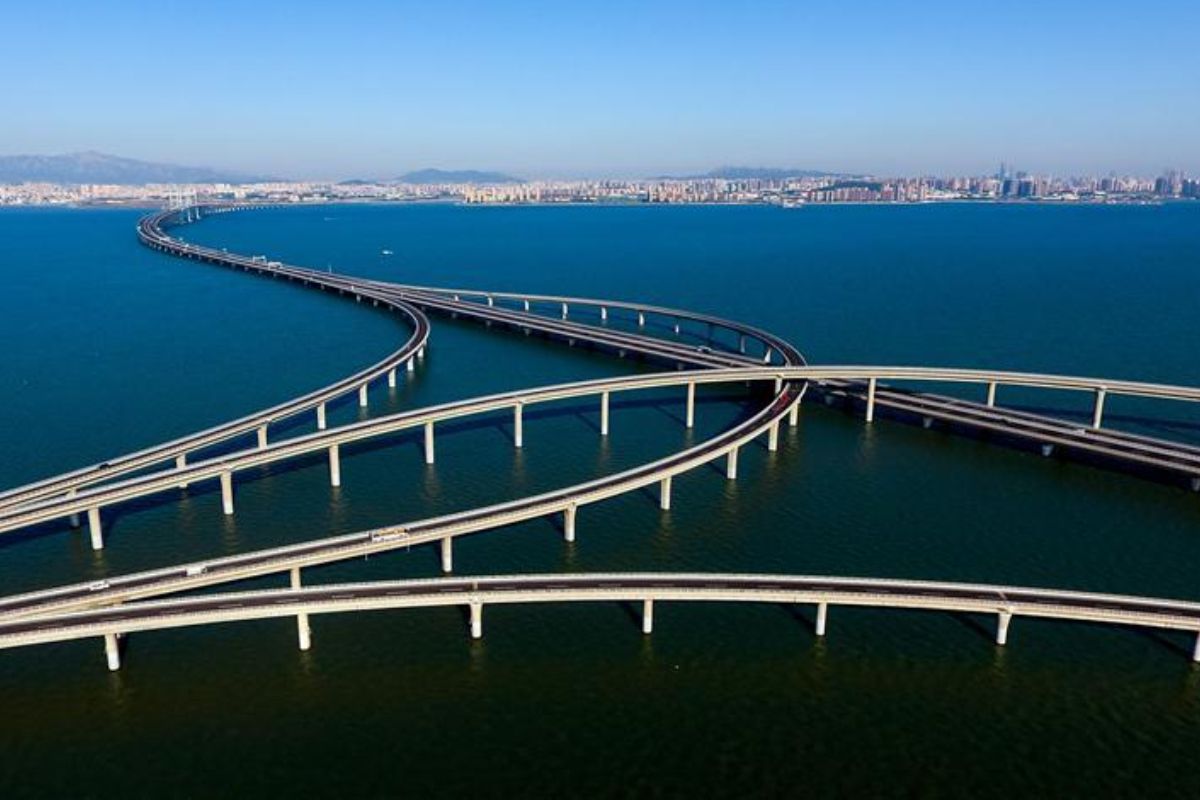
With a Length of 42.5 Km, the Qingdao Haiwan Bridge Connects Opposite Shores of the Jiaozhou Bay and Symbolizes the Strength of Chinese Engineering in Withstanding Magnitude 8 Earthquakes.
The world’s longest sea bridge was inaugurated in 2011, connecting the Chinese cities of Qingdao and Huangdao through a colossal structure that extends over 42.5 kilometers over Jiaozhou Bay. More than an engineering record, the project represents a symbolic turning point in China’s ability to execute megaprojects in short timeframes, with technical precision and unprecedented seismic safety.
The construction, completed in just four years, required 450,000 tons of steel and 2.3 million cubic meters of concrete. The result is a bridge capable of withstanding extreme winds, collisions from large vessels, and earthquakes of up to magnitude 8, becoming a landmark of durability and innovation in maritime engineering.
The Engineering Behind a World Record
The Qingdao Haiwan Bridge was designed to withstand the harshest conditions of the marine environment.
-
Oldest tree on the planet reappears after 130 years of searches: Wattieza, 385 million years old, was 10 meters tall and had no leaves or seeds; Gilboa fossils in New York solved the mystery in 2007.

-
A 48-square-meter house assembled in hours with 4,000 bricks made of recycled plastic that does not absorb moisture, has natural thermal insulation, and costs less than 90,000 reais in a complete kit.

-
Luciano Hang revealed that Havan’s air fleet has already accumulated more than 20,000 landings, 10,000 flight hours, and 6 million kilometers traveled, and he says that without the planes, the company would never have grown so quickly.

-
A historical discovery in the Andes Mountains reveals a gold deposit valued at 770 billion reais hidden over 4,000 meters above sea level on the border between Chile and Argentina, and the whole world is watching.

Situated in an area prone to typhoons and tectonic instability, its structure of reinforced pillars and flexible expansion joints allows it to absorb large vibrations and displacements, ensuring stability even in the face of intense shocks.
The project was conducted with a focus on efficiency and resilience. Teams worked simultaneously on multiple sections, both on land and at sea, drastically reducing the timeline.
This model of parallel execution, coupled with the use of high-performance materials, made it possible to deliver the world’s largest sea bridge in just four years, a feat rarely achieved even in countries with a century-long tradition in civil engineering.
Connectivity and Regional Impact
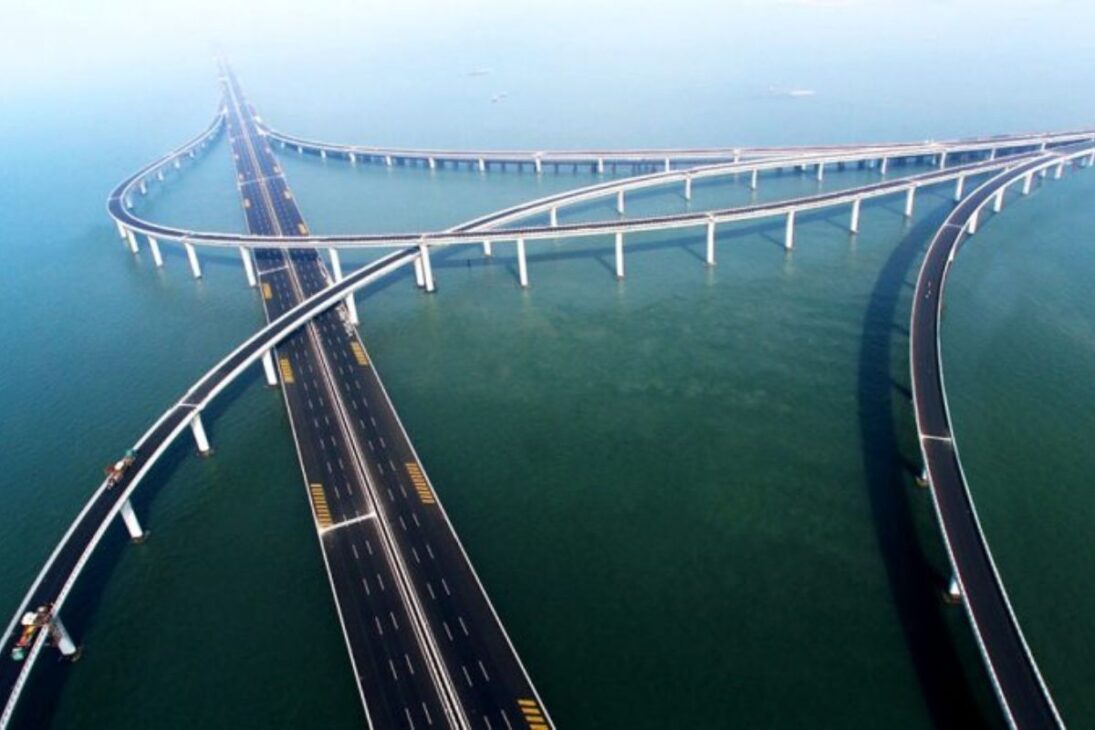
The bridge shortens the distance between Qingdao and the Huangdao industrial area by more than 30 km, cutting travel time from 40 to just 20 minutes.
This new connection has transformed local logistics and boosted regional trade, strengthening Qingdao’s role as one of China’s most strategic ports.
In addition to its practical function, the structure holds strong symbolic value: it represents China’s technical mastery in building large-scale infrastructures and reinforces the country’s goal of integrating urban and industrial centers through high-capacity coastal and maritime corridors.
The world’s longest sea bridge has thus become an icon of national ambition and state efficiency.
With its inauguration in 2011, the Qingdao Haiwan Bridge became a part of history as one of the greatest structural engineering achievements of the 21st century.
Its ability to withstand earthquakes and typhoons, combined with construction precision in a marine environment, places it on par with other iconic megastructures in China, such as the Danyang-Kunshan Grand Bridge.
The project encapsulates the new philosophy of Chinese engineering: fast, robust, and resilient infrastructures, capable of meeting growing urban demands and withstanding extreme conditions.
The bridge not only shortens physical distances but also symbolizes the technological advancement and self-confidence of a nation that has turned significant challenges into opportunities for innovation.
Do you believe that future Chinese megastructures can surpass the impact of the Qingdao Haiwan Bridge? Share your opinion in the comments; we want to know how you see the future of global engineering.








Seja o primeiro a reagir!