





 Portuguese
  English
  Spanish
  10 min of reading
  0 comments


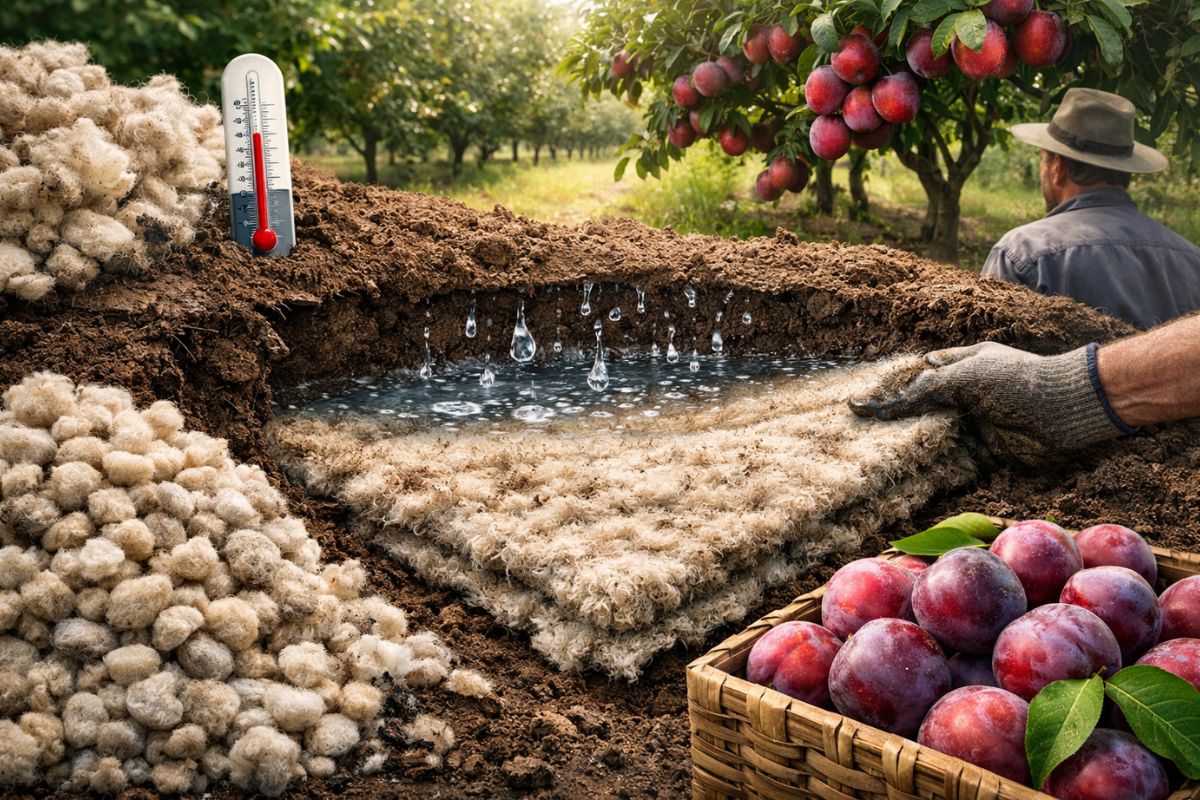
In Australia, Restoration Took Shape From A Discarded Residue: Wool Compressed Into Pellets, Mats, And Liquid Solutions Capable Of Reducing Soil Temperature By Up To 10°C, Retaining Water Twenty Times Its Own Weight, Releasing Nutrients Slowly And Improving Crops Without Chemical Fertilizer Even In Extreme Droughts.
In Australia, soil restoration began to be considered from a seemingly insoluble impasse. On one side, thousands of tons of wool lost economic value in an industry pressured by fast fashion and cheap synthetic fibers. On the other, rural areas faced extreme heat, erosion, low water retention, and weakened crops. Rather than treating these two crises as separate problems, researchers, agricultural engineers, and producers began to connect them.
What emerged from this approach was a biological solution with technical design. Wool ceased to be merely a livestock waste and became converted into buried pellets, covering mats, and liquid fertilizers rich in amino acids. The Logic Of Restoration Is Simple In Appearance And Sophisticated In Practice: use an abundant fiber, rich in keratin and nutrients, to return moisture, structure, thermal protection, and gradual nutrition to the soil over the months.
From The Wool Crisis To The Opportunity Of Soil Restoration

Australia built an important part of its economic trajectory on sheep farming. The country is home to over 70 million animals, a number far exceeding its human population, and for a long time occupied a central position in the global wool market. There was a time when Australian fiber represented a symbol of quality and value, to the point that the country held 45% of the world’s production. But this scenario began to change rapidly when consumption shifted towards cheaper synthetic materials and faster production chains.
-
Mercado Livre has started selling medications in Brazil with delivery in up to 3 hours, and the project that launches in São Paulo may expand to the entire country, transforming the way millions of Brazilians buy medicines.

-
While the South begins April with sun and heat, a change in the weather already has a defined scenario in Brazil, and forecasts indicate heavy rain in the North and a sharp drop in temperature in the coming days.
-
Elon Musk wants to place humanoid robots in roles currently occupied by people, leading alongside giants like Amazon, Nvidia, and Figure in a race to replace human labor with machines, and advocates for a future where working would cease to be an obligation and become a choice.

-
A US company creates a facade that looks like stone or wood but generates energy: “invisible” solar panels for walls, easy installation, up to 130 W, and an off-grid YouTuber showcases it and raises funds for a battery.



This market shift had a direct effect on the field. In 2018, the value of wool peaked at 2,000 Australian dollars per ton but then plummeted drastically, sometimes to below 800 dollars.
For many producers, especially under heat of up to 40°C in regions like Queensland, shearing remained mandatory to avoid thermal stress and death of the animals, but the cost of paying workers, operating machines, and transporting the production began to exceed the financial return obtained from the fiber itself. It was at this point that wool ceased to be a valuable asset and began to be treated as a liability.
The paradox became evident. While wool accumulated without a profitable destination, often being stockpiled or sent for incineration, Australian soil suffered from drought, compaction, and loss of vitality.
On one side, there was an organic material rich in proteins, nutrients, and water retention capacity. On the other, cracked soil and crops stressed by lack of moisture. The connection between these two extremes opened space for a decisive idea: to transform the wool surplus into a tool for agricultural and ecological restoration.
This turnaround did not happen haphazardly. It was not simply about spreading raw wool on the land and waiting for results.
The challenge was to convert a waste into a technically functional input, with predictable behavior in the field. In this case, restoration was born from the intersection of economic urgency and biological engineering, uniting the need to find a destination for the fiber and the need to return resilience to productive and degraded areas.
How Wool Works Below The Ground
The performance of wool in the soil begins with its microscopic structure. Its main component is keratin, a fibrous protein also found in human hair and nails.
This composition, combined with the physical shape of the fiber, provides a significant capacity for moisture absorption and retention. In its natural state, wool can absorb water vapor equivalent to 30% or 40% of its own dry weight without conveying a feeling of dampness. This characteristic, in itself, already sets it apart from many organic materials used in agricultural management.
When wool undergoes compression under pressure and temperature and is transformed into pellets, its function changes in scale. The pellets behave like small underground reservoirs, capable of absorbing up to twenty times their own weight in water.
After rain or irrigation, they swell and store this moisture. As the soil begins to dry again, they release the water slowly and continuously in the root zone. It is precisely this gradual release that makes the material especially valuable in contexts of low precipitation and intense heat.
The effect is not limited to water. As soil microorganisms break down keratin, wool starts to release nutrients at a prolonged pace. Among the highlighted components are 16% nitrogen, along with sulfur, organic carbon, and traces of zinc, copper, and manganese.
Instead of a rapid discharge, as occurs with many soluble chemical fertilizers, the fiber acts through progressive decomposition, maintaining nutritional supply for up to six months. Soil restoration, therefore, advances on two fronts simultaneously: hydration and nutrition.
This mechanism changes the logic of management. Instead of depending solely on constant irrigation or immediate-response fertilization, the producer begins to work with a layer of biological support installed within the land. Water remains available for a longer period, the microbiota receives food, the physical structure of the soil improves, and roots find a less hostile environment to grow. It is not just a pinpoint correction; it is a reorganization of the soil’s functioning.
Pellets, Mats, And Liquid Fertilizer: Three Formats For The Same Restoration
The technology developed from discarded wool has been scaled up in different application formats. The underground pellets are one of the most emblematic forms, but they are not the only one.
Another reported strategy is the production of cover mats made from shredded wool mixed with a small amount of corn starch as a binder. These mats are placed around the base of plants, forming a protective layer that reduces the direct exposure of the soil to intense heat.
The thermal effects of this cover are noteworthy. On scorching summer days, the wool mat can cool the soil by between 6°C and 10°C.
This reduces evaporation, preserves moisture, and protects the root system from temperature spikes that affect plant metabolism. In areas subject to heatwaves, this detail can determine the difference between a plant that merely survives and a plant that can grow vigorously. Restoration, at this level, ceases to be abstract and becomes measurable in ground temperature.
There is also a secondary effect that has gained practical importance: natural resistance to slugs and snails. The fine fibers of wool irritate the sensitive surface of these organisms, functioning as a physical barrier without the need for pesticides.
Instead of a chemical defense, what forms is a biological protection based on the texture of the material itself. For productive systems and gardens, this adds an additional benefit without increasing the toxic load on the environment.
Another technical development was the creation of liquid fertilizer from the hydrolysis of wool in a slightly alkaline medium. The process generates a solution rich in amino acids that can be applied over the leaves.
According to the dynamics described, this formulation favors photosynthesis and helps the plant regulate the opening and closing of the stomata more efficiently, a crucial mechanism for facing drought. Rather than a single product, wool has become a restoration platform, adaptable to underground applications, surface coverage, and foliar nutrition.
What Changed In The Orchards And In The Test Areas
The field results gave real weight to the proposal. In an experimental plum farm, researchers divided the area between conventional management and one based on wool technology, combining underground pellets and covering mats. The goal was not only to observe whether the plants would react but to understand if the soil, root, and productivity would respond consistently to the new system.
The described response was expressive. Plum production increased by 37%, while the size of the fruits grew by up to 50%, without the use of chemical fertilizers. These numbers are noteworthy because they do not merely indicate recovery of the plant under stress but an effective gain in agronomic performance. Restoration ceased to be synonymous with damage control and began to indicate productive improvement as well.
The soil in the treated plots also exhibited structural changes. It became looser, more ventilated, and with pH shifted towards a more balanced range. Roots began to grow deeper and denser, developing more root hairs, which amplifies the capacity for water and nutrient absorption. Instead of remaining concentrated in a vulnerable superficial layer exposed to heat and drying, they began to better explore the profile of the land.
This point is central to understanding why the technology gained relevance. It is not just about feeding the plant; it is about healing the soil. When the microbiota finds organic carbon, more stable moisture, and organic matter capable of decomposition, the underground environment reorganizes. Restoration, then, occurs not only in the immediate cycle of the crop but in the ecological base that supports fertility over time.
Restoration Left Australia And Was Tested In Extreme Scenarios
Although Australian drought provided momentum for the model, the use of wool as a restoration tool has been observed in very different contexts as well. In Norway, for example, the central problem was not a lack of water, but the erosion caused by intense rains and by melting ice on mountain trails. Synthetic solutions had been used in these paths, but the wear of these materials generated microplastics and additional environmental liabilities.
It was in this context that the Ascent Project tested low-quality raw wool, unsuited for the textile industry, in trail coating. More than ten years later, the paths remained stable, with wool integrated into the soil and vegetation growing through the applied layer. Restoration worked there as biological stabilization, replacing an artificial plastic containment with a solution that incorporates itself into the landscape rather than contaminating it.
In the Gobi Desert of Mongolia, the challenge was even more severe. The temperature differences between day and night can reach 30°C, while wind and sand hinder the establishment of young plants. In this environment, scientists used between 2 and 11 tons of wool fertilizer per hectare. The reported result was a jump in plant coverage, which increased from about 1% to 50% to 60%, along with a 40% increase in species diversity.
These cases demonstrate that the versatility of wool does not depend on a single type of landscape. In one place, it holds the soil and prevents erosion; in another, it helps maintain moisture and protect roots in a desert area. Restoration based on natural fibers has proven adaptable precisely because it works with fundamental biological processes: water retention, physical protection, gradual organic matter supply, and support for vegetation regeneration.
From Expensive Waste To Economic Asset: The New Wool Chain
The expansion of this model also affects rural and urban economies. Australia already had a vast infrastructure linked to livestock farming, with animal transport, logistics systems, and collection chains distributed across the territory. For years, this machinery primarily served the export of meat and wool. Now, part of this same ecosystem begins to feed a new productive front: that of environmental and agricultural restoration based on the recycling of fiber.
In Victoria, over 40 startups focused on wool recycling were founded just in 2024. These companies do not only deal with shearing waste. They also collect old sweaters, wool carpets, and other discarded items, broadening the available raw material. Recycling ceases to be merely a rural strategy and begins to involve cities, household consumption, selective collection, and industrial transformation on a small and medium scale.
One of the processes mentioned mixes wool with food scraps, vegetable peels, and coffee grounds in sealed containers. After about ten weeks, the compost transforms into high-potency organic fertilizer. This step is important because it shows that restoration is not limited to the field; it reorganizes waste flows throughout society. What once cost to discard begins to generate work, input, and new economic value.
There is also a cultural effect in this change. In schools in Orange, for instance, children no longer see an old wool sweater as mere trash, but as material capable of feeding gardens and vegetable patches. This shift in perception may be one of the deepest layers of the process. When a waste starts to be understood as a resource, the very notion of disposal weakens. Restoration, in this sense, not only rebuilds the soil; it rebuilds the logic of material use.
A Technical Solution That Follows Biology, And Does Not Fight Against It
The strength of this Australian experience lies in the fact that it does not try to impose a mechanism foreign to the soil’s functioning. On the contrary, it builds upon natural processes and reinforces them: moisture retention, organic decomposition, feeding of the microbiota, physical protection of the surface, and support for root development. There is technique, there is industrial transformation, and there is applied engineering, but all of this operates in harmony with the biology of the land.
This combination helps to explain why the proposal stands out at a time of growing pressure on agriculture, water, and fertility. Wool-based restoration does not appear as a magic solution, but rather as a concrete response to a very clear contradiction: a country with millions of sheep, tons of worthless fiber, and vast areas facing drought and degradation. By connecting these elements, Australia has transformed a troublesome waste into an instrument of regeneration.
In the end, the main lesson is not just in wool. It lies in the ability to perceive that many environmental problems worsen because useful resources are treated as trash before their potential is understood. In this case, a fiber previously associated with excess, cost, and market loss has begun to act as an underground reservoir, thermal cover, slow-release fertilizer, and natural barrier against pests. It is a restoration that begins in the soil but reveals a much larger shift in reasoning.
The question that remains is direct: how many wastes that today seem worthless could help recover degraded areas, reduce losses in the field, and relieve pressure on natural resources? And, in your view, do solutions like this have a better chance of growing precisely because they are simple, biological, and recycle what already exists?







Seja o primeiro a reagir!