





 Portuguese
  English
  Spanish
  3 min of reading
  0 comments


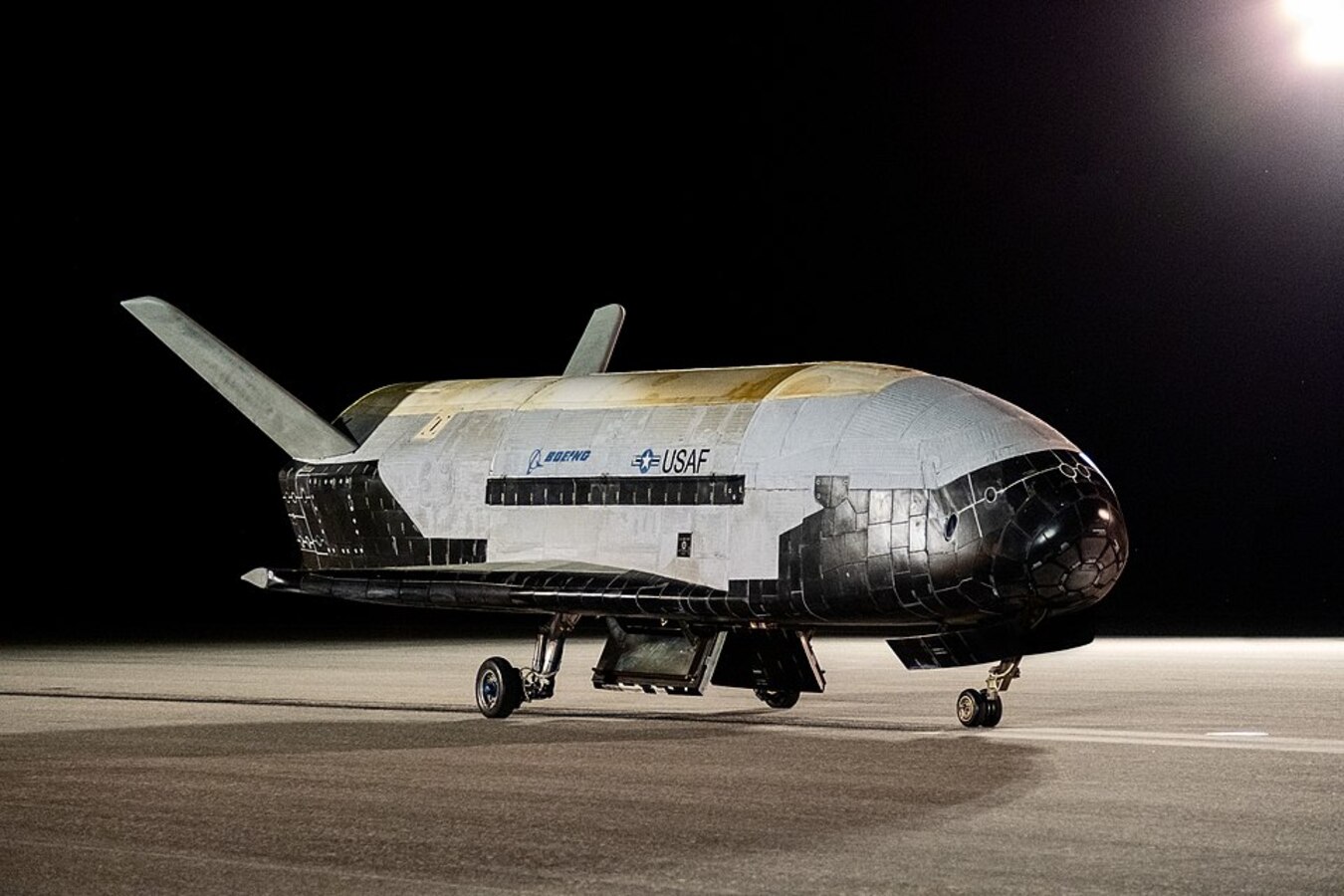
Space Plane X-37B Begins Eighth Mission Focused on Quantum Navigation, Technology That Promises to Overcome GPS Vulnerabilities and Transform Defense and Space Exploration
The U.S. military space plane X-37B is scheduled to launch on August 21 for its eighth mission. Much of the craft’s operations remain classified, but one highlight draws attention: the testing of a quantum navigation system. The technology may offer an alternative to GPS, which is essential in various sectors.
Limitations of GPS
Today, GPS is in virtually everything, from smartphones to aviation and logistics. However, it is not infallible. Outside of Earth’s orbit, signals become unstable or even nonexistent. The same happens in underwater environments, where submarines cannot access them.
Moreover, in conflict scenarios, signals can be jammed, spoofed, or even disabled.
-
Motorola launched the Signature with a gold seal from DxOMark, tying with the iPhone 17 Pro in camera performance, Snapdragon 8 Gen 5 that surpassed 3 million in benchmarks, and a zoom that impresses even at night.

-
Satellites reveal beneath the Sahara a giant river buried for thousands of kilometers: study shows that the largest hot desert on the planet was once traversed by a river system comparable to the largest on Earth.

-
Scientists have captured something never seen in space: newly born stars are creating gigantic rings of light a thousand times larger than the distance between the Earth and the Sun, and this changes everything we knew about stellar birth.

-
Geologists find traces of a continent that disappeared 155 million years ago after separating from Australia and reveal that it did not sink, but broke into fragments scattered across Southeast Asia.

This creates critical vulnerabilities. Therefore, the most important thing is to seek alternatives capable of functioning without relying on external signals.
Traditional inertial systems already offer some autonomy. They use accelerometers and gyroscopes to calculate movement.
The problem is that they accumulate errors over time, needing correction from satellites or other sources.
Where Quantum Physics Comes In
The X-37B mission aims to validate a quantum inertial sensor based on atom interferometry. In this process, atoms are cooled to temperatures near absolute zero and manipulated with lasers to enter superposition.
Behaving like waves, they travel distinct trajectories. Then, these trajectories are recombined, creating interference patterns. These patterns record extremely precise information about movements and rotations.
The advantage lies in stability. Since atoms are identical and do not suffer wear, the system promises high sensitivity and lower susceptibility to long-term errors. Additionally, it does not require external corrections.
First Time in Real Mission
So far, experiments with atom interferometers have occurred in orbit. Projects like NASA’s Cold Atom Laboratory and Germany’s space agency MAIUS-1 have explored the technology in a scientific environment.
However, the X-37B will be the first to test it in a practical space navigation context. The goal is to validate a compact, robust, and efficient unit capable of operating in long missions.
Thus, it represents a milestone: taking laboratory science to real-world applications in aviation and space exploration.
Military and Civil Impact
The military interest is clear. The United States Space Force seeks to ensure resilience in operations without GPS.
At the same time, deep space exploration missions, such as travels to the Moon and Mars, depend on autonomous navigation.
Quantum systems could become not just a complement but even the main basis for guidance.
Furthermore, civilian applications are also on the horizon. Countries like the United States, China, and the United Kingdom are already investing in the topic, broadening the technological race.
In 2024, Boeing and AOSense conducted the first crewed flight with continuous quantum navigation for about four hours without GPS support. In the same year, the United Kingdom tested the technology on a commercial aircraft.
The X-37B now marks a new step. If successful, the experiment could pave the way for an era where quantum navigation transitions from mere promise to actually integrating into the daily routine of aviation, defense, and space exploration.
With information from Olhar Digital.







-

Uma pessoa reagiu a isso.