





 Portuguese
  English
  Spanish
  4 min of reading
  0 comments


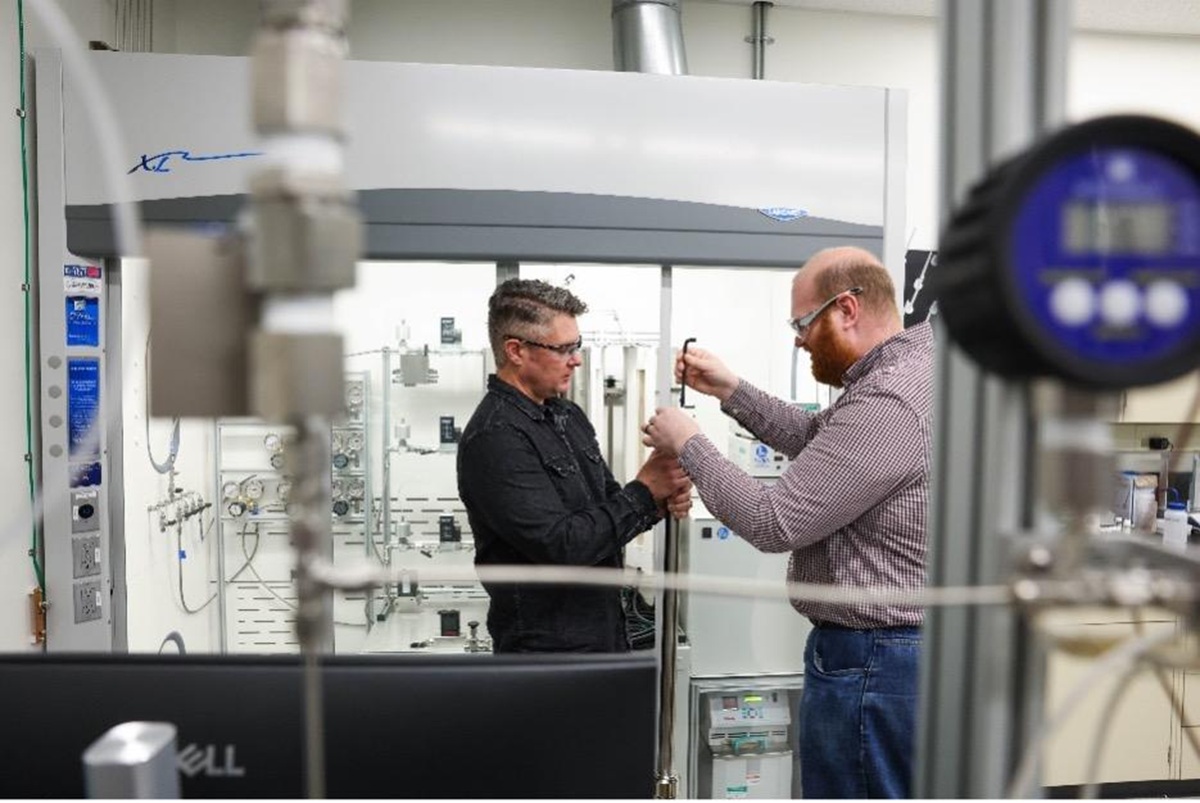
The United States advances in the race for cheaper aviation fuel with a new catalyst capable of converting ethanol into olefins in a single step, reducing steps in the process, targeting industrial scale and responding to a global sector demand projected at 230 billion gallons by 2050
Researchers in the United States have developed a new catalyst that can significantly reduce the cost of producing sustainable aviation fuel by converting ethanol into industry precursors in a single step. The technology has been licensed by Gevo, an advanced biofuels company based in Colorado, from two patents from the Oak Ridge National Laboratory of the U.S. Department of Energy.
The new technological route simplifies a process that, under conventional conditions, requires multiple phases to transform ethanol into olefins, essential compounds in the production of aviation fuel. With the single-step conversion, the expectation is to significantly improve process efficiency and accelerate its commercial application.
Andrew Sutton, senior scientist in the manufacturing science division of ORNL, stated that the partnership should accelerate the transition of catalytic technologies from laboratory scale to pilot-scale reactors. The work combines the laboratory’s research structure with Gevo’s industrial expertise to test the advancement under conditions closer to commercial operation.
-
According to scientists, colonists born on Mars may develop immunity different from that of Earth and have a higher risk of infections when coming into contact with humans from Earth.

-
Dubai places robots on the front line of firefighting with jets of 2,400 liters per minute and a range of up to 60 meters; these machines take on extreme risk zones and mark the arrival of artificial intelligence in the most dangerous physical work in the world.

-
The rain has already exceeded the limit in Rio Grande do Sul, and now the worst is coming: an extratropical cyclone and gusts of 80 to 100 km/h, with a risk of flooding, power outages, and high waves on the coast of Rio Grande do Sul tomorrow.

-
The Brazilian Air Force brings together 13 countries and over 1,200 military personnel in Campo Grande for the largest multinational natural disaster response exercise ever held in Brazil, featuring simulations of forest fires and high-complexity aerial rescues.

New route to produce aviation fuel
Sustainable aviation fuel, known by the acronym SAF, is presented as a cleaner alternative to conventional petroleum-derived fuel. Its production can utilize renewable waste, fats, oils, and agricultural residues, playing a significant role in efforts to decarbonize air transport.
In this context, the new catalyst was developed to make the conversion of ethanol, also known as ethyl alcohol, into olefins more efficient. These compounds are considered fundamental precursors for the manufacture of aviation fuel, and the simplification of the production route can reduce costs and increase carbon efficiency.
The International Air Transport Association, which represents over 80% of global air traffic, has already shown great interest in SAF. Additionally, several airlines have made commitments for large-scale purchases, which increases the pressure for more efficient and scalable solutions.
Partnership between ORNL and Gevo targets commercial scale
The initiative is being funded by a three-year research and development cooperation agreement, under the U.S. Department of Energy’s Technology Commercialization Fund. During this period, ORNL will be responsible for developing and testing catalytic pellets in advanced chemical reactors.
The laboratory will also produce computational models to predict the technology’s performance at an industrial scale. At the same time, ORNL will utilize the advanced material analysis resources of the Nanophase Materials Science Center to better understand the behavior of the catalyst in large-scale reactors.
Gevo will contribute specialized knowledge in process design and operation, as well as guide the integration of the technology into the pilot reactor. Andrew Ingram, director of process chemistry and catalysis at the company, stated that the collaboration is focused on evaluating a new catalytic process capable of converting ethanol into valuable fuel precursors and also into alternative chemicals, such as butadiene.
Additional applications and market expectations
In addition to use in the aviation fuel chain, the olefins generated by this process can also be employed in the production of plastics, solvents, and surfactants. The material also highlights that the global plastics market is expected to exceed $1.3 trillion by 2033.
Ingram stated that the work complements Gevo’s ethanol conversion portfolio, but differs from both the commercial implementation of the alcohol-to-jet fuel conversion process by Axens and the company’s next-generation ETO platform. The economic evaluation of the process will be crucial in determining the potential for scaling this technological route.
If the economic viability is confirmed, the technology could offer a flexible and economically viable alternative to expand biological-based solutions in the United States. Ingram stated that this advancement could create new markets and increase demand for farmers producing energy and material feedstocks.
The growth outlook for the sector reinforces the strategic importance of the research. Global demand for aviation fuel is expected to reach 230 billion gallons by 2050, and the increased use of SAF could help meet this volume while also enhancing U.S. energy security and reducing emissions.









Seja o primeiro a reagir!