





 Portuguese
  English
  Spanish
  6 min of reading
  2 comments


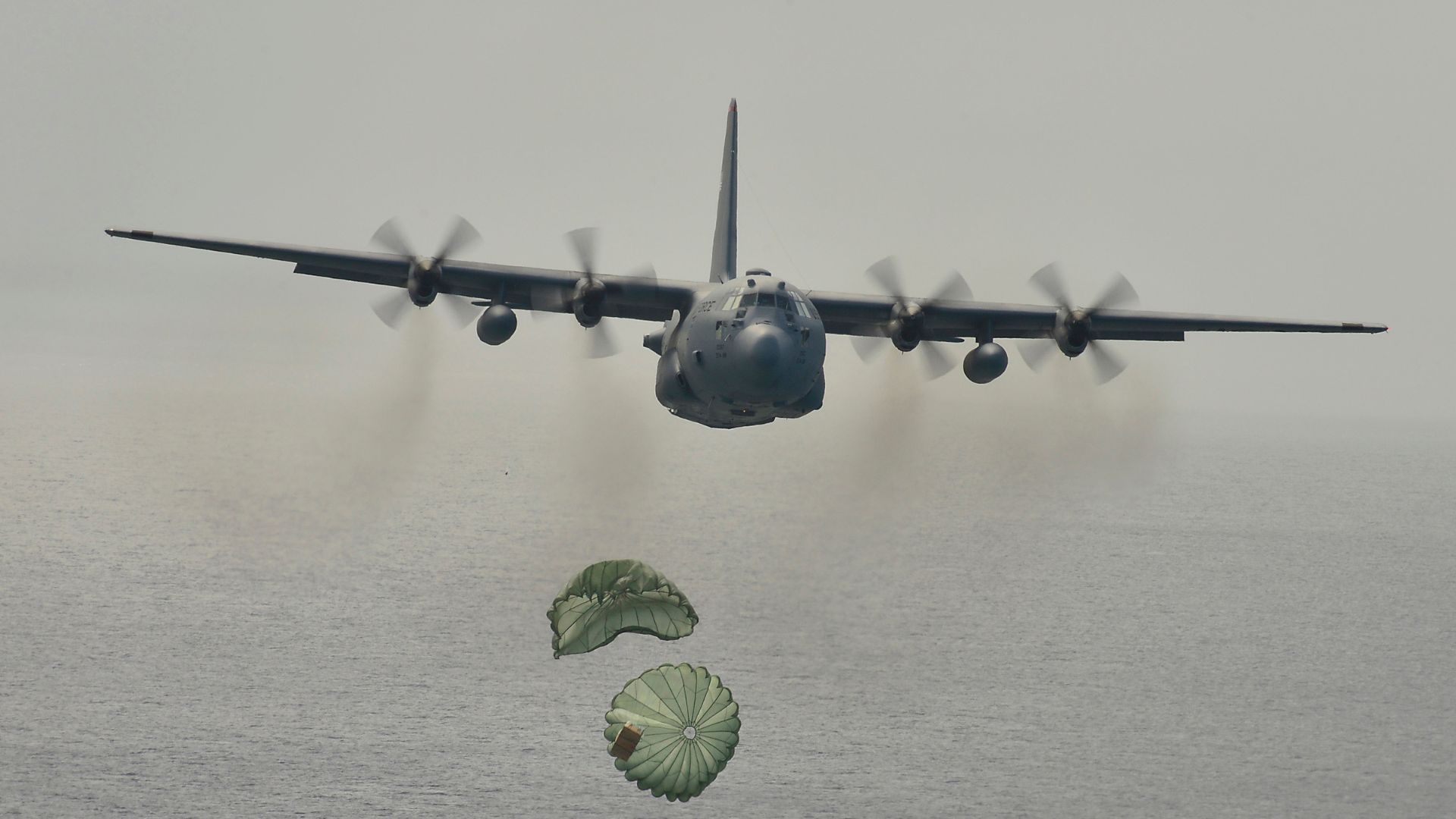


Historic Aerial Mission Combines Humanitarian Aid and Military Training in One of the Most Isolated Regions on the Planet, Using Large Planes to Supply Islands Without Ports or Structured Airports While Keeping Crews Prepared for Real Operations in Extreme and Unpredictable Environments.
Maintained continuously for over seven decades, an aerial operation in the Pacific follows an unusual route even within the military universe.
Through C-130 Military Aircraft, packages containing donations are parachuted to communities located on remote islands, where access by ship can take hours or even days and is not always viable throughout the year.
In addition to delivering essential supplies, the same flight serves as operational training in a real environment, requiring precise calculations of wind, altitude, speed, and release time to ensure that the cargo reaches the correct point.
-
Church from 1888 becomes a mansion of over 330 m² in Canada after a renovation of R$ 3.4 million and is eventually sold for nearly R$ 4.3 million.

-
How an innovative city combines high technology, well-being, and sustainability to become the largest reference in clean energy on the planet.

-
Couple buys 1846 church in ruins for R$ 660,000, invests R$ 3.2 million in renovations, transforms it into a millionaire mansion, and even preserved a historic cemetery with over 300 graves.

-
He started running at 66 years old, broke records at 82, and is now a subject of study for having a metabolic age comparable to that of a 20-year-old, in a case that is intriguing scientists and inspiring the world.


Although it has low visibility outside the military circuit and the islands being served, the initiative is described by the United States Air Force as the longest continuous humanitarian air operation of the Department of Defense in the Pacific.
The origin dates back to 1952 when a crew from a B-29 spotted residents waving on Kapingamarangi Island and decided to drop a supply package attached to a parachute.
That improvised gesture gave rise to what would later become known as Operation Christmas Drop.
Aerial Logistics in Areas Without Ports or Runways
In areas where logistics heavily depends on the sea and weather conditions, planned aerial drops reduce steps and shorten distances.
This dynamic stems from a practical reality: in many of these islands, there is no structured port, runway capable of receiving large aircraft, or a regular supply chain.

Given this scenario, concentrating supplies in a single flight cycle decreases reliance on maritime windows and infrequent commercial routes.
Currently, the operation involves dozens of islands scattered across the Pacific and usually prioritizes areas close to the coast.
For safety, the drops occur over the sea, which reduces the risk of accidents on land and facilitates the retrieval of the loads.
According to data released by the Air Force itself, the reach extends to more than 50 islands and covers an approximate area of 1.8 million square nautical miles.
The annual impact can reach more than 20,000 residents, varying according to the planning of each edition.
Why the C-130 is Used in Tiny Islands
The contrast between the size of the C-130 and the small scale of the islands is one of the most striking aspects of the mission.
Designed for transport, the aircraft combines payload capacity and performance on short runways, which expands logistical possibilities in regions with limited infrastructure.
Even so, when delivery occurs without landing, the decisive factor is not the landing, but the precision of the aerial drop.
Seen from above, each island stops being just a green spot surrounded by blue and becomes an exact set of coordinates.
The goal is to ensure that the packages, attached to canopies, descend steadily and hit a defined recovery zone established in advance.
Any variation in wind, speed, or altitude alters the parachute drift and can push the cargo outside the safe area.
Preparation of Donations Before Takeoff
The moment the boxes leave the aircraft is the most visible of the operation, but it is far from being the first step.
Long before takeoff, the donations are gathered, sorted, and packaged to withstand impacts and moisture.

This is essential because many packages come into contact with water before being recovered.
The assembly of the loads involves tying, securing, and technical checks, designed to keep the set stable during release and descent.
Institutional reports also highlight the role of volunteers and partners in raising and organizing materials.
At the same time, there is constant coordination with local communities and authorities responsible for recovery.
In previous editions, the logistics have been described as the result of months of preparation, with strict steps of weighing, securing, and verifying.
Military Training in Real Conditions
In addition to its humanitarian character, the mission serves a strategic training function.
It allows crews and cargo teams to operate in real conditions, something difficult to fully reproduce in simulated exercises.
The dropping of supplies by parachute is a skill used in disaster responses, in resupplying isolated teams, and in supporting operations far from urban centers.
By executing the procedure on long routes, under typical Pacific winds and with small targets, the teams are exposed to a high level of operational demand.
During flights, safety protocols guide each stage inside the aircraft.
Equipment checks, securing points, and constant communication are treated as basic requirements.
Any calculation or synchronization failure can result in loss of material or difficulty in recovery.
Weather predictions and the definition of operational windows are also part of the planning since rapid changes in atmospheric conditions directly affect the trajectory of the packages.
Coordination with Communities and Vessels
The success of the mission does not depend solely on the aircrew.
At the drop site, teams on the ground or on vessels monitor the descent and collect the boxes.
This support is essential to ensure that supplies are recovered safely and quickly.
When the drop occurs over the sea, the response time becomes crucial.
The quicker the recovery, the lower the chance of damage caused by water or drift away from the shore.

The Air Force itself defines the operation as a low-altitude, low-cost exercise, marked by operational repetition and execution discipline.
This standardization helps explain why the mission remains active over time.
The cycle of preparing, flying, dropping, and returning provides predictability to the communities served and keeps teams ready for emergency scenarios.
Mission Little Known Outside the Pacific
The informal classification of “secret mission” arises mainly from the contrast between its long duration and low visibility outside the region.
In public materials, the operation is described as an annual event, with institutional disclosure and the participation of partners.
There are records of involvement from units based in Guam and Japan, as well as cooperation with allied countries in different editions.
There is no clear indication in open sources that it is a classified action.
Nonetheless, operating in a vast maritime zone far from conventional routes contributes to the perception of something off the radar. In practice, what sustains continuity is a straightforward logistical equation.
In places where there are no roads and ports are limited, supplying depends on the ability to place a well-prepared package at the exact point, at the right moment.
If an initiative that started with an improvised drop in 1952 remains active to this day, what prevents this aerial delivery model, already repeatedly tested in real conditions, from being adopted more broadly to serve isolated communities in other parts of the world?






Ayuda de Estados Unidos, Lo dudo. Y menos ahora con el inhumano ese personaje que está ahorita en el Gobierno.
Poderiam fazer isso na Palestina