





 English
  Francês
  Alemão
  Italiano
  Japonês
  Norueguês
  Portuguese
  Spanish
 3 min of reading
  0 comments


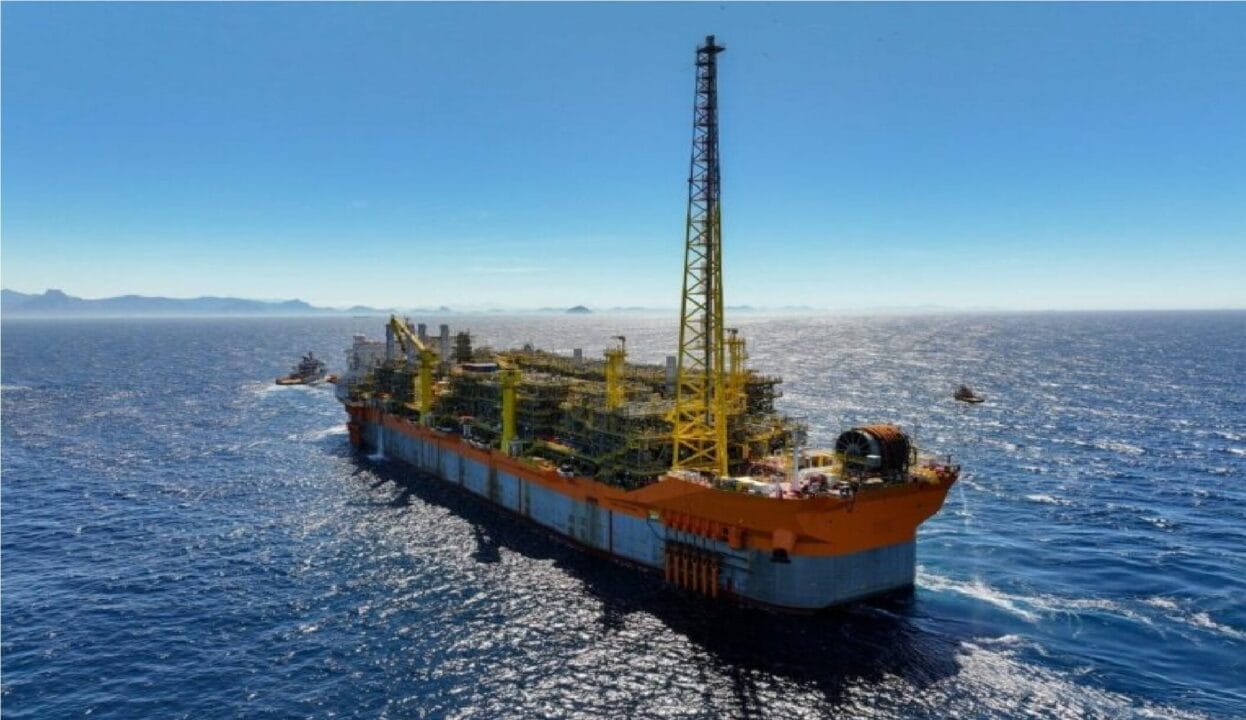
Petrobras Launched Another FPSO, Now Operational, in the Gigantic Mero Field in the Santos Basin, Highlighting Once Again!
Petrobras, the Brazilian state oil and gas giant, has commenced production of another Floating Production, Storage and Offloading Unit (FPSO) in its colossal oil field in the pre-salt area of the Santos Basin, offshore Brazil. This is the third production unit in the field, out of a total of five, as the other two are yet to be installed.
The second phase of development, or Mero-2, includes the FPSO Sepetiba with a production capacity of 180,000 barrels of oil per day (b/d) and a compression capacity of up to 12 million cubic meters of gas. This will raise the production capacity of the Mero field to 410,000 barrels/day. Two additional phases, Mero-3 and Mero-4, are under construction, with operations expected to start by 2025.
Innovative Technology and Low Emissions in the FPSO of the Santos Basin
The FPSO Sepetiba has been designed for routine zero flaring, minimizing greenhouse gas emissions, with associated gas reinjected into the reservoir. Additionally, it comes equipped with innovative technologies to enhance production efficiency and enable carbon capture, utilization and storage (CCUS), contributing to emission reductions.
-
Historic bankruptcy of Centauro shocks the market, and the century-old company puts more than 500,000 products, machines, and complete infrastructure up for online auction.

-
New shoe factory in Ceará is expected to create 400 jobs and strengthen the local economy.

-
No one imagined it, but a mixture of sawdust with a mineral that fights fires surprises scientists with a result that changes the course of fire-resistant construction.

-
From empty land to a high-end house, wooden construction uses a lightweight system, metal structure for the foundation, ventilated ceramic cladding, and special windows to create an efficient and comfortable living space throughout the year.

The Mero field is operated by Petrobras (38.6%), in partnership with Shell Brasil (19.3%), TotalEnergies (19.3%), CNPC (9.65%), CNOOC (9.65%), and Pré-Sal Petróleo (PPSA) (3.5%). Patrick Pouyanné, President and CEO of TotalEnergies, emphasized the importance of the Mero development for the company, aligning with the strategy of low-cost, low-emission oil production and the launch of the FPSO.
Future Expansion of Petrobras in the Santos Basin
Petrobras plans to put into operation 11 additional FPSO units in the offshore pre-salt layer of Brazil by 2027, increasing production to 2.4 million boe. For this, an investment of 102 billion dollars is expected over the next five years in FPSOs, prioritizing oil and natural gas projects, as well as initiatives to reduce carbon footprint.
The Importance of Petrobras’s Role in the Santos Basin
Petrobras’s operations in the Santos Basin are of utmost importance for Brazil’s oil and gas sector and also for the economy of the country as a whole. The Santos Basin is one of the most promising areas for oil exploration in Brazil, especially due to the presence of the pre-salt, a layer of rock located beneath the seabed that contains large oil reserves.
Petrobras has played a fundamental role in the development of this region, investing in advanced exploration and production technologies to enable oil extraction in deep waters and challenging conditions. Furthermore, the company has significantly contributed to increasing national oil production, which directly impacts the country’s trade balance and job and income generation.
Oil exploration in the Santos Basin also has strategic implications for Petrobras and for Brazil as a whole. The pre-salt is one of the main sources of oil in the country, and its successful exploration can ensure energy self-sufficiency and boost the national economy. In addition, Petrobras has been seeking to develop sustainable technologies and practices to reduce the environmental impact of its operations in the region, demonstrating a commitment to environmental preservation.







Seja o primeiro a reagir!