





 Portuguese
  English
  Spanish
  5 min of reading
  1 comment


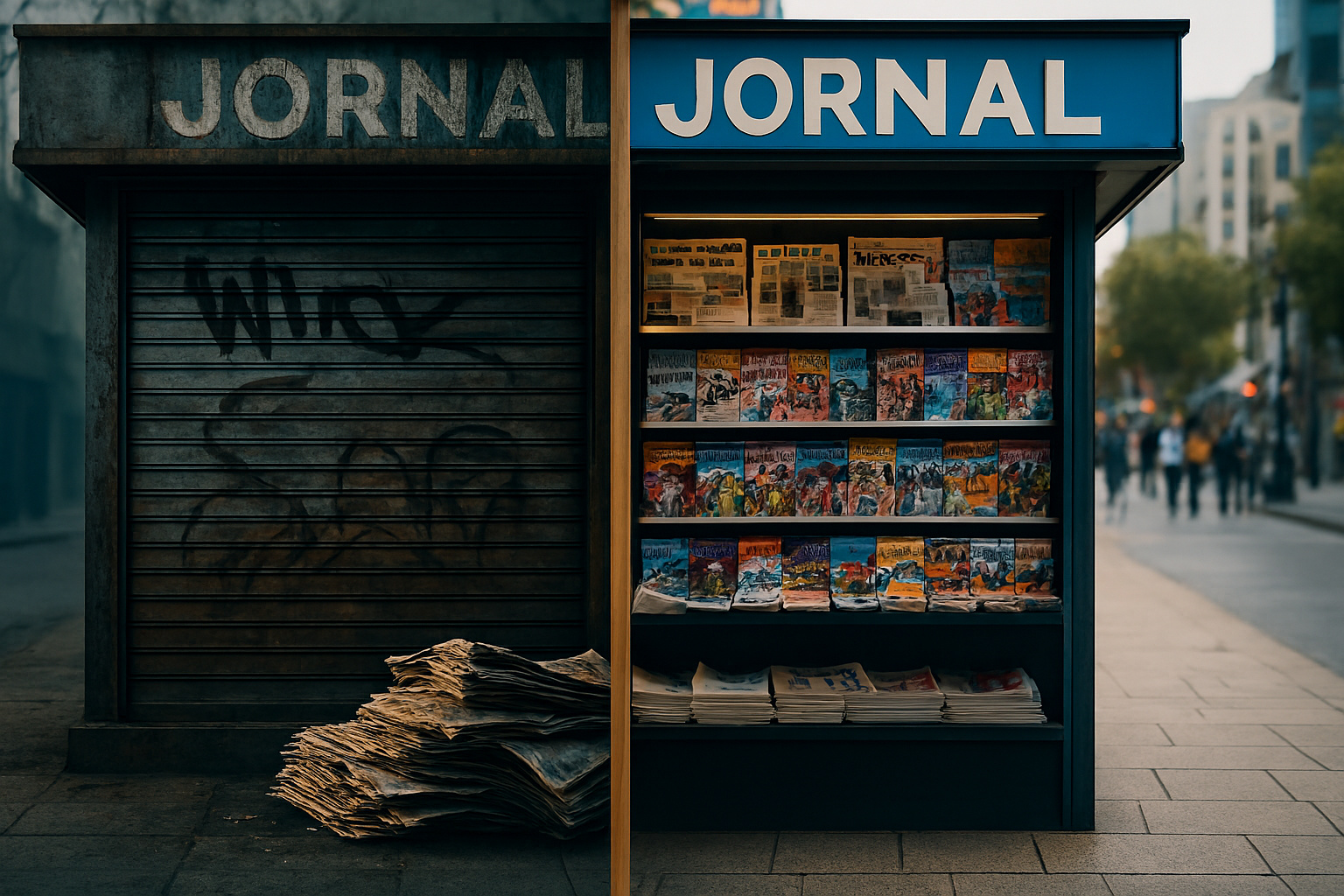


The Newsstands, Which For Decades Were Urban Icons and Meeting Points in Brazilian Cities, Are Disappearing, Victims of the Digital Age and Changes in Reading Habits.
For decades, newsstands were an inseparable part of the landscape of Brazilian cities. On every corner, it was possible to see showcases full of magazines, eye-catching covers, and stacks of fresh newspapers at dawn. But today, the scene is different: shuttered doors, yellowed magazines, and abandoned kiosks. What used to be a meeting point for readers and the curious has now become a symbol of the transition between the analog and digital worlds.
The phenomenon is national. According to data from the Union of Newsboys and the National Association of Newspapers (ANJ), Brazil has lost more than 70% of its active newsstands since the early 2000s. In São Paulo, there were nearly 2,000 newsstands in 2005; today, just over 500 remain. In Rio de Janeiro, the number has dropped from 1,400 to fewer than 400, many of which operate only as convenience stores or betting kiosks.
The Collapse of the Print Era in Brazil
The decline of newsstands is a direct reflection of the crisis of printed journalism. Between 2010 and 2024, the circulation of newspapers and magazines fell by more than 80%, according to a survey by the National Association of Magazine Publishers (Aner). Major titles that once dominated the shelves, such as Caras, IstoÉ Gente, Contigo!, and Placar, drastically reduced their print runs or migrated to digital.
-
The Argentine government celebrates the lowest poverty rate in 7 years, but experts warn that the methodology has changed, real wages have fallen, unemployment has risen, and the number of people on the streets of Buenos Aires has increased by 57% since Milei took office.

-
7.8 magnitude earthquake in Indonesia frightens the population, triggers tsunami alert, and hits an island with over 200,000 inhabitants this Thursday.

-
Google will finally let you change that embarrassing Gmail address you created in your teenage years without losing any accounts, logins, or old emails: the feature is already available in the United States.

-
Heading to Brazil in a Bonanza F33 single-engine aircraft: a couple departs from Florida on a visual flight, makes technical stops in the Caribbean to refuel and organize paperwork, and begins the staged crossing until they reach the country.




The era of printed morning reading, coffee, and newspapers on the table has given way to cell phone notifications and instant headlines. Brazilians now get their news from social networks, news portals, and content aggregators — many of them free.
According to DataReportal 2024, 93% of Brazilians consume news via smartphone, and only 4% still buy physical newspapers regularly. This has completely transformed the business model of newsstands, which relied on sales volume and daily replenishment.
The Newsstands That Try to Survive Reinvent Themselves
Even in the face of collapse, some newsstands resist — reinventing themselves as multifunctional points. In São Paulo, the city government has authorized the resale of mobile phone top-ups, transportation cards, and even coffee and quick snacks. In cities like Curitiba and Belo Horizonte, newsstands have started selling stationery, tickets, used books, and collectibles, trying to adapt to new times.
In Rio de Janeiro, some kiosks have been remodeled into betting points for Loterj and payment terminals, a way to give new life to spaces that once supported entire families.

The Urban and Cultural Impact of Disappearance
Newsstands have always been more than just sales points. They represented a center of community, information, and popular culture. There you could buy newspapers, comic books, gossip magazines, stamps, tickets, and collectibles. For many Brazilians, the newsstand was the first contact with the world of news, sports, and politics.
Today, the physical space of newsstands is slowly being absorbed by new commercial uses, such as food trucks and micro convenience stores. However, the disappearance of their metal and colorful structures changes the visual fabric of cities, making them more homogeneous, gray, and digital.
The Digital Revolution That Changed Everything
The advancement of the internet was just the first blow. In recent years, PIX, e-commerce, and social networks have completed the revolution, making the physical purchase of information almost obsolete. Monthly magazines began to compete for space with free real-time content, while newsstand collections — once popular — were replaced by digital subscriptions and e-books.
Brazil now has over 230 million active cell phones, and the average consumption of news via social networks grew by 42% in just three years, according to the Reuters Institute (2024). For new readers, the idea of buying a printed newspaper seems anachronistic — and for the young, almost folkloric.
Historic Newsstands That Became Memories
Some newsstands resist as icons of an era. In São Paulo, the Banca do Largo do Machado and Banca 2000, on Paulista Avenue, remain open but have been reinvented as cultural meeting points and mini bookstores. In Rio, the Banca do Pepe, in Copacabana, has transformed into a souvenir and postcard shop.
These survivors function more as symbols of nostalgia than as profitable businesses.
Tourists and former residents visit them as if visiting a living museum — recalling an era when news had the smell of ink and paper.

“The younger ones stop and ask what used to be sold here. It’s strange to realize that the term ‘newsstand’ already sounds old,” says Mrs. Marlene, a news vendor for 42 years.
The Uncertain Future and Possible Reinvention
Despite the trend of disappearance, some see a new function for newsstands.
Urban revitalization projects, such as the ReocupaSP Program, aim to transform them into microstores, delivery collection points, mini art galleries, and public reading booths.
Residents of the area argue that the old newsstands could be repurposed as urban microservices points, assuming new functions in the city’s landscape. These spaces could sell transport tickets, offer free internet access, and serve as charging stations for electric bicycles, becoming useful and modern structures in urban daily life.
This proposal seeks to unite public support and private creativity to revitalize facilities that are currently underutilized.
The Symbol That Survives in Collective Memory
Even if they disappear physically, newsstands will continue to live in the affective memory of Brazilians.
They marked decades of social transformations — from dictatorship to the 90s, from the 2002 World Cup to the digital age — and were the backdrop for everyday stories, loves, and friendships.
Today, the generation that grew up buying World Cup stickers, comic books from the Turma da Mônica, or gossip magazines looks with melancholy at the disappearance of a space that represented the materiality of information.
Brazil may have migrated to digital, but it is in the memories of newsstands — with their smells of paper, sounds of AM radio, and eye-catching covers — that one of the most human chapters of the country’s urban history is preserved.









Isso tudo é de uma melancolia profunda, é precisa ver o que vai ser daqui algumas decadas , em que nem lojas fisicas sabem se irão sobreviver.