





 Portuguese
  English
  Spanish
  4 min of reading
  0 comments


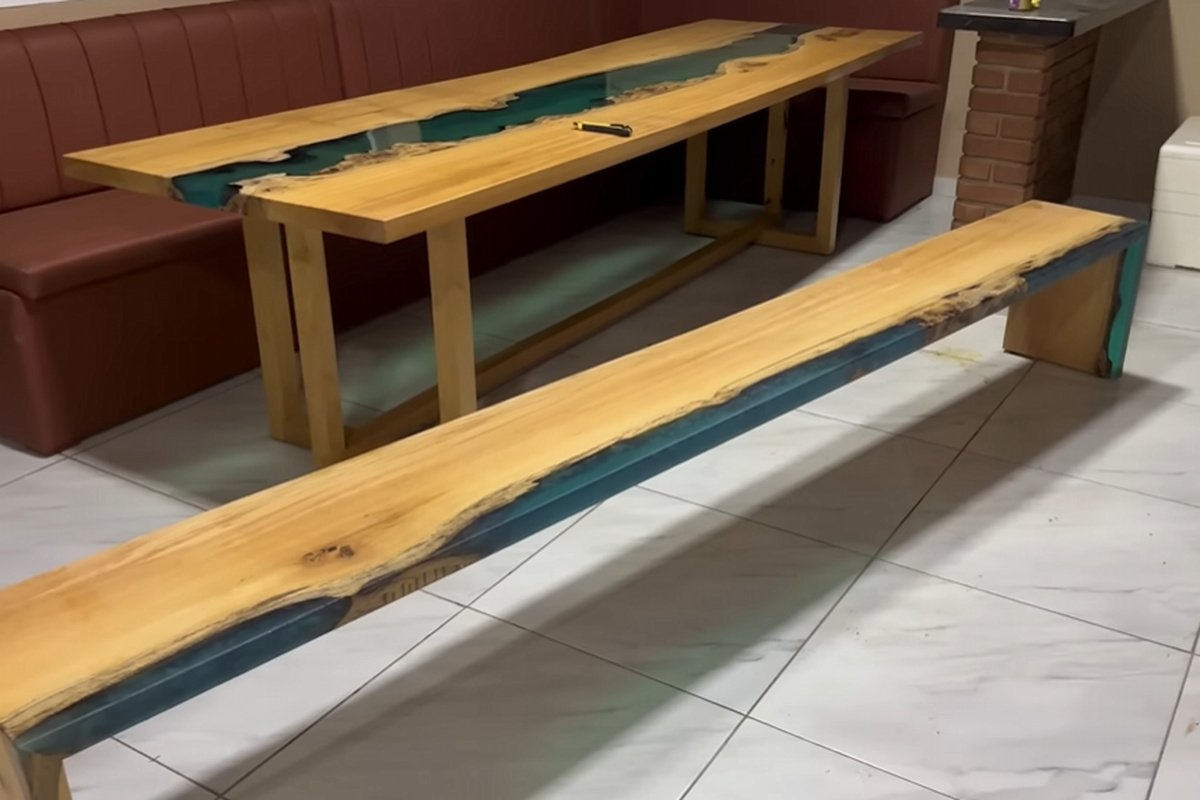
Artisan Project Shows Real Challenges Of Modern Woodworking By Combining Solid Wood, Epoxy Resin, And Technical Adjustments To Correct Structural Failures
An artisan woodworking project caught attention by revealing, in detail, how a solid wood bench with epoxy resin was produced after a technical error during manufacturing.
The piece was created as a continuation of a table previously delivered to the same client and, therefore, needed to use exactly the same board of wood.
This technical detail ended up transforming the production into a more complex process than expected.
Moreover, manufacturing required various structural adaptations to maintain the original aesthetics of the project.
As a result, the finished bench became part of the same set as the table produced earlier.
Structural Correction Of Wood Required Technical Solutions
During the beginning of production, it was identified that the wood board had significant warping at one end.
Normally, pieces with this type of deformation would be discarded or repurposed in smaller projects.
However, since the bench needed to use exactly the same wood as the already finished table, the piece had to be salvaged.
Therefore, various technical cuts were made on the underside of the board to increase its flexibility.
Next, the wood was pressed and stabilized with epoxy resin, allowing the structure to be aligned.
Calculation Error Generated Unexpected Increase In Project Cost
During this stage, however, a calculation error occurred regarding the depth of the cuts made in the wood.
As a consequence, when the piece was adjusted to the final size of the bench, some cuts became visible on the front edge.
This forced the carpenter to use more epoxy resin to fill the imperfections.
According to the project creator, this error ended up generating an approximate loss of R$ 1,000 in materials.
Nevertheless, the project continued, with new solutions being applied throughout the process.
-
The Argentine government celebrates the lowest poverty rate in 7 years, but experts warn that the methodology has changed, real wages have fallen, unemployment has risen, and the number of people on the streets of Buenos Aires has increased by 57% since Milei took office.

-
7.8 magnitude earthquake in Indonesia frightens the population, triggers tsunami alert, and hits an island with over 200,000 inhabitants this Thursday.

-
Google will finally let you change that embarrassing Gmail address you created in your teenage years without losing any accounts, logins, or old emails: the feature is already available in the United States.

-
Heading to Brazil in a Bonanza F33 single-engine aircraft: a couple departs from Florida on a visual flight, makes technical stops in the Caribbean to refuel and organize paperwork, and begins the staged crossing until they reach the country.




Application Of Epoxy Resin Guaranteed Structural Stability
After the structural correction, a generous layer of epoxy resin was applied over the wood.
This step aimed to stabilize the piece and prevent further warping in the future.
Additionally, the resin was also used to fill natural micro-cracks present in the wood.
Another important point was the prevention of splinters or chips, since the piece would be used as a bench.
Finally, the pigmented resin was prepared to reproduce the color of the original table.
Mixture Of Pigments Was Necessary To Reproduce The Original Color
The pigment used in the previous table was no longer available on the market.
For this reason, the shade needed to be manually recreated during the process.
To achieve the desired result, blue and green pigments were mixed into the epoxy resin.
The coloration was tested on small samples before the final application.
Thus, the resin could maintain a visual aspect similar to that of the original table.
Large Amount Of Resin Was Used In Filling
During the filling of the wood cavities, approximately 8 kg of epoxy resin was prepared.
Even so, part of the resin ended up penetrating internal cavities of the wood.
This process required new applications to complete the structural filling.
According to the project creator, about 2 to 4 kg of resin were lost in this process.
Despite this, the final structure was successfully stabilized.

Sanding And Precision Cuts Defined The Finishing
After the curing of the resin, the piece was demolded and underwent an intense sanding process.
Next, precision cuts at a 45-degree angle were made to assemble the bench.
These cuts ensured alignment and a more refined finish to the piece.
Subsequently, a finishing product providing a satin touch was applied.
This coating also protects the wood and resin from wear.
Production Required Intensive Work And Delivery Was Completed
The bench was completed after four days of intense work.
During this period, the carpenter even worked up to 24 hours straight to meet the promised deadline.
Once finished, the furniture was delivered to the client’s farmhouse in Brazil.
During a video call, the client approved the final result of the project.
The bench then became part of the same set as the existing table.
Final Value Reflects Artisanal Process And Technical Complexity
The project ended with a final value of R$ 11,000 for the artisan bench.
This amount considers the manual labor, the wood used, and the application of epoxy resin.
Additionally, the process involved various technical stages and structural corrections.
Therefore, the final cost also reflects the level of complexity in manufacturing.
Given all this artisanal and technical process, to what extent does the value of a handcrafted piece of furniture reflect the true work behind its creation?









Seja o primeiro a reagir!