





 Portuguese
  English
  Spanish
  5 min of reading
  174 comments





Petrobras and Eletrobras Are Not Being Considered in This Estimate. Caixa Econômica Federal, Banco do Brasil, Among Other Public Banks, Are Also Not Part of This Calculation.
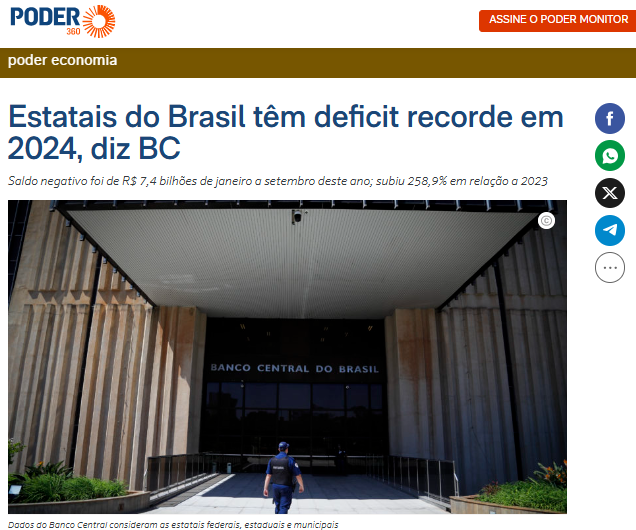
The deficit of Brazilian state-owned companies reached a new record in September 2024, totaling an impressive R$ 7.4 billion in the year-to-date, according to data released by the Central Bank on November 11, 2024 (Poder360).
This figure represents the worst result recorded for the period, according to the historical series maintained by the monetary authority since 2002. The data reflect a scenario of great challenges for the finances of state-owned companies, which, in many cases, face difficulties in balancing revenues and expenses.


This deficit includes the accounts of federal, state, and municipal state-owned companies, although the groups Petrobras and Eletrobras are excluded from this calculation. Additionally, public banks such as Caixa Econômica Federal and Banco do Brasil are also not part of this analysis. In total, the deficit balance is divided between federal state-owned companies, with R$ 4.18 billion, and state-owned companies, which recorded R$ 3.26 billion, showing that the impact occurs at both the federal and regional levels.
-
A new Brazilian shopping center worth R$ 400 million will be built in an area equivalent to more than 4 football fields, featuring 90 stores, 5 cinemas, a supermarket, a college, and parking for 1,700 cars, potentially generating 3,000 jobs.

-
Larger than entire cities in Brazil: BYD is building a 4.6 km² complex in Bahia with a capacity for 600,000 vehicles per year, but the discovery of 163 workers in conditions analogous to slavery has shaken the entire project.

-
With an investment of R$ 612 million, a capacity to process 1.2 million liters of milk per day, Piracanjuba inaugurates a mega cheese factory that increases national production, reduces dependence on imports, and repositions Brazil on the global dairy map.

-
Brazilian city gains industrial hub for 85 companies that is equivalent to 55 football fields.


The deficit situation raises questions about the sustainability of these companies’ operations and the financing and investment model used. Amid global economic challenges and increasing pressure on fiscal control, these numbers highlight a concerning picture for public accounts and the financial balance of the country.
Main Factors for the Deficit in State-Owned Companies
The Central Bank pointed out that a deficit of this magnitude indicates a decrease in the assets of state-owned companies, often caused by investments aimed at expanding operations or improving services provided. According to Fernando Rocha, head of the institution’s Statistics Department, a practical example can occur when a sanitation state-owned company decides to expand its coverage area to serve more regions. Initially, these investments may lead to deficits, but in the long run, they may yield returns in the form of increased revenue, such as the payment of fees.
The Ministry of Management and Public Innovation also commented on the deficit situation, emphasizing that a large portion of the primary deficit of federal state-owned companies in 2024 corresponds to investments in infrastructure. According to the ministry, the primary result takes into account only the revenues and expenditures of the current year, without accounting for resources accumulated from previous years or financing revenues. Thus, the primary result alone may not reflect the financial health of these companies.
The ministry also noted that many state-owned companies record primary deficits even when profits increase, especially during phases of expansion and business modernization. These improvements can range from the adoption of new technologies to the expansion of service networks, as seen in transportation or basic sanitation companies. Therefore, the deficit is partly a reflection of growth investments.
Gross Debt and Consolidated Results
In addition to the deficit, the Central Bank reported that the gross debt of the Brazilian government ended September 2024 at 78.3% of GDP, a slight decrease from the previous month.
This figure includes amounts from the federal government, INSS, state and municipal governments and is one of the most closely monitored indicators by investors to assess the country’s fiscal sustainability.
The reduction, although modest, marks a pause in the upward trajectory that began in June 2023, when public finances faced increased pressure due to economic adjustments (Valor Econômico).
Meanwhile, the net debt – which deducts government assets – reached 62.4% of the GDP in September 2024, recording the highest level since 2002.
This increase was largely driven by currency appreciation, which directly impacts the overall balance of government accounts. With the growth of debts and the accumulation of deficits, the economic situation of state-owned companies and the public sector as a whole has been receiving increasing attention.
The primary deficit of the consolidated public sector, which includes the central government, regional governments, and state-owned companies, was R$ 7.3 billion in September. This figure represents a significant improvement compared to the same period last year when the deficit had reached R$ 18.1 billion. The recovery occurred despite a deficit of R$ 4 billion in the central government, which was offset by the increase in federal revenues over the period.
Expectations for End of 2024 and Fiscal Target
For 2024, President Luiz Inácio Lula da Silva‘s government set a deficit target of R$ 28.8 billion as the maximum limit within the tolerance margin for fiscal adjustment. The government’s central objective is to balance public accounts to avoid new accumulations of excessive debts. This fiscal commitment aligns with the effort to control public indebtedness, a crucial factor for investor confidence and economic stability.
Currently, the Union maintains direct control over 44 federal state-owned companies and indirectly over another 79 subsidiaries. This large number of companies controlled by the government reflects the substantial presence of the state sector in the Brazilian economy and highlights the importance of effective management of public accounts.
In a global scenario of uncertainties and economic pressures, the strategy of reducing the deficit, controlling gross debt, and increasing efficiency in state-owned companies is essential for long-term economic stability.
If these fiscal adjustment measures are well implemented, state-owned companies could contribute more significantly to the country’s growth, helping to prevent additional financial pressures on the public budget.










FONTE DESTA MATÉRIA; https://en.clickpetroleoegas.com.br/wp-content/uploads/2024/11/Banco-Central-revela-prejuizo-recorde-de-estatais-brasileiras-a-niveis-historicos-jamais-vistos-desde-2002.pdf
Cadê a lista das estatais com os respectivos motivos??? Pelo menos das federais…
Quando for falar do que os “investidores” estão observando era bom citar as manobras contábeis das grandes varejistas, como a AMERICANAS, para apresentar “lucro” e fazermos o comparativo de um cenáro de influência na decisão do investidor… Um post desse não é nem “matérias”…
Eu gostaria de trabalhar no Canadá eu só pinto industrial imobiliário
para deminuir a corrupção no setor público a solução é privatizar a qualidade do serviço é outra coisa .o que é público todos mundo quer mandar é vira bagunça
Banco Central comandado por chesfe de qu4drilha, tentando derrubar um governo que preocupa-se com a fome! O que é que podemos esperar? Infelizmente, só tentativa de desestabilizar o governo progressista. JESUS CRISTO foi “axassinado” porque era progressista.