





 Portuguese
  English
  Spanish
  3 min of reading
  236 comments


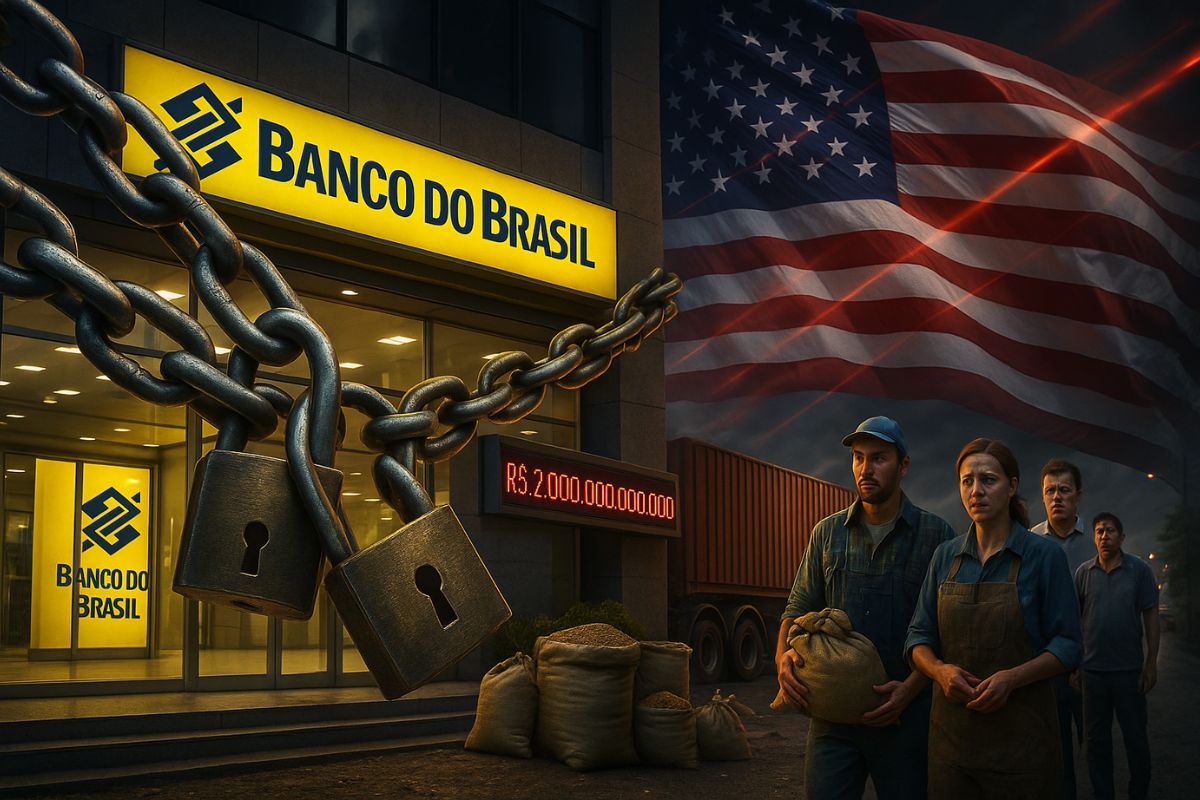


According to lawyer Davi Aragão, if secondary sanctions are applied, Banco do Brasil may have blocked the payment of salaries, entire crops, and exports in 2025.
The Banco do Brasil is the backbone of the national financial system. Founded in 1808, with over two centuries of operation and presence in 20 countries, it manages assets exceeding R$ 2 trillion. Its role ranges from paying public servants to large-scale agricultural financing, also extending to support Brazilian exports.
However, the bank has come under the radar of the U.S. Department of the Treasury. According to lawyer Davi Aragão, there is a risk of applying secondary sanctions under the Magnitsky Act, American legislation created in 2012 to punish entities accused of supporting democratic violations or already sanctioned actors. If realized, the effects could paralyze part of the Brazilian economy.
What Are Secondary Sanctions?
Primary sanctions, applied in July 2025, were already targeting specific individuals and institutions linked to Brazil.
-
A new Brazilian shopping center worth R$ 400 million will be built in an area equivalent to more than 4 football fields, featuring 90 stores, 5 cinemas, a supermarket, a college, and parking for 1,700 cars, potentially generating 3,000 jobs.

-
Larger than entire cities in Brazil: BYD is building a 4.6 km² complex in Bahia with a capacity for 600,000 vehicles per year, but the discovery of 163 workers in conditions analogous to slavery has shaken the entire project.

-
With an investment of R$ 612 million, a capacity to process 1.2 million liters of milk per day, Piracanjuba inaugurates a mega cheese factory that increases national production, reduces dependence on imports, and repositions Brazil on the global dairy map.

-
Brazilian city gains industrial hub for 85 companies that is equivalent to 55 football fields.


Secondary sanctions expand the impact because they punish any international institution that maintains ties with Banco do Brasil.
In practice, this would mean disconnecting Banco do Brasil from the global financial system, blocking settlement operations and international transfers.
This rupture would directly affect the settlement of exports, payment of social benefits, and the flow of rural credit.
Immediate Impact on the Economy
The first effect would be on millions of daily transactions. Salaries of civil servants, pensions, and transfers of social programs could be compromised.
Agricultural financing, one of the pillars of Banco do Brasil’s operations, would also come to a halt, affecting everyone from small producers to large exporters.
Experts warn that the 2026 harvest could be compromised, raising internal costs and reducing the international competitiveness of Brazilian agribusiness.
As a consequence, there would be repercussions on food prices, the commodities market, and the trade balance.
Exports Under Threat
The Banco do Brasil is a key player in international settlements of strategic products like soy, iron ore, and oil.
Without full access to global banking networks, exporters would be left unpaid and contracts could be terminated, harming companies and the exchange balance.
Europe and the United States could increase diplomatic pressure, forcing Brazil to seek alternatives in parallel financial systems, such as those from Chinese and Russian state banks.
Political and Diplomatic Repercussions
According to lawyer Davi Aragão, such a sanction would not be just against a bank, but against the entire financial infrastructure of Brazil.
The effect would be comparable to a partial blockade, unprecedented since the redemocratization.
The government would have to respond with emergency measures, such as creating parallel compensation mechanisms, agreements with strategic allies, and changes in its foreign policy.
But any move in this direction could increase friction with the U.S. and the European Union.
The Risk of Daily Collapse


More than a clash between governments, the risk falls on the practical lives of Brazilians.
Workers could be left without salaries, producers without credit, and exporters without international settlements.
This is not a common banking crisis, but a direct attack on the financial heart of the country.
This scenario raises questions about the resilience of the national financial system and how far international pressure can affect the economic routine of millions of people.
In your opinion, can sanctions against Banco do Brasil lead to an economic collapse, or does the country have viable alternatives to sidestep U.S. pressure? Do you believe the impact will be more diplomatic or practical in the daily life of Brazilians? Share your thoughts in the comments — we want to hear from those monitoring this situation in practice.








O Brasil precisa ter um sistema operacional financeiro próprio esse senário nos dexa claro não devemos confiar em ninguém.
Pra cima deles TRUMP…
Restringe entrada e espaço aérea caça passa porte e vistos de autoridades brasileiras ,proíbe investimentos em dólar ,congela investimentos e bens desses aliados a esquerda dentro dos Estados..
Bóta pra tora 🇱🇷🇱🇷😂😂
**** neles TRUMP 🇱🇷🇱🇷🇱🇷🇱🇷