





 Portuguese
  English
  Spanish
  3 min of reading
  37 comments


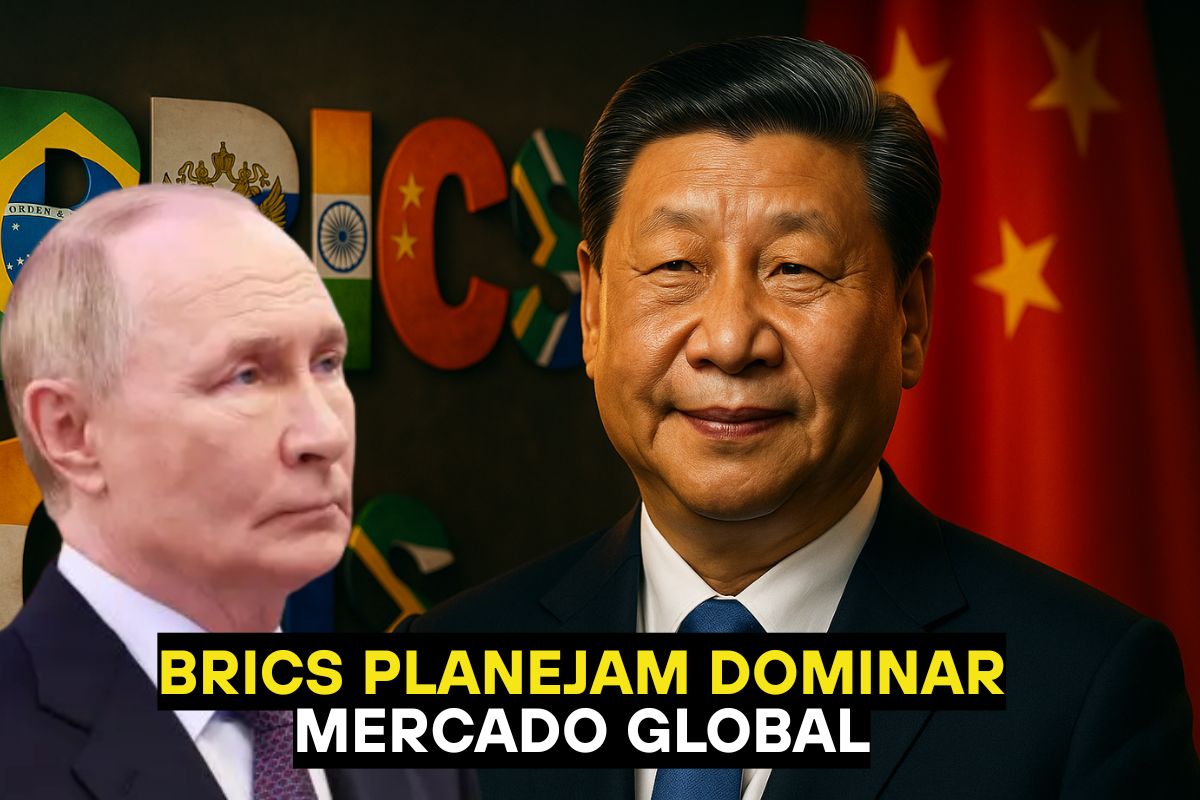


Investments Over US$ 20 Billion in AI and Robotics, Joined by Cooperation Between China and Russia, Reposition the Block as a Strategic Force in the Sector.
The billion-dollar Chinese subsidies and Russian support are paving the way for the BRICS to take on a central role in the global technological innovation market. According to China Daily, Beijing is allocating more than US$ 20 billion in 2024 to boost artificial intelligence (AI) and robotics startups, while Moscow is coordinating mechanisms for integrating venture capital and new entrepreneurs.
This movement comes at a time of gradual recovery in the venture capital sector, which, after a 50% drop in 2023, returned to grow by 25% in the first half of 2025.
The combination of massive investments from China and Russia’s institutional coordination places the block in a strategic position amid the global competition for technological prominence.
-
A new Brazilian shopping center worth R$ 400 million will be built in an area equivalent to more than 4 football fields, featuring 90 stores, 5 cinemas, a supermarket, a college, and parking for 1,700 cars, potentially generating 3,000 jobs.

-
Larger than entire cities in Brazil: BYD is building a 4.6 km² complex in Bahia with a capacity for 600,000 vehicles per year, but the discovery of 163 workers in conditions analogous to slavery has shaken the entire project.

-
With an investment of R$ 612 million, a capacity to process 1.2 million liters of milk per day, Piracanjuba inaugurates a mega cheese factory that increases national production, reduces dependence on imports, and repositions Brazil on the global dairy map.

-
Brazilian city gains industrial hub for 85 companies that is equivalent to 55 football fields.


China as a Financial Engine of Innovation
China maintains a prominent position as the third-largest global destination for venture capital, alongside the United States and the United Kingdom.
Focusing on sensitive areas such as humanoid robots and generative AI, the country aims to accelerate the transition of its technological ecosystem to global leadership.
According to Alexander Vedyakhin, Vice President of Sberbank, the flow of capital has become increasingly selective, prioritizing sectors with higher potential for returns.
In this scenario, AI already accounts for almost a third of all global investments in 2024, reinforcing China’s bet as a strategic movement and not just a temporary circumstance.
Recovery of Venture Capital
After reaching US$ 643 billion in 2021 and halving in 2023, the global venture capital market stabilized at US$ 330 billion in 2024.
The 25% growth in early 2025 is interpreted as a sign of renewed confidence, with the BRICS trying to take advantage of this new phase to attract leading startups.
Emphasis is placed on focus on governance and multipolar cooperation, as capital depends not just on the number of transactions but on where resources are applied.
In this environment, the alliance between China and Russia becomes essential to expand the BRICS’ space in the geopolitics of innovation.
Moscow as a Strategic Stage
Sberbank, in partnership with the Russian government, is organizing the Moscow Startup Summit for October, an event that will bring together more than 600 investors and 150 international speakers.
The meeting aims to connect startups with global corporations, investors, and public authorities, as well as stimulate partnerships among BRICS countries and the Shanghai Cooperation Organization (SCO).
In addition to business rounds, there will be an exhibition of technological solutions and awards for outstanding projects. The intention is to consolidate Moscow as a convergence point for capital, technology, and innovation within the block.
Chinese Expansion in the BRICS Ecosystem
Among the acceleration programs of Sber500, about 13% of startups have chosen China as their destination for international expansion.
This data reinforces the attractiveness of the Chinese market, which ranks among the ten largest hubs of founders enrolled in acceleration programs promoted by the Russian bank.
Combined, these movements reveal the clear intention of the BRICS to transform political cooperation into economic prominence in the technology sector, reducing dependence on traditional hubs like Silicon Valley and London.
The advance of billion-dollar Chinese subsidies and Russian support shows that the innovation market is becoming increasingly multipolar, and the BRICS want to occupy a prominent space.
The question is whether this strategy will be sufficient to overcome structural barriers and rival the United States and the European Union in the coming years.
Do you believe that the BRICS will be able to lead the next wave of global innovation? Or are the internal challenges of the block still an obstacle?
Share your opinion in the comments, your insight helps enrich the debate.










“A história nos mostra que o imperialismo não são eternos!”
O Brinks já é uma realidade, só não vê quêm não quer, a solução vai ser á Europa se entregar ao Brinks e isolar Japão e os estados unidos com o dólar decadente dele.
Acho que é indiscutível o protagonismo de das Civilizações do Oriente, tendo investido continuamente em suas imensas e cultas populações, que ensinam tanto ao mundo.
Os valores humanos e construtivos não são uma promessa .
São uma feliz realidade.