





 Portuguese
  English
  Spanish
  4 min of reading
  0 comments


Secret Underground Facilities Of The US Remain Active And Protected, Revealing The Strategic Legacy Of The Cold War And Its Current Developments
The existence of underground facilities controlled by the government of the United States has always generated curiosity. Although few are accessed by the press, some of these structures are known. They involve nuclear missile silos, alternate command centers, shelters against attacks, and locations intended for continuity of government in case of serious emergencies. Below are the main examples revealed to the public.
Underground Nuclear Missile Silos
The United States maintains a network of underground nuclear missile silos, mainly in northern states like Montana, North Dakota, and South Dakota.
These facilities are part of the military program of the Department of Defense (DoD) and are under the responsibility of the Space Force, the sixth branch of the US armed forces.
-
Friends have been building a small “town” for 30 years to grow old together, with compact houses, a common area, nature surrounding it, and a collective life project designed for friendship, coexistence, and simplicity.

-
This small town in Germany created its own currency 24 years ago, today it circulates millions per year, is accepted in over 300 stores, and the German government allowed all of this to happen under one condition.

-
Curitiba is shrinking and is expected to lose 97,000 residents by 2050, while inland cities in Paraná such as Sarandi, Araucária, and Toledo are experiencing accelerated growth that is changing the entire state’s map.

-
Tourists were poisoned on Everest in a million-dollar fraud scheme involving helicopters that diverted over $19 million and shocked international authorities.


One of the most cited examples is Minot Air Force Base in North Dakota. This base hosts continuous operations 24 hours a day, with long shifts.
The teams sleep on-site due to the distance from the silos in remote areas. Operations include training and surveillance, with officers ready to act in case of real activation.
In the 1990s, some of these bases were the target of protests. A group of elderly activists was organizing demonstrations in front of the silos.
The protests were not widely publicized and, although isolated, drew attention to the continued existence of these facilities even after the end of the Cold War.
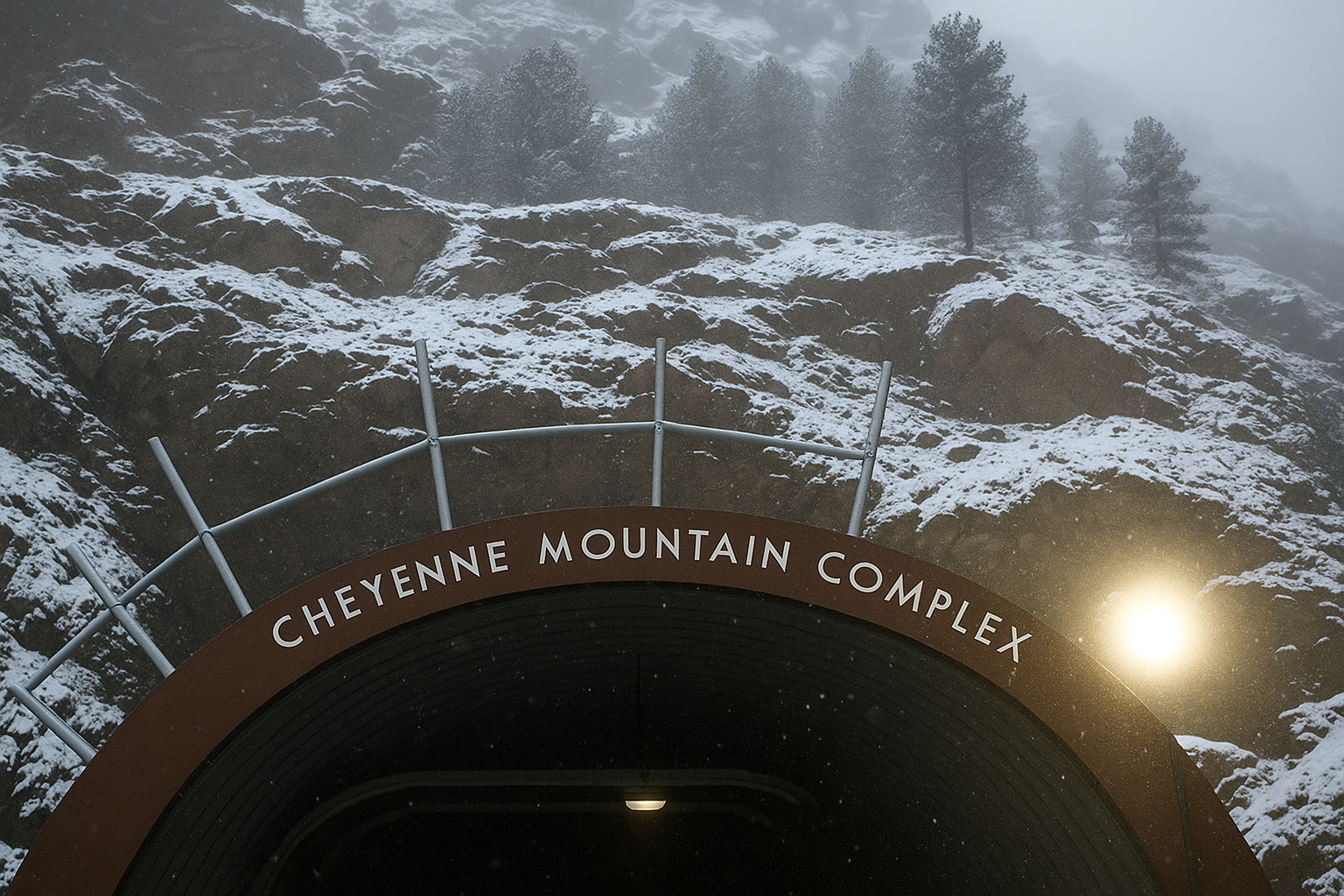
Cheyenne Mountain Complex
Built during the Cold War, the Cheyenne Mountain Complex is one of the most well-known structures in the US.
Located in Colorado Springs, Colorado, it is protected by about 600 meters of granite. Construction began in 1961, with the excavation of approximately 700,000 tons of rock.
The facility served as the command center for NORAD (North American Aerospace Defense Command), becoming operational in 1967. It was capable of withstanding nuclear explosions and electromagnetic pulses. For decades, it housed various command and defense systems.
In 2002, the site was renamed Cheyenne Mountain Air Force Station. As of 2006, the main mission of NORAD was transferred to Peterson Air Force Base.
The former facility is now used for training and support. Currently, about 200 people work there, a much smaller number than the two thousand employees recorded at the height of the Cold War.
Raven Rock Mountain Complex
The Raven Rock Mountain Complex, also known as Site R, is located in Pennsylvania. It was built to be an alternate command location in case of a nuclear attack.
The idea arose with the Continuity of Government doctrine, which has roots in the American Revolution but gained momentum with President Truman in 1952.
The site would house leaders of the Department of Defense and their teams, ensuring the continuity of government operations in case of destruction in Washington. The bunker gained notoriety after the book Raven Rock, published in 2017 by Garret Graff, which details the creation and functioning of the structure.
In 2006, the complex was used in a military exercise simulating the effects of an avian flu pandemic.
The Department of Defense found that containing an infection was more difficult than anticipated. This led to questions about the real viability of maintaining continuous operations during health crises.
Mount Weather Operations Center
Not all underground facilities are under military control. One example is the Mount Weather Emergency Operations Center, managed by the Department of Homeland Security (DHS). The facility is located in the Blue Ridge Mountains, about 100 kilometers from Washington, D.C.
Mount Weather is prepared to house the President of the United States and cabinet members in case of a nuclear attack. The existence of the site was mentioned after the attacks of September 11, 2001, when then Vice President Dick Cheney was reportedly taken there.
According to documents from FEMA (Federal Emergency Management Agency), the center is considered a key point for the continuity of government. Its use is reserved for extreme situations, although few details are officially published.
Military Installations: A System That Still Operates In Silence
Despite the reduction of tensions after the end of the Cold War, these underground facilities continue to operate, with purposes ranging from nuclear defense, space surveillance, support for the International Space Station, and maintenance of government structure during severe crises.
Press access is controlled, visits are rare, and when they occur, they involve long commutes, military escorts, and image restrictions.
These facilities remain as silent legacies of a period when the threat of nuclear destruction shaped strategic decisions of the United States.
Today, many of these centers are still active, although with functions adapted to modern reality. Some serve for training, while others remain ready for emergencies. What remains is the secrecy and strategy behind structures designed to function even in the worst possible scenarios.
With information from Veteran.com.









-

4 pessoas reagiram a isso.