





 Portuguese
  English
  Spanish
 3 min of reading
  1 comment


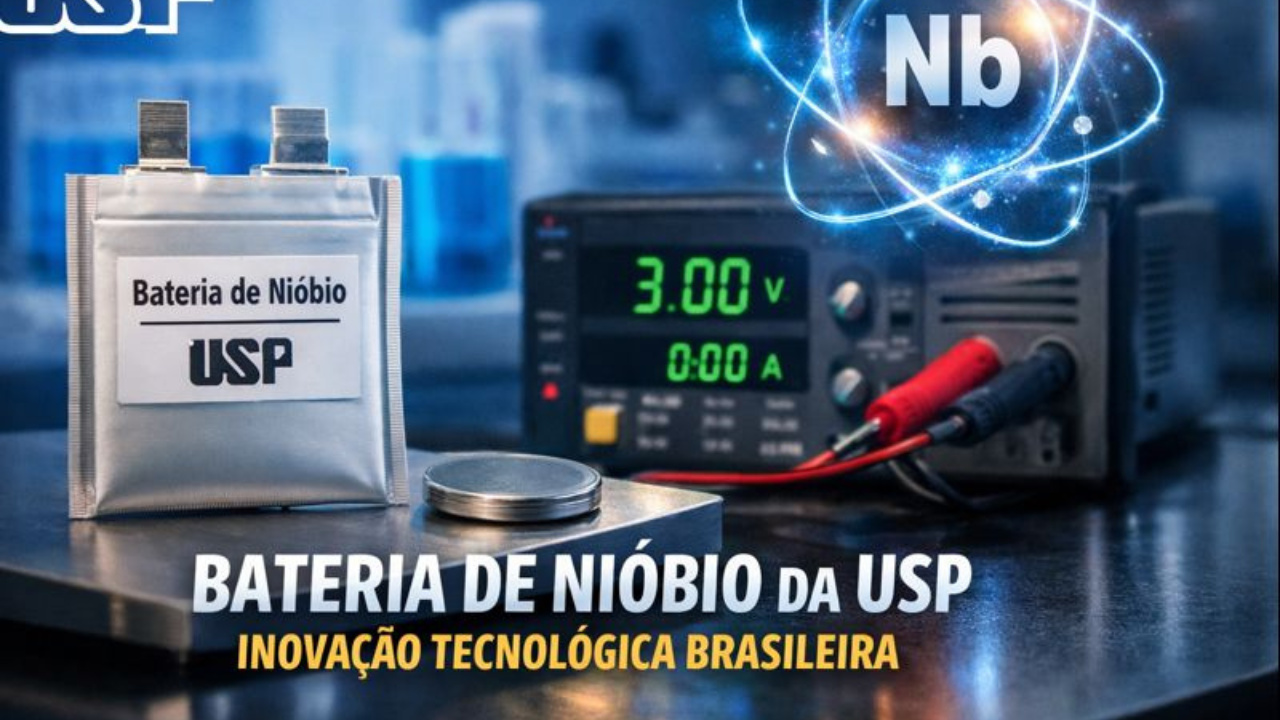


USP Technological Innovation Creates Stable, Rechargeable Niobium Battery Ready for Industrial Testing in the Energy Storage Sector.
The niobium battery developed by University of São Paulo represents a decisive advance for energy storage in Brazil.
The prototype is rechargeable, operates outside of controlled laboratory environments, reaches 3 volts of tension, and has already entered the industrial testing phase.
The project has been conducted by USP researchers for about ten years and reinforces the role of national scientific research in the creation of technologies with market potential.
-
With a cost per shot close to zero, the DragonFire laser could change naval warfare in 2027 and provide British ships with nearly unlimited defense against drones.

-
A British startup creates tires that generate electricity in electric vehicles when passing over potholes, speed bumps, and cracks.

-
Scientists have created robots made with living cells that have their own nervous system, swim on their own, explore the environment, and self-organize without any genetic engineering, and now they want to do the same with human cells.
-
Students create a solar-powered ambulance that operates without a plug, without fuel, and still keeps medical equipment running in remote areas.
The development occurs on the São Carlos campus, involving the Institute of Chemistry and the Institute of Physics of the university.
The central objective has always been to overcome a historical obstacle: the rapid degradation of niobium in electrochemical environments, especially in the presence of water and oxygen.
Niobium Battery Born to Operate in Real Conditions
Unlike many academic prototypes, the Brazilian rechargeable battery was designed to function under conditions similar to those faced by industry.
This means operating outside ideal environments and maintaining stability even after successive charge and discharge cycles.
According to the researchers, achieving this performance required a change in approach.
So instead of merely adapting traditional materials, the team decided to redesign the chemical environment in which niobium operates, allowing the metal to maintain its integrity over time.
USP Technological Innovation Inspired by Biology
The solution found is directly inspired by nature.
The group developed a system called NB-RAM, an active redox medium that acts as a kind of “smart protection” for the metal.
In this environment, niobium can repeatedly alternate its electronic states without suffering degradation.
This behavior mimics processes observed in enzymes and metalloproteins, common in biological systems.
Thus, the USP technological innovation advances by uniting chemistry, physics, and natural principles to solve a problem considered critical in the battery sector.
National Scientific Research and the Challenge of Chemical Balance
A large part of the system’s refinement was under the responsibility of researcher Luana Italiano, who led two years of continuous adjustments. The work involved dozens of experimental versions until stability and reproducibility were achieved.
According to the researcher, the biggest challenge was finding the exact balance point.
Overprotecting niobium reduces energy efficiency; on the other hand, insufficient protection accelerates degradation.
Thus, this fine-tuning was essential to turn the concept into a functional niobium battery.
Industrial Tests Bring the Battery Closer to the Market
With the system stabilized, the team moved on to tests in formats used by the industry.
The results demonstrated consistent performance over several charge and discharge cycles, validating the technical feasibility of the technology.
Energy Storage and Strategy for Brazil
The battery has a voltage compatible with most commercially available solutions today.
Additionally, the technology has already had a patent filed by USP, a fundamental step to protect the innovation and enable future partnerships with the productive sector.
To scale up production, the researchers advocate the creation of a multimodal innovation center, bringing together universities, governments, and startups.
Thus, the proposal is to accelerate the transition from the laboratory to the market, strengthening the energy storage ecosystem in the country.
Brazilian Rechargeable Battery Symbolizes a Paradigm Shift
For Crespilho, the project goes beyond the technology itself.
In this context, the Brazilian rechargeable battery emerges as a concrete example of how national scientific research can generate innovation, added value, and technological leadership.
The advancement of the niobium battery reinforces that investing in science is strategic not only for the present but for the country’s energy future.










Mas também, depois dessa baboseira toda em torno do nióbio, já era hora de algo de concreto efetivo!!!..