





 Portuguese
  English
  Spanish
  5 min of reading
  0 comments


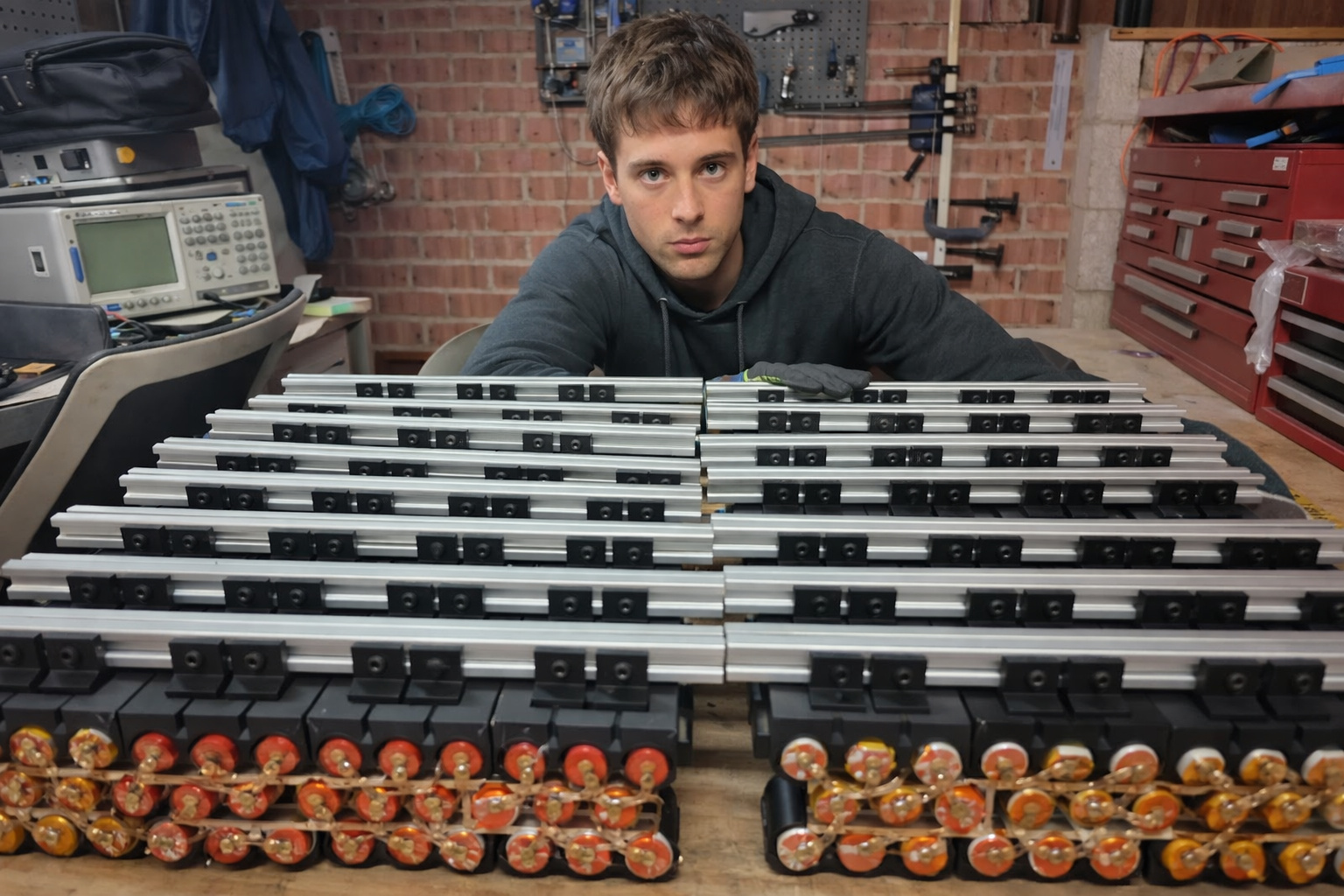
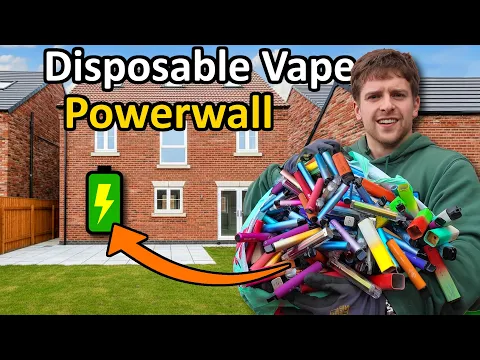
Experiment Reveals How Over 1 Million Discarded Vapes Per Day Hide Batteries Capable of Powering a Home
During the peak consumption in the United Kingdom, more than 1 million disposable vapes were thrown away every day. This number alone is striking. However, the problem goes far beyond the volume of waste.
The information was disclosed by the experiment’s creator on his YouTube channel. There, he decided to prove something bold: turning hundreds of disposable vapes into a battery capable of powering an entire workshop — and even part of a house.
While millions of devices went straight to the landfill, he saw energy potential. After all, each vape contains a rechargeable lithium-ion battery, the same technology used in cell phones and laptops. Therefore, the waste is not just environmental, but also energy-related.
-
Spain surprises the world by erecting 62 artificial dunes, mixing sand with natural remains of posidonia, and causing the structure to lose only 1.4% of its volume in 1 year.

-
With 16 Bulava missiles, improvements in acoustic stealth, and a design focused on silent patrols, Russia’s nuclear submarine was born to ensure Moscow’s invisible retaliation and has become one of the pillars of its maritime strength.

-
‘Populous’ city in Rio among the worst in Brazil in national ranking and exposes silent development crisis.

-
Couple buys house in the South Zone of São Paulo, opens a hidden door in the garage, and finds a secret wine cellar with dozens of old wines forgotten since the 1970s.

How Much Energy Is in a Disposable Vape?
First of all, we need to understand energy capacity. If a battery provides 1 watt for 1 hour, it has 1 watt-hour (Wh). For comparison, a typical smartphone has about 10 Wh.
With this in mind, the goal became clear: to build a battery with 2,500 Wh (2.5 kWh). In other words, enough energy to power a workshop for several days or keep a house running for about 8 hours, considering that the average residential consumption is around 6,000 Wh per day (6 kWh).
The small vape cells offer, on average, 1.8 Wh. Therefore, it would require almost 1,400 units. However, larger models deliver about 5 Wh, which reduces the necessity to approximately 500 cells.
Given this significant difference, he focused exclusively on the larger batteries.
The Unexpected Challenge: Half of the Batteries Were Useless

However, a critical problem soon emerged. During initial tests, he found that about 50% of the cells were below 3 volts. When a lithium battery drops below 3V, it suffers permanent damage and cannot be safely recovered.
This happened because the internal circuit of the vapes continues to consume energy slowly, even after use. As many units were stored for over a year, several batteries simply ran completely out.
To resolve this bottleneck, he created a smart sorting system. Using a CPAP machine air pump, he simulated an automatic puff. If the vape blinked, it meant the battery was still above 3V. Otherwise, it was dead.
Thus, he was able to quickly separate usable units from unusable ones. Consequently, he drastically reduced the wasted time dismantling devices with no potential for reuse.
Even so, the work was intense. It took him about 2 months to complete the dismantling and testing. Furthermore, each batch required approximately 2 hours for balancing and capacity measurement. In the end, he was able to reuse about 500 functional cells.
This number, therefore, shows how the manual recycling of these devices requires immense effort.
How He Assembled the 50-Volt Battery
After selecting the viable cells, he began building the battery.
First, he grouped nine cells in parallel. This configuration increased the capacity without raising the voltage. Then, he connected several modules again in parallel to further expand the energy storage.
Subsequently, he connected 14 groups in series, which raised the total voltage to approximately 50 volts. Each half measured about 25 volts before the final connection.
In this way, he achieved a structure of both high capacity and high voltage at the same time.
Safety System Inspired by Tesla

As the system would power real equipment, he prioritized safety.
To start, he installed individual fuses in each cell, drawing inspiration from the battery design of the Tesla Model X, which uses wires as micro fuses. Thus, if a cell failed or short-circuited, the fuse would automatically isolate the problem.
Additionally, he added a high-capacity main fuse between the two halves of the battery. In parallel, he installed a BMS (Battery Management System) to monitor the voltage of each group.
Without this management system, a battery of this size could fail catastrophically. Therefore, he checked all connections several times before activating the assembly.
Converting 50V DC to Residential Power
The battery provides around 50 volts of direct current (DC). However, homes use about 240 volts of alternating current (AC). Therefore, he connected an inverter to perform this conversion.
First, he disconnected the workshop from the traditional power grid. Then, he connected the system to the inverter. In a few seconds, the workshop began to operate exclusively on energy from the repurposed batteries.
The system sustained about 200 watts of continuous consumption. Oscilloscope, fans, power supplies, and other equipment functioned normally.
The Ultimate Test: Powering the House Off the Grid
After validating the operation in the workshop, he conducted the boldest test.
First, he completely disconnected the house from the power grid. Then, he connected the system to the main panel. Immediately, the lighting began to work again. Soon after, the microwave operated without difficulties. Additionally, the electric kettle heated water normally.
What This Experiment Reveals About Electronic Waste
Despite the technical success, the experiment sends a clear warning.
If it took 2 months of manual labor to assemble a 2.5 kWh battery, imagine the effort required to repurpose millions of units discarded daily.
Recently, the United Kingdom banned disposable vapes and began requiring models with replaceable pods and USB-C ports, which cost about 3 dollars. Still, many establishments continue prioritizing complete kits. Therefore, the impact of the measure may be limited.
Ultimately, the problem involves industry, consumers, and public policies. Meanwhile, millions of lithium batteries continue to go to waste.
Today, he can charge the battery during the night when the electricity is cheaper. However, the next step is already defined: to integrate solar panels and operate completely off-grid.
Now I ask you: after discovering that millions of rechargeable batteries go to waste every day, do you still see disposable vapes in the same way?








-

-

4 pessoas reagiram a isso.