





 Portuguese
  English
  Spanish
  4 min of reading
  0 comments


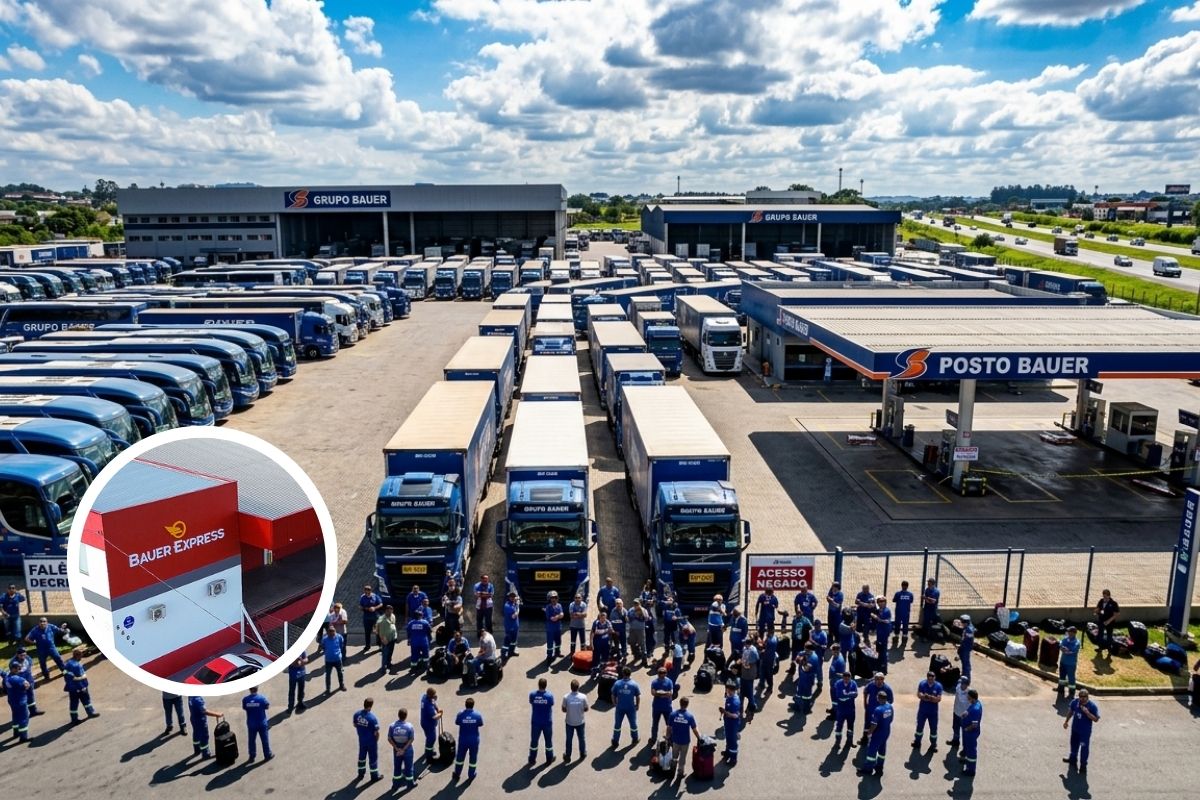
The case of Grupo Bauer exposes how costs, tight margins, and expensive credit can bring down even a logistics company with 25 years and a network of gas stations
The Grupo Bauer went bankrupt even after attempting judicial recovery, and the impact was heavy: debt over R$ 50 million and around 100 workers laid off, according to reports from the base. The company had over 25 years in the market, a fleet of more than 800 vehicles, and a presence in several states, in addition to operating a network of gas stations.
The fall of Grupo Bauer draws attention because it occurred at a time when logistics is growing in Brazil, driven by large investments and the sector’s dependence throughout the economy. When even judicial recovery doesn’t work, the warning is not limited to one company.
What happened to Grupo Bauer

The Grupo Bauer was already in judicial recovery and tried to cut costs, renegotiate contracts, and improve relationships with suppliers and customers. Still, it could not fulfill the plan and had to file for bankruptcy.
-
Premium Brazilian brand born during the pandemic brings fine cocoa from Bahia to Switzerland, Germany, and France, has won 9 awards, and claims to have the 2nd best milk chocolate in the world: meet Luz Cacau.
-
Júnior Friboi has just purchased one of the largest feedlots in all of Brazil, located in Goiás, with the capacity to produce 180,000 cattle per year, and the manager has already come forward to reassure employees about layoffs.

-
Pharmacy inside the supermarket: what changes now in your purchase, why medicines won’t go on the shelves, which rules remain strict, mandatory pharmacist, separate space, controlled storage, more convenience and competition in the country.
-
Ports like Santos and Paranaguá are operating at their limits and may block containers as early as 2030, warns a study by Macroinfra; bottlenecks increase costs and delays and push cargo to Rio, Salvador, Pecém, and Suape across Brazil.

The case is described as the collapse of a respected group in the South of the country, and the immediate result was the combination that scares any capital-intensive sector the most: high debt, decreased efficiency, and loss of financial breath over time.
Why judicial recovery did not save the company
Judicial recovery exists to provide breathing room and time, but it does not create cash on its own. The base text points out that the failure of the Grupo Bauer plan connects to three points that, together, form a pressure that is hard to hold.
Without real cash generation, judicial recovery becomes just a pause before the outcome. And when costs rise, margins shrink, and credit tightens, the company loses the ability to sustain day-to-day operations, even if sector demand seems heated.
High costs and heavy operation in transportation
The first axis is the cost of the sector. Transportation depends on fuel, fleet maintenance, and constant operation. The text emphasizes that expensive fuel and maintenance weigh directly on the account, and that high interest rates affect working capital.
This creates a rhythm problem: cash comes in slower, expenses come in faster. In logistics, a few bad months can turn into a hole.
Tight margins and difficulty passing on costs
The second axis is compressed margin. With strong competition, passing on costs to the customer becomes a dispute. When the company tries to raise prices, the customer pressures, switches suppliers, or reduces volume.
The base text expands this point beyond the Grupo Bauer: many companies are facing rising costs and little ability to pass them on to the market, because the end consumer does not keep up with the increase. When the margin disappears, revenue may still exist, but the company cannot breathe.
Expensive credit and restrictions for those already in debt


The third axis is credit. With high interest rates, more indebted companies lose access to financing, which weakens any attempt at restructuring.
Judicial recovery depends on time, but it also depends on financial instruments and viable renegotiation. If credit becomes expensive and cash does not improve, the plan lacks support.
The domino effect of bankruptcy on the local economy
The bankruptcy of Grupo Bauer does not only affect the CNPJ. The text points out chain consequences.
For the regional economy, this can mean a loss of logistical capacity, impact on suppliers and service providers, as well as a domino effect on local economies. A fleet of over 800 trucks does not disappear without leaving a hole.
For workers, the effect is direct: 100 families with interrupted income and uncertainty about payments, especially when the case goes to court.
For companies and consumers, the consequence may appear in practice with less competition, higher logistical costs, and the risk of price increases.
Four practical tips to avoid the path of Grupo Bauer
The base text concludes with four objective learnings, especially for those working in logistics and tight-margin sectors.
1. Early intervention
Restructure before insolvency. If the problem has already appeared, acting early is decisive.
2. Strict cash management
Daily or weekly flow, not just monthly. Most bankruptcies start in cash, not in discourse.
3. Deleveraging in periods of high interest rates
Reduce debt when credit becomes expensive. This decreases the risk of losing access to capital at the worst moment.
4. More conservative recovery plans
Based on real flow and not on optimistic projections. Without conservatism, the plan becomes a promise without foundation.
What the case reveals about the business environment
The case of Grupo Bauer reinforces a harsh message: judicial recovery does not guarantee survival. It depends on efficient management, real cash generation capacity, and an economic environment that does not crush operations.
When this does not happen, bankruptcy ceases to be a moral debate and becomes a concrete economic consequence. And understanding the mechanism of this fall helps other entrepreneurs act before reaching the same point.
In your opinion, what weighs more in a collapse like that of Grupo Bauer: high interest rates and expensive credit, or tight margins that prevent passing on costs to the customer?








Seja o primeiro a reagir!