Portuguese
  Spanish


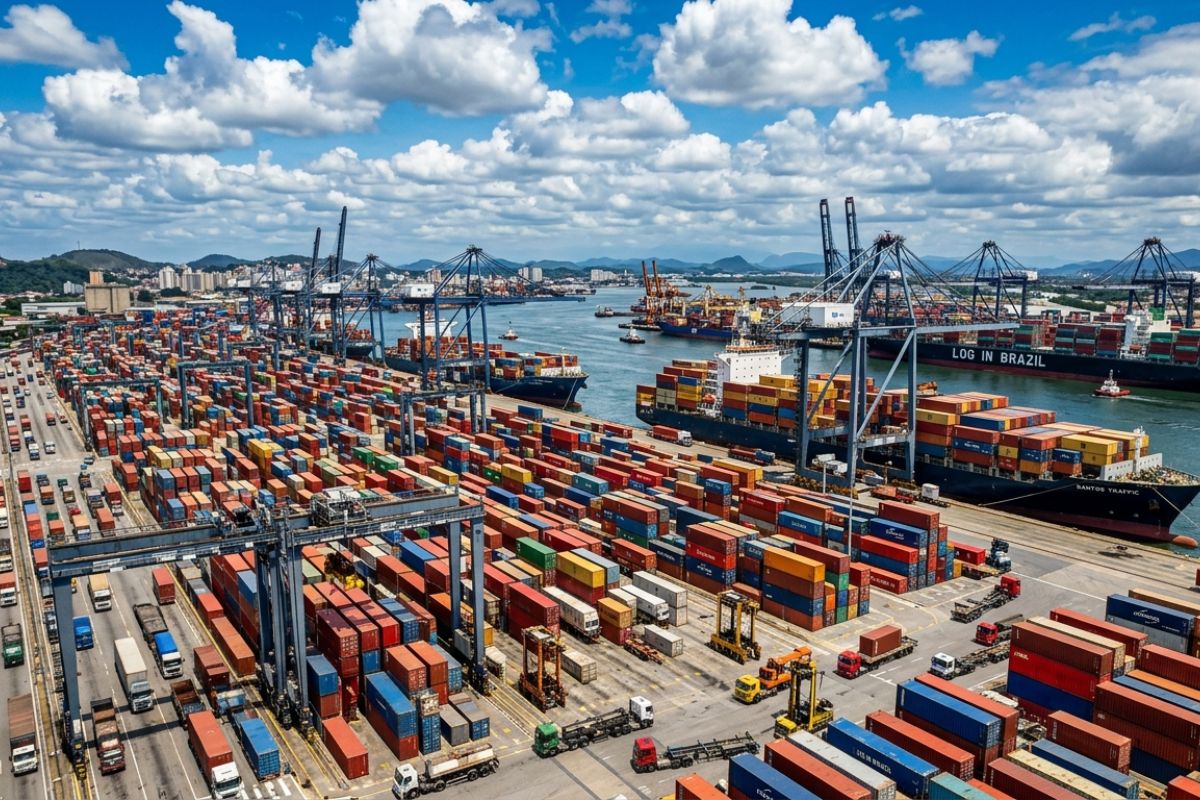

Macroinfra warns that Santos, Paranaguá, and terminals in SC operate at their limits, generating costs, delays, and migration of containers to Rio, Salvador, Pecém, and Suape.
Containers are at the center of a warning that concerns national logistics: a study by Macroinfra indicates that the main terminals in the country have moved to a state of operational saturation, with a real risk of capacity exhaustion if expansions and new projects do not move forward.
The analysis uses data from Antaq and observes the period from 2015 to 2025, pointing out that operations at the limit intensified mainly from 2020 onwards, increasing extra costs, generating delays, reducing the reliability of the supply chain, and increasing the risk of stoppages, with more sensitive impacts after 2030 and the possibility of complete saturation in 2032.
The warning from the study about containers and port capacity
The Macroinfra research projects that Brazilian ports could reach their container handling limits by 2040, but highlights a more urgent point: exhaustion could occur much sooner if expansion projects and new terminals do not progress.
-
As Brazil Expands Social Welfare, Survey Reveals 40% Blame Poverty on Laziness, While 58% Cite Lack of Opportunities

-
China Tightens Control on Antimony, Driving Prices from $22,000 to Nearly $40,000 per Ton as U.S. Rushes to Bolster Strategic Reserves

-
BlackRock Freezes $1 Billion in Brazilian Renewable Energy, Impacting 1.5 GW of Planned Projects and Highlighting Investor Concerns Over Infrastructure Bottlenecks Cutting Up to 25% of Solar and Wind Generation
-
Labor Shortage: Despite Record Average Salary, 90% of Brazilian Bar and Restaurant Owners Struggle to Hire Key Roles Like Sushi Chefs and Head Cooks


The diagnosis is clear in four terminals considered critical in the analyzed segment: Santos, Paranaguá, Itajaí/Navegantes, and Itapoá. With this scenario, the practical consequence is already appearing: migration of container flows to less occupied ports and terminals.
Santos: increasing pressure even with productivity gains

In Santos, the occupancy rate of the main terminals increased from 55.9% in 2015 to 76.8% in 2024, closing at 79.7% in the last year. The study describes the complex as operating under extreme pressure.
There was an improvement in average productivity over the last decade, from 72 to 86 TEUs per hour, but the gain is still considered insufficient to absorb the growth in demand for containers. TEUs is the standard unit representing the volume of a 20-foot container.
Paranaguá: TCP terminal enters saturation zone
At the Port of Paranaguá, the usage rate of the TCP terminal increased from 35.7% in 2015 to 81.8% in 2024 and 86.0% in 2025, entering a saturation zone.
Productivity advanced from 83 to 107 TEUs per hour between 2015 and 2023, but fell to 88 TEUs per hour in the last year, signaling that efficiency alone does not eliminate the risk when practical capacity is already at its limit and container volumes continue to grow.
Itapoá and Santa Catarina: high efficiency, overload as well
In Santa Catarina, the Port of Itapoá, described as one of the most efficient, has also begun to feel the overload: the usage rate rose from 50.2% in 2015 to 84.7% in 2024 and reached 88.7% in the last year, reinforcing an operation above practical capacity.
Productivity grew from 64 to 93 TEUs per hour, but the study suggests that, with the demand for containers accelerating, physical and operational limits are once again becoming a concern even in terminals considered advanced.
The cost of operating at the limit: delays, loss of reliability, and risk of stoppage
According to Macroinfra, operating at or above the limit tends to produce a cascading effect: extra costs, delays, loss of predictability, and greater risk of interruptions. In practice, this affects everything from delivery deadlines to the competitiveness of cargo in foreign trade and the domestic market.
When the supply chain becomes less reliable, shipowners, operators, and cargo owners seek alternative routes to keep containers moving, even if it means redesigning entire logistical corridors.
Migration of containers to secondary ports in Brazil
With bottlenecks in the main terminals, the study points to a geographical redistribution favoring previously less utilized ports, such as the one in Rio de Janeiro. The participation of the Rio port in the national container flow nearly doubled, from 3.7% to 6.2% between 2015 and 2025.
During the same period, the total movement in Rio grew by 139%, from 292,000 TEUs to 917,000 TEUs. In addition, Salvador, Pecém, and Suape maintained or increased their participation, absorbing cargo that sought alternatives to congested corridors.
High demand and capacity that does not keep up

The survey also links the current pressure to the growth in the volume transported in containers. Between 2015 and the last year, Brazilian maritime exports and imports using this mode increased by 60%. In the domestic market, cabotage rose by 111%.
The problem is the mismatch: domestic and external demand is growing, but the capacity expansion of the main terminals is not keeping pace, even with works and projects mentioned in the text, such as improvements in Santos and a new terminal in Suape.
What could happen after 2030 and why planning is immediate
The study points out that bottlenecks may intensify after 2030 and cites the possibility of complete saturation in 2032. One data point reinforces the urgency: the projected demand for four years from now is 20.4 million TEUs, consuming almost all of the total projected capacity of 23 million.
This suggests that exhaustion could occur before the longer-term horizon, and therefore, the text indicates the need for immediate planning and a new wave of projects to sustain economic growth and avoid bottlenecks in container movement.
Which port do you think will feel the impact of these container bottlenecks first, Santos, Paranaguá, or the terminals in Santa Catarina?