





 Portuguese
  English
  Spanish
  6 min of reading
  8 comments


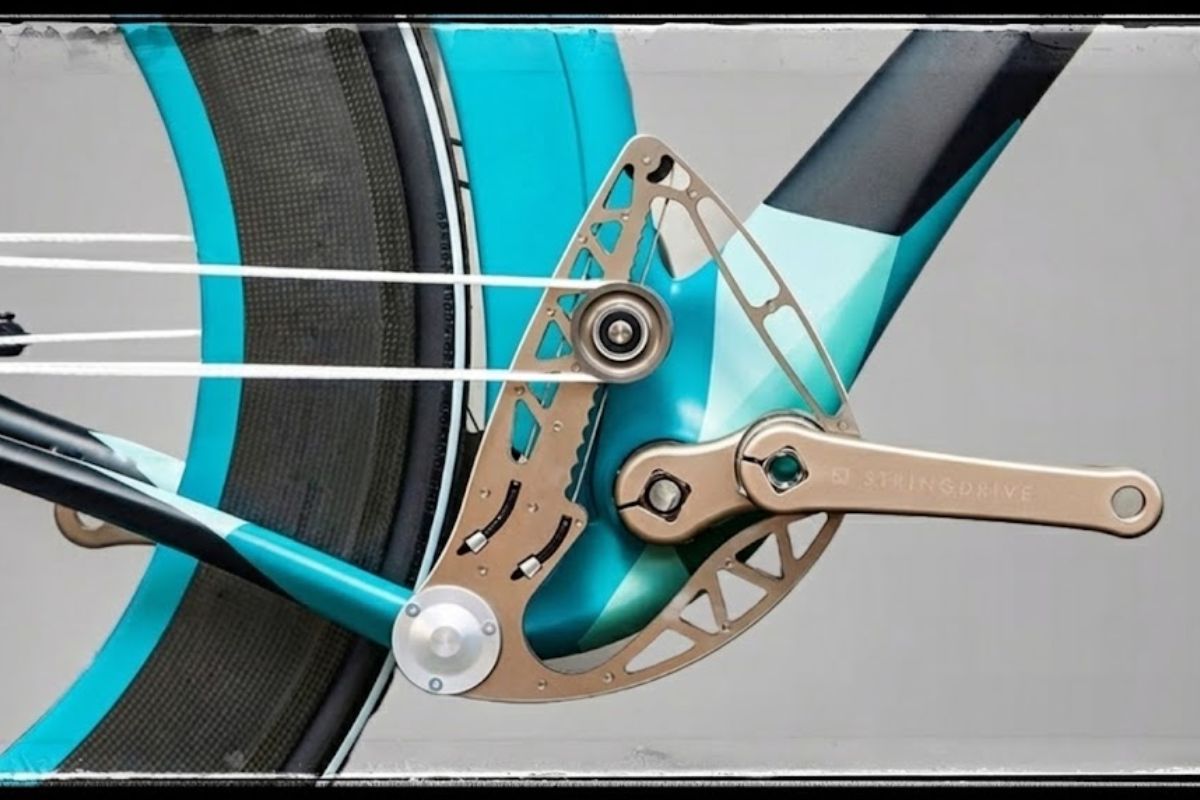


In The Engineering Of String Drive, Ropes Replace The Chain And Pull The Rear Wheel Through Drums, Offering 19 Gears, Stop Shifting And Operation Without Grease. The Idea Has Already Faced 4,800 Km Without Stopping, But Requires A Specific Frame, Accepts Only Rim Brakes And Demands Frequent Ropes On Bikes Without Chains
The chainless bicycles have returned to the technical debate when a rope transmission system, the String Drive, tried to rewrite a habit of over a century: the metal chain as the axis of propulsion. The proposal is to replace links and oil with Dyneema ropes, with an architecture that changes the way force reaches the wheel.
The concept impresses by gathering rare promises in the same set: silence, clean operation, 19 gears without overlap and the possibility of shifting gears with the bicycle stopped. At the same time, the project carries limitations that may hinder scaling, mainly the incompatibility with disc brakes, the need for a proprietary frame, and the short lifespan of the ropes.
How Chainless Bicycles With Rope Transmission Work

In chainless bicycles with String Drive, pedaling continues in a circular motion, but the mechanics behind it changes.
-
While the world looks at oil, the war with Iran is already disrupting helium supply from Qatar, affecting car and iPhone chips, threatening AI expansion, and putting pressure on aluminum packaging at the highest value in four years.

-
Global warming will expose a treasure hidden under the ice of Antarctica and may spark an international dispute over gold and valuable minerals.

-
A street vendor from Praia Grande built a robot made of scrap from scooters and washing machines that pulls his popcorn cart on the beach, emits sounds, and interacts with customers, becoming an attraction on the coast of São Paulo.
-
The specifications of the Xiaomi 18 Pro Max have been leaked, and the highlight is a dual 200 MP camera with a new 22-nanometer technology that promises to consume less energy and capture details in shadows and bright areas using LOFIC HDR.
Instead of rotating a chainring that drags a chain, the crank arms activate two levers.
These levers pull ropes attached to each side of the rear, alternating traction as the ropes wind and unwind in an organized manner on drums.
The practical result is a grease-free and oil-free transmission, with fewer typical dirt points and without the classic behavior of exposed chains.
The focus becomes the set of ropes and drums, not a chain, cassette, and rear derailleur.
Dyneema And The Promise Of Strength In A Lightweight Component

The heart of the system is the rope.
The specification mentioned for the Dyneema ropes indicates tensile strength superior to that of a bicycle chain.
An example cited is that a 3.5 mm rope would withstand over 16,000 Newtons of force, a value presented as above the industrial standard used as a reference for chains.
In addition to strength, there is the characteristic of not absorbing water.
This allows use in humidity and even in snow, although durability depends greatly on the resistance encountered in use.
In other words, withstands difficult environments, but “lives” longer when the scenario helps.
The Daily Use Package: Silence, Cleanliness And Off-Standard Gear Shifting
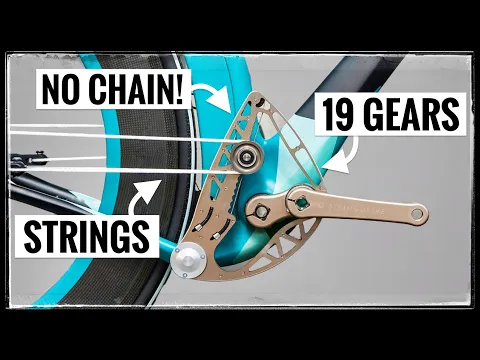

Among the most evident advantages in chainless bicycles, the system is described as smooth and silent, without the need for grease or oil.
The practical promise is straightforward: less maintenance and less dirt on hands and clothes.
The String Drive is also presented as a system that, once configured, does not require gear adjustment and avoids the “skipping” effect during shifts.
The detail that changes the routine the most is the ability to shift gears at any time, even while stopped, in neutral, and even under full pedal load.
For those used to the limitations of traditional gearing, this repositions what “control” of the transmission means.
19 Gears And The Range Of Gears: Where The System Delivers And Where It Falls Short
The set offers 19 gear options.
The highest gear is indicated as about three times the lowest, with suggested equivalence to a traditional road transmission or an 8-speed Shimano internal hub.
There is also mention of three rear drum sizes, allowing for lower gears for climbs or higher ones for flat terrain.
The limit appears when the comparison goes to current standards. The gear range of the String Drive is described as lower than that of modern systems.
The contrast used is that road transmissions today reach about 450% in range, and systems for rugged terrain often exceed 500%.
Thus, chainless bicycles tend to do well in urban settings but may be restricted on steep hills and during fast cruising.
The Extreme Test: 4,800 Km In 11 Days And The Discussion About Efficiency
The technology gained weight when an ultra-endurance cyclist used the rope transmission in a non-stop race of 4,800 km.
The conclusion in 11 days, with an average of 422 km per day, became an argument that the system is not just a bench idea.
Efficiency, however, remains at the center of technical debate.
The String Drive converts rotational movement into alternating and then back to rotational, a pathway that is not usually the most efficient. Furthermore, there are sliding surfaces that create friction.
Still, the cited performance suggests that losses do not make the use unviable, at least in favorable conditions and with prepared cyclists.
The Real Cost: Short Ropes, Quick Swaps And Comparison With Chain And Belt
The most sensitive point in chainless bicycles is the wear of the ropes.
The typical durability cited ranges between 1,000 and 2,000 km. This contrasts with high-end chains, associated with 4,000 to 7,000 km, and with modern belts, which can exceed 30,000 km.
The system tries to compensate with simplicity: the rope is treated as the main consumable item, costing around US$ 10 each.
The spares could be stored in the seat post, and swapping would be possible in about 5 minutes, without removing the rear wheel.
Even so, in practice, the calculation becomes one of frequent replacement, not of “install and forget”.
The Industrial Block: Disc Brakes, Electric Bikes And Proprietary Frame
There is an objective reason for the String Drive not fitting into the current standard: the drum on the left side occupies the space where a disc brake rotor would be.
Therefore, the system is described as compatible only with rim brakes. In a market where the disc has become standard, this limitation restricts adoption and resale.
Another block is electrification. The proposal would not have an easy way to turn into an e-bike because components of the system occupy areas where a central motor or hub motors would normally be.
Additionally, there is the structural factor: it is not a transmission that can be installed on any bike.
It requires a specially designed frame, with specific guides and mounts and wider dropouts to accommodate the drums, as well as several exclusive parts.
This increases logistics costs and complicates replenishment.
Weight, Control And Ergonomics: Details That Add To The Purchase Decision
In addition to incompatibilities, there are hidden experience costs.
The system requires a grip shift, and there are reports that it can be difficult to turn levers when wet, in addition to poor integration with a curved handlebar.
There is also the added weight, estimated at around 1 kg compared to a bicycle with gears.
In summary, chainless bicycles ultimately require the cyclist to buy not just an idea, but a complete ecosystem, with different maintenance and a set of choices that do not always align with market standards.
The Interesting Anomalies: Pedaling Backwards And The Promise To Reduce The Dead Point
The String Drive brings unusual behaviors.
One of them is that you can pedal backwards and the bike moves forwards because the levers continue to pull the ropes regardless of the pedal direction.
There is also the possibility of configuring different gear ratios for each crank arm, using rear drums of different sizes, something useful for those looking to compensate for an injury or strengthen one leg.
Another point is the design to reduce the “dead point” of pedaling: the transmission decreases the ratio at the top and bottom and increases when the cyclist can apply more force, an effect compared to using an oval chainring.
At the same time, it is noted that there is no consensus on biomechanical gain, as changes in ankle movement can neutralize gains in knees and hips.
Chainless bicycles with String Drive show that there is space for real innovation in transmission, with clear benefits of cleanliness, silence, and operation without frequent adjustments.
But the set also reveals why certain solutions remain trapped in niches: disc brakes have become standard, electric bicycles have grown, and the requirement for a proprietary frame, added weight, and short-lived ropes impose difficult barriers to ignore.
Would you bet on chainless bicycles for daily use even knowing that they are currently limited to rim brakes and frequent rope replacement?








Apostaria se certas condições fossem satisfeitas, como a maior durabilidade da corda e uma logística melhor. Para que uma inovação “pegue” é necessário que substitua com vantagens o padrão antigo. As vantagens oferecidas à meu ver ainda são insuficientes.
Eu tenho vontade de comprar uma bike dessas, pena não ter conseguido ver onde comprar
É uma boa opção para uso urbano, deslocamentos para o trabalho ou escola. Também para uso recreativo, sem compromisso de desempenho competitivo.