





 Portuguese
  English
  Spanish
  6 min of reading
  0 comments


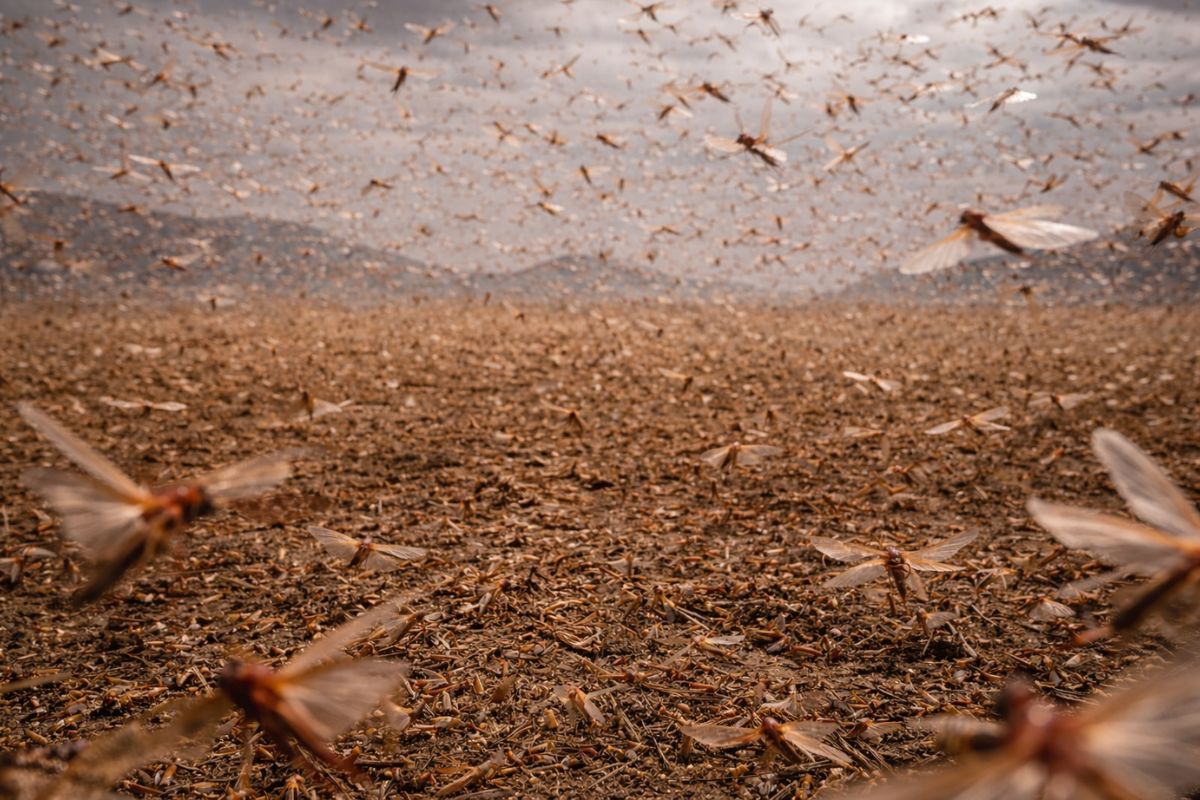
Swarming Locusts Advanced Kilometers Per Day, Darkened The Sky, Consumed Enough Food For Thousands Of People In Hours And Forced Communities To Abandon Chemical Fighting To Learn To Live With The Disaster.
In East Africa, locusts have ceased to be an occasional phenomenon of nature and have begun to function as a biological force capable of reshaping entire landscapes in a matter of hours. Where there were once crops, pastures, and fruit trees, there now exist scraped fields, bare branches, and exposed soil, the result of the passage of swarms that move like living clouds, covering the sky and consuming everything they encounter along the way.
The invasion occurred over a region already pressured by chronic food insecurity, conflicts, climate instability, and fragile agricultural systems. When traditional responses failed or came too late, entire communities were forced to make an extreme decision: if the locusts could not be completely eliminated, perhaps they could be turned into food, a source of income, and a last resort to survive hunger.
A Plague That Crosses Borders And Ignores Human Limits

The locusts that have overtaken East Africa do not respect fences, national borders, or planned agricultural zones.
-
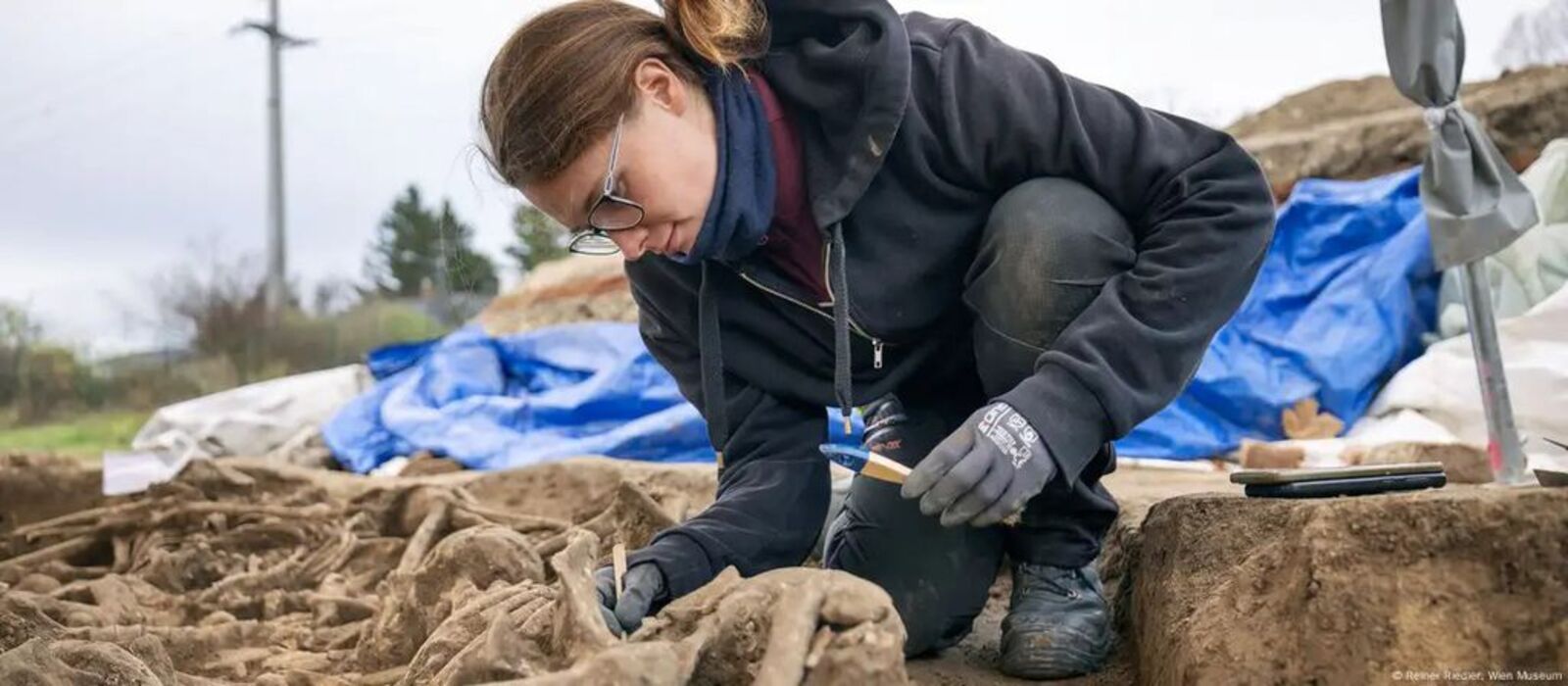
Remains with battle wounds of over 100 soldiers from the Roman Empire are found beneath a football field in Vienna, leaving everyone surprised.
-
Elon Musk notes Brazil and lowers the price of his internet, Starlink, promising to connect all corners of the country with affordable plans, 10,000 satellites, and 1 million active users in the national territory!

-
Man creates an infinite source of FREE electricity at home with a PVC wind turbine using a repurposed motor.

-
An aquatic seed consumed for centuries in Asia is going viral in the West after studies highlighted its antioxidant compounds and potential anti-inflammatory properties. It pops like popcorn, has low fat content, and is already being called the new functional snack.


Entire swarms can travel more than 90 kilometers in just one day, propelled by the wind and the constant search for fresh vegetation.
When they form on a large scale, they do not arrive gradually.
They first appear as a distant blot on the horizon. Then, the blot grows, the sky darkens, the sound of millions of wings imposes itself, and the landscape begins to disappear before the eyes.
The magnitude of the problem is hard to translate into numbers, but the impact is immediate.
A single swarm concentrated in a relatively small area can consume, in just 24 hours, enough food to sustain tens of thousands of people.
In regions where agricultural production is subsistence-based and stocks are limited, this means the almost instant collapse of local food security.
How The Environment Created The Perfect Conditions For The Swarm Explosion

The emergence of these swarms was not random. Intense rains in normally arid areas created moist soils ideal for egg-laying.
Each female locust lays hundreds of eggs, and when conditions remain favorable, successive generations overlap in a short period of time.
The result is an exponential multiplication, too rapid to be contained by conventional responses.
When the population density increases, locusts change their behavior.
They stop acting as isolated insects and begin to cluster, forming coordinated masses that move as a single organism.
At this stage, they cease to be merely an agricultural pest and become an extreme ecological phenomenon, capable of transforming productive areas into barren zones in just a few days.
The Devastation That Goes Beyond The Lost Harvest

For those who directly depend on the land, the passage of locusts does not mean just the loss of a harvest.
It means the breakdown of an entire cycle of survival.
The consumed plants do not leave enough seeds for replanting. Food reserves disappear.
The income obtained from the sale of surplus simply ceases to exist. In many villages, local markets emptied faster than any humanitarian aid could arrive.
Hunger, in these cases, is not a future threat. It settles almost immediately.
And as swarms can return or reach neighboring areas, even those trying to recover risk losing everything again in the next season.
When Chemical Control Is No Longer A Solution

Given the scale of the invasion, chemical combat was the first response adopted in many regions.
Ground and aerial spraying attempted to contain the swarms before they reached sensitive agricultural areas.
On paper, the strategy seemed logical. In practice, it proved limited.
Besides the logistical difficulties of reaching remote areas in time, the intensive use of pesticides brought new risks.
Broad-spectrum products do not only target locusts, but also pollinators, soil organisms, and water systems.
In regions where biodiversity is already under pressure, the side effects have begun to be as concerning as the pest itself.
In many cases, even after extensive spraying efforts, billions of locusts survived, reproduced, and spread even more vigorously after new rains.
It became clear that, in isolation, chemical control would not solve the problem.
The Unexpected Turn: Transforming The Pest Into A Resource
It was in this context of despair that an idea emerged which, at first glance, seemed unthinkable.
Instead of trying to exterminate the locusts completely, some communities began capturing them.
The reasoning was simple and brutally pragmatic: the insects were abundant, nutritious, and literally covering the territory.
Nutritionally, locusts offer high protein content and essential micronutrients.
When dried and processed properly, they can be turned into powder, stored for longer, and used both in human food and as animal feed.
What was once a mobile threat began to be seen as an emergency source of sustenance.
How Collection Became Possible Amid Chaos
The collection did not happen randomly. It exploited a crucial detail of locust behavior. During the day, the heat keeps them active and hard to catch.
At night, with the sharp drop in temperature in the desert, many become nearly motionless, clustered in trees, bushes, or on the ground.
Taking advantage of this moment, residents began to collect large quantities of insects in the early morning before they resumed moving at dawn.
After collection, locusts were quickly taken to processing points, where they underwent cleaning, heat treatment, and drying, reducing health risks and allowing for storage.
Food, Feed, And Income In An Emergency System
In some regions, the powder produced from locusts began to be incorporated into local diets.
In others, it became an input for animal feed, helping keep herds alive at a time when pastures had been destroyed.
This indirect use had an important effect: preserving part of the rural economic base, even after the loss of crops.
Additionally, collection began to generate income.
Payment per kilo collected turned the pest into a temporary source of money, enough to buy basic foods, medicines, or pay for transport.
For families that had lost everything, this income represented the difference between starving or holding on until the next season.
Clear Limits And Risks That Remain
Despite the immediate benefits, no one confuses this strategy with a definitive solution. Manual collection cannot control gigantic swarms on the move.
It works in limited areas, close to human communities, and does not prevent new waves of locusts from forming.
There are also significant risks. Insects collected in areas sprayed with pesticides cannot be used as food, as they accumulate chemical residues.
Moreover, transforming the pest into an economic resource requires caution to avoid perverse incentives, such as the deliberate maintenance of foci close to villages.
A Crisis That Exposes The Fragility Of Human Systems
The locust invasion in East Africa revealed something greater than an agricultural disaster.
It exposed the fragility of already pressured food systems, the difficulty of quick responses in vulnerable regions, and the combined impact of extreme climate, poverty, and conflict.
In the face of this scenario, communities did not choose perfect solutions. They chose possible solutions. There was no victory, only adaptation.
There was no miracle, only pragmatism in the face of imminent collapse.
When locusts multiply again on a continental scale, should the priority be to insist on attempts at total extermination, even with environmental risks and rising costs, or to invest in controlled coexistence strategies that transform part of the destruction into immediate survival for those living at the front lines of the crisis?







-

-

-

-

6 pessoas reagiram a isso.