





 Portuguese
  English
  Spanish
  8 min of reading
  3 comments


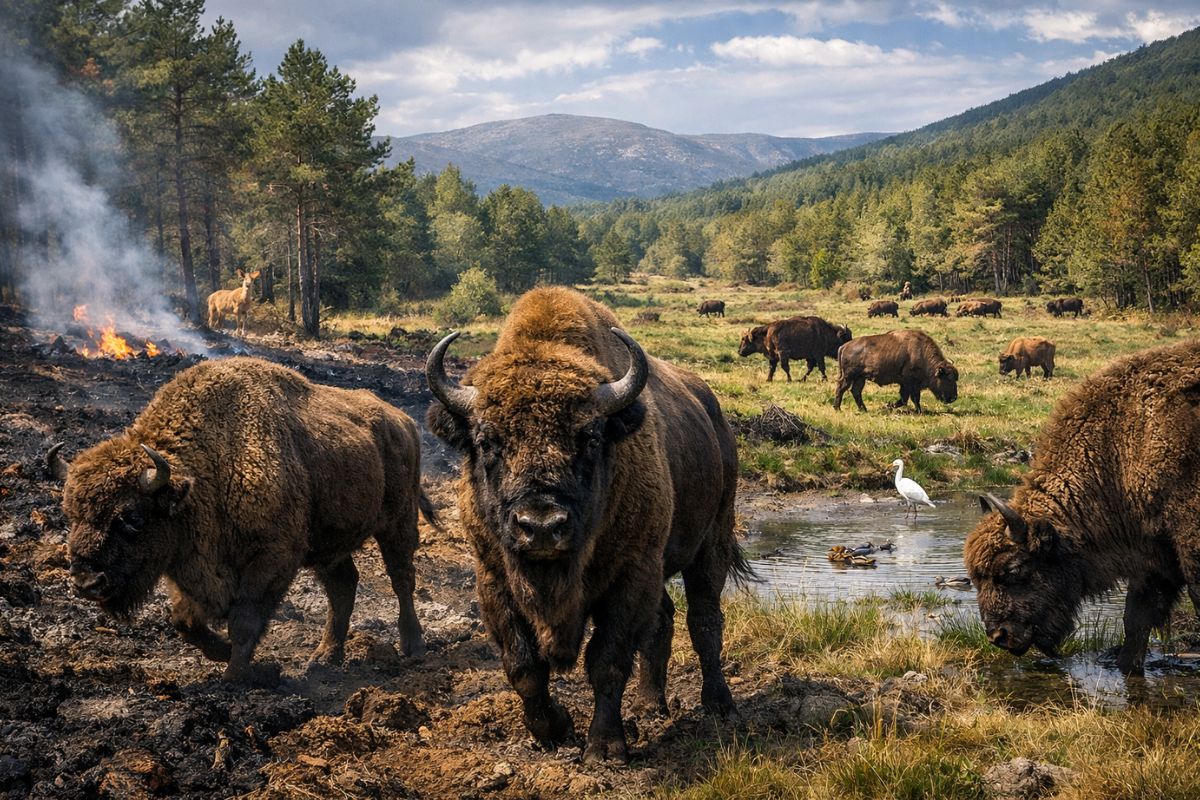


In El Recuenco, In The Province Of Guadalajara, Nine European Bison Undergo Acclimatization And Will Be Released Into 400 Hectares Of Public Forest, With GPS, International Research, And A Promise To Restore Ecosystems And Generate Local Income.
In Spain, European bison were released for the first time in the Iberian plateaus and arrived in the village of El Recuenco, in the province of Guadalajara, to start a historic ecological experiment led by Rewilding Spain. The herd is entering a process of acclimatization and rigorous monitoring before roaming a large public forest area.
The bison are the largest land mammal in Europe and the last large wild cattle on the continent. By moving through this Iberian territory, they will directly impact vegetation, soil, and fire risk, reopening natural clearings, altering the structure of the forest and reactivating ecological dynamics that can transform the environmental future of rural Spain.
Where It Happened And Why This Moment Is Historic

The unprecedented release took place in the Iberian plateaus, with the animals settled in the village of El Recuenco, a small community with about 80 inhabitants, located in the interior of Spain, in the province of Guadalajara.
-
Submarine cables installed to transmit the internet now also help scientists detect earthquakes.

-
After so many blackouts, a family transforms an electric truck into a power source for their home and shows how a 100 kWh battery can keep everything running for days.

-
Ukraine is already testing, and China has already shown the world, and now the Brazilian Army is developing its own swarm of autonomous drones with artificial intelligence that share data in real time and operate without centralized control, uniting military and universities.

-
Few people know, but the most nutritious part of wheat has been discarded for decades to produce white flour, and the “polyamine” spermidine activates cellular cleaning, reduces mortality, and may slow down memory loss.


The initiative was built with direct participation from the local government, which requested to receive the herd as a strategy to generate ecological and social impact.
The historic nature of this moment is not just in the symbolism of seeing bison in the Iberian landscape.
The central milestone is that, for the first time, these animals will be used as the main piece of a study that seeks to practically answer how large herbivores can restore ecosystems in Mediterranean regions and other landscapes in Europe.
Who The Bison Are And How The Herd Was Assembled

The herd released in El Recuenco consists of nine European bison, consisting of five females and four males, of different ages.
This detail is essential because a group with varied age ranges tends to have behavior closer to the natural one, with social organization and more stable interactions.
The bison came from a private property in El Espinar, about 65 kilometers from Madrid, in the northwest of the capital. The adults had been on this property since they arrived from Poland and the Netherlands three years ago, while the younger ones were already born there.
The result is a herd that is already socially cohesive, used to living in groups, and better prepared to deal with the conditions of inland Spain.
The Acclimatization Period Before The Release

Before fully entering the landscape, the bison will spend several weeks in an adaptation enclosure, with close health and behavior monitoring.
This stage serves as a critical transition between management in a controlled environment and life in an extensive area.
After this period, the animals will be released into a fenced area of 400 hectares of public forest.
The fencing indicates that the project works with territorial control of the herd to monitor ecological effects and reduce conflict risks while the experiment is being consolidated.
What The Bison Do In Practice When They Start Roaming

Bison do not “pass” through the landscape. They interfere with it. Due to their physical size and feeding patterns, they act as a mobile mechanism of ecological management.
As they move, the bison press and move the soil with the weight of their bodies, changing microstructures and creating small patterns of impact that can favor infiltration and water retention in some areas, in addition to exposing areas where seeds can germinate.
By grazing, they reduce biomass, alter the height and distribution of vegetation, and change how the forest organizes itself.
This type of presence tends to create mosaics on the ground, with more open areas and denser areas, promoting structural diversity.
It is precisely here that the idea of “reopening natural clearings” comes in: instead of a homogeneous and closed forest, zones of ecological breathing emerge, favoring different species of plants and animals.
Reducing The Risk Of Wildfires As The Central Objective
One of the most direct points of the project is the expectation that the bison will help reduce the risk of catastrophic wildfires.
The logic is based on grazing and feeding behavior within the forest.
By consuming part of the vegetation, the bison reduce potential fuel for fires, decreasing the continuity of flammable material in sensitive areas.
This is especially important in regions under increasing pressure associated with climate change, where forest resilience has become a management priority.
The mayor of El Recuenco, Enrique Collada, highlighted exactly this expectation: grazing and feeding in the forest as a natural tool to reduce fires, in addition to the tourism potential of an emblematic species to attract visitors and create economic opportunities.
Expected Benefits For The Village Of El Recuenco
El Recuenco is a small community and, like many rural Spanish settlements, it has experienced significant socioeconomic decline in recent decades.
In this context, the project was treated as an opportunity for local reactivation on two fronts.
The first is ecological: recovery of the landscape, greater forest resilience, and reorganization of the ecosystem.
The second is social and economic: greater flow of visitors, wildlife observation, nature tourism, and new activities associated with rewilding.
The local expectation is that the presence of the bison will generate new opportunities, jobs, and income for the inhabitants, without eliminating traditional uses of the area.
The public forest will remain available for activities such as timber extraction, hunting, mushroom gathering, and recreation, in addition to wildlife observation.
Why Bison Are Considered “Landscape Engineers”
The European bison is described as a keystone species, with enormous potential to shape and restore landscapes. The importance of this role appears on two levels.
The first is ecological: large herbivores directly influence vegetation, open areas, change growth patterns, and create new opportunities for other species.
The second is strategic: understanding this impact allows for more informed decisions on how to manage forests so they are healthy and resilient, especially in the face of fires and climate pressures.
In the case of the Southern Iberian System, understanding whether bison thrive and how they influence plant balance is an essential step to consider expanding the model to other areas of the Peninsula and to similar Mediterranean regions.
The Scientific Study Behind The Reintroduction
The release is not just a conservation action.
It is part of an international study coordinated by Rewilding Spain with participation from academic and research institutions.
Among the mentioned entities are the University of the Basque Country, University of Manchester, and ECONOVO, an affiliate center of Aarhus University in Denmark.
The study will be based on comprehensive scientific analysis and includes concrete objectives.
Stress levels in the herd will be evaluated throughout the year, the diet composition will be examined, described as entirely natural, and the impact on vegetation will be observed, including a parallel study focused on woody vegetation.
To monitor actual movement, the bison will be tracked in the field using GPS collars, allowing for mapping movements, patterns of territory use, and behavioral changes over time.
A Replicable Model On A European Scale
The research was designed to be replicated in other bison populations in Europe, with a network that includes different landscapes and environmental conditions.
The plan broadly covers regions of the continent, ranging from Spain to Scandinavia, passing through the Netherlands, Poland, Romania, and reaching farther points like Azerbaijan.
This replication is decisive because it allows for comparison of species adaptation in very distinct contexts and understanding how far the European bison can act as a restoration engine in varied environments.
The Historical Recovery Of The Species And Why It Allows For New Projects
The project also takes place at a symbolic moment for the species.
In the last decade, the number of European bison has increased from just over 2,500 to about 9,000 individuals.
This growth is described as remarkable because, in 1927, there were fewer than 60 living individuals, restricted to zoos and private parks.
The recovery has opened the door for actions that go beyond preserving the animal and aim to reinstate its ecological role in real landscapes, with measurable effects.
The Ancient Presence On The Peninsula And The Ecological Void That Remained
The history of the bison on the Iberian Peninsula is considered more complex than previously thought. Recent DNA evidence from Cantabria, in the northwest of Spain, supports the hypothesis that the European bison was present in the region in the past, although the subject still depends on further research.
Even with this ongoing debate, the reintroduction is presented as fully justifiable for functional reasons. Bison can fulfill ecological functions similar to those of large herbivores that disappeared from the landscape due to human activity, such as the aurochs and the wild horse.
Social Support And Building Local Consensus
A decisive point of the project was the social work in El Recuenco.
The local council conducted a dialogue process with residents, with lectures, meetings, and site visits to build consensus around the initiative.
This step is important because rewilding depends on public acceptance, especially in areas where forests are used for timber, hunting, and gathering natural resources.
The project was designed to coexist with these activities, without blocking local population use of the territory.
A Rewilding Strategy In A Much Larger Territory
El Recuenco is presented as part of a broader context, in which the responsible team manages over 20,000 hectares of natural pastures in other wildlife restoration sites in the Iberian plateaus.
This data expands the scale of what is at stake. It is not about an isolated experiment, but a regional strategy that already includes other large herbivores and has been accumulating learnings that will now be applied to the European bison.
What Can Change In Rural Spain With The Presence Of Bison
The central idea behind this reintroduction is simple and powerful: restore natural processes instead of relying solely on heavy human interventions.
If the bison create clearings, reduce plant fuel, help maintain the forest more resilient, and stimulate diversity, the landscape may change by itself.
At the same time, if the village attracts visitors, generates income, and opens opportunities, the project can be a new path for development in rural areas, with local engagement and public support.
The bison arrive as an emblematic animal but also enter as a living tool for restoration and as a test for the future of inland Spain.
Do you think bison can become the strongest solution to reduce fires and revitalize rural villages in Spain?





Más estupideces como las de siempre leyes sin sentido desde los despachos los bisontes provocarán accidentes pasarán enfermedades ya que están salvajes y molestarán a los productores de vacuno extensivo que somos los que vivimos en esos pequeños pueblos y con nuestros animales realmente cuidamos el monte y generamos riqueza pero se sigue sin entender la realidad y haciendo políticas desde la lejanía del monte en un despacho total desconocimiento
Creo que si y debería extenderse más en zona s protejidas
Torcendo muito pra que esses bisontes se adaptem bem ao clima mais quente e seco do Mediterrâneo, sem grandes problemas, e mostrem que a natureza ainda tem truques na manga pra se recuperar quando a gente dá uma mãozinha (ou melhor, quando a gente tira o pé e deixa ela trabalhar).